
 ט״ו בסיון תשע"א
Alban Heruin 17
Last night before bed, after I created and listed this ENEIT oil at my Etsy shoppe WITCHCRAFTS and on my shoppe blog, I did something I haven't done is several months. I blindly reached in and drew a mystical rune from my runebag to see what cosmic energy was afoot in my world, according to my magical runes. I drew Kenaz, in complete synchronicity with the oil I had just created. Kenaz is the rune of the artisan craftsman and of the master of the technical aspects of magic, knowledge, cunning, creativity, illumination, observation, intellect, skill, occult female secrets, controlled fire and kinship. Kenaz is the torch of enlightenment. Kenaz is clarity.
Also symbolic of the teaching-learning dynamic and study, this Kenaz rune drawing was also synchronous with my dream from earlier this week, namely Lamed, where the magical Hebrew letter Lamed (ל) is likewise linked to the dynamic of teaching-learning. As with Lamed, Kenaz symbolizes Divine Inspiration. As with Lamed, Kenaz symbolizes the power to control the fire which fuels creativity.
There is wholeness in harmony. Now, I have a clear thought about holiness. Interestingly, this insight, brought into focus through the complexity of Kenaz, was born from the pentacle number five, the Hebrew letter hei (ה) and the Middle Welsh word ENEIT.
Friday, June 17, 2011
Magical Letter Harmony, the Language of Holiness

Sunday, October 12, 2008
Paradoxical Holiness
י"ג תשרי התשס"ט
Blodlessing 14
In follow-up to earlier entries on the rescue at Gibraltar and the gates of the seasons, in regard to the paradoxical nature of holiness, paraphrased from the lyrics of Samhain by Inkubus Sukkubus -
comes old Death a-riding on the storm,
with hungry eyes for funeral fires
to burn at the morrow's dawn
but the fire of life still burns
and the wheel of life still turns
and those marked for death
go back home for Samhain
and in the night sky
on the lunar light they fly
as witches await the feast
the Dark Mother takes us in
Have a blessed Samhain! So mote it be, אמן!
Monday, May 26, 2008
The Holy Half-Shekel & Removal Of Death Tumah
כ'א באייר תשס"ח
Mab 22
The night before last night (Saturday night following Shabbat), I dreamt. There is more to this dream than I am going to blog, but here is the end of the dream.
I was with a rabbi, believe it or not. I'm not sure exactly what our connection was, but he had taken me up for some reason, like a teacher or advocate or something.
He took me into the inner outer court of "the temple" (which was like a makeshift diaspora shul) covered within the folds of his cloak or robes of some sort. After we were inside, I came out from among the folds and stood there within the midst of the room.
There was a long table in the middle of the room where judges sat. The head judge sitting at the middle of the table was a woman.
A large group of people came into the room from the outside. I was now surrounded by a large group of Christians whom had agreed to pay $50 per person for the opportunity to see inside the temple. Some of them began to secretly and quietly sing Christian hymns around me, which seemed to try to incorporate me as one "lost" in the crowd among them. I didn't feel they were doing this specifically to me, but to the temple room itself (as if trying to imprint the walls with the presence of their song). I felt so unseen and marginalized standing there surrounded by people to whom I did not belong. I could hear them because I was surrounded by them. The others inside could not. I wanted them to go away, I was feeling smothered and suffocated by the covert singing of hymns by some of them.
The head woman judge spoke to the crowd who had each agreed to pay $50 to be there at that moment, surrounding me, and told them that their $50 worth of time was over now, to bring the money forward to pay for their visit, and directed them that it was now time to leave the shul-temple. Visiting time was over. Each one was to bring his or her $50 to the person at the end of the table collecting the money for the visit.
The head woman judge looked at me. "I don't have $50, I didn't agree to pay $50," I said. "I'm not one of this group. I came in with him," I said, pointing to the rabbi who was standing away from the whole fiasco. The rabbi acknowledged me. The group left and I stayed behind in the room.
We all went into another less formal room. Everyone was now chanting Hebrew prayers and such things. The head woman judge said to me, "Do you think you could fit here?" "I don't know", I said, "I haven't said the prayers in a long time."
The scene changed. Now the rabbi was using me as a divining tool of some sort. He was holding me around the waist and I was leaning out from the waist, like we were attached at the waist. My arms and hands were free floating out into the space in front of us, as if my fingertips were "smelling" the air. I did not consciously direct the movement of my arms/hands, they moved as if they were a sense organ seeing what could not be seen, leading us toward something.
My fingertips touched different places in space and we all followed were they led. Suddenly, my fingertips turned around and I touched myself.
We were then inside a cave where a woman had been held captive for a long time. At first, the cave appeared empty. Again, I was used as a divining tool. There was dirty iron pot sitting on the ground near one corner of the back wall where waste had once been collected during her captivity. The rest of the cave was immaculately clean and well kept for a cave. She had been held prisoner here for a long time. Where was she now?
I looked and found a shallow grave, like a bump in the floor shaped like a body. Her body was still in it, protectively covered over by tightly woven soil (held together by fine plant roots) like an earthen shroud. With my hand, and my face near her face, I was able to poke through into the woven soil around her face, into the space in front of her face, and then started to pull back all the woven soil which protectively covered and sheltered her from the deathly dankness of the cave. As I did, exposure to the fresh air (we had brought with us by finding and opening to enter the cave) agreed with her. She didn't disintegrate like a mummy or once-enshrouded dead body exposed to air might have. Instead, death left her body and she came back to life. The shroud made of woven soil had kept safe her life.
We had to get her to the surface, and did quickly. Once on the surface, she was me I think. I could make no distinction between us. The rabbi pulled something away from us. It looked like a huge slate blue rock the size of a small boulder covered with a filmy luminescent membrane like that which covers a newborn. The thin membrane isolated the bulk of the rock from contact with everything else and held it congealed together like a ball. I knew what it was - it was death tumah. He threw it out into the water which was flowing like a river, to be carried away in the current of running water.
I woke up.
Sunday, March 23, 2008
Perfectly And Abundantly Made
י'ו באדר ב' תשס"ח
Raven 17
Ten Sefirot of Nothingness, ten and not nine, ten and not eleven
Understand with Wisdom, be Wise with Understanding ...
עשר ספירות בלימה, עשר ולא תשע, עשר ולא אחת-עשרה
הבן בחכמה וחכם בבינה
Sefer Yetzirah 1:4
The moon (ב) is in Virgo (י) in the second House of Acquisition of the zodiac in my sidereal natal chart. What does this בי mean? It literally means "with ten". With ten what, exactly? There is "nothing" to tell me what "ten" בי is referring to. Wait, I understand now! I remember the words "ten sefirot of nothingness, ten and not nine, ten and not eleven" that I am made with.
The word for "ten" in the above excerpt from Sefer Yetzirah is עשר. The shoresh עשר means "enriching", "being abundant", and "complete unit".
The word for "nine" in the above excerpt is תשע. The shoresh תשע means "decrease" and "less than a complete unit".
The word for "eleven" in the above excerpt is אחת-עשרה. Here is where the vessels may become shattered. אחת is the feminine form of "one" unit (as אחד is the masculine form of "one" unit). One complete unit holds the feminine and masculine forces it contains in equal balance. In the Hebrew word for eleven (אחת-עשרה), the feminine unit force (אחת) emerges unilaterally increased (עשרה), which would ultimately result in an uncontainable and destructive imbalance among the polarities, and thereby shatter the vessels.
Thus, "with ten" Understanding and Wisdom are bestowed abundantly and in perfect balance so as not to shatter the vessels.
With "nine", Understanding and Wisdom lack fullness and wither.
With "eleven", there is too much Understanding and not enough Wisdom. Understanding is a powerful force of restrictive differentiation. Without an equal balancing Wisdom force of expansive integration to meet Understanding's movements, the vessels implode and shatter.
Taken together, I wisely have come to understand that I have been perfectly and abundantly made "with ten" in complete harmony.
There are seven Hebrew words in the portion of the excerpt "ten and not nine, ten and not eleven" (עשר ולא תשע, עשר ולא אחת-עשרה).
There are ten Hebrew words in the excerpt "ten sefirot of Nothingness, ten and not nine, ten and not eleven" (עשר ספירות בלימה, עשר ולא תשע, עשר ולא אחת-עשרה).
Thus, I manifestly acquired בי at birth.
Saturday, March 15, 2008
Holy Holy Holy Host
ח' באדר ב' תשס"ח
Raven 9
Tzav, Pakod, Meumah - Holy, Holy, Holy
In Unblemished Mitzvah I brought down the idea that the vulnerability of meumah to blemish (mum) is neutralized by the presence of tzav (command of mobilization), and that materiality neutralized of potential blemish is actualized through the endless action pakod. Remembering.
Interestingly, as mentioned in the earlier entry, meumah and tzav each have a gematria of 92. The digit sum of 92 is 11. Eleven is the number of Temple incense spices corresponding to the rectification of Tohu (the state from which the vessels may shatter and become seemingly disconnected from Wholeness), the elevation of Tohu back into the realm of Holiness, and the "distillation and transformation of all corporeality and physicality into supernal luminescence."
Torah instructs us not to duplicate the Temple incense compound for personal use, lest s/he be "cut off" (shattered and seemingly disconnected). In other words, the duplication of meumah implies that bringing down the power of meumah without tzav (bringing down something from something), may shatter the personality, while the power of meumah tempered with tzav (bringing down something and nothing), does not shatter the personality. The personality remains whole in the case where the 92-compound meumah is not itself duplicated, but tempered through a different 92-compound, namely tzav.
Tzav tempers meumah by adding it's own digit sum of 11 to the 11 of meumah, bringing down the whole essence of the 22 Creation Letters of the aleph-beit.
Thus, meumah is not duplicated for personal use, it is completed in a wholistic bodily realization (a Host) of Intelligent Creative Consciousness.
Importantly, with respect to the upcoming observance of Purim, the word-set tzav-pakod-meumah corresponds to the "holy, holy, holy" descent of my soul through all contractions of the created world, while yet still remaining bound to the Divine Essence.
Tuesday, February 26, 2008
Living Kedushah
כ' באדר א' תשס"ח
Keolwulf 21
Another point related to today's Walking On Fire entry Roar Of The Lion, pertains to a second point of the article by Rabbi Ari Enkin posted by Gil Student at Hirhurim in the discussion on knotting tzitzit during the blackness of night and more:
Many Tzitzit professionals have the custom never to cut Tzitzit strings with scissors or any other metal object. Instead, any necessary cutting or shortening is done with one's teeth.[1] This idea of not using metal in the process of making Tzitzit mirrors the building of the Beit Hamikdash. We are told that it was forbidden to use any metal utensils when hewing the stones which were to be used in the construction of the Altar. As such, some suggest that the use of metal should be forbidden in the process of making Tzitzit as well.
This common denominator between the Altar and Tzitzit is their role in lengthening human life, [2] while metal is a material used in weaponry whose primary purpose is to shorten it. [3]
Back in January of 2007, I posted a kabbalistic perspective regarding the iron of a witch's athame as a holy tool of her sacred altar, writing:
The iron blade of a witch's athame upon her altar is a perfect symbol for the rectification of evil and its elevation back into the realm of kedushah (holiness, sacredness). In the Jewish tradition, this rectification and re-elevation is called tikun olam (repair of the world).
The iron of knives and swords have historically been used to shorten life, making them typically antithetical for use upon a sacred altar, whose purpose is to enhance and lengthen life. However, in the "future world" (in Hebrew "leatid lavo" לעתיד לבא, a code for the transcendent rectified feminine sefirah Binah and her parzufim), our Sages teach that the Temple will be built using iron. Normally, it is forbidden to use tools of iron to cut stones for the Temple altar.
Kabbalistically, iron, one of the seven metals [1] corresponding to the seven mystical attributes of the heart, corresponds to the attribute of Malchut, the element of the heart most "vulnerable to negativity and egocentricity". Malchut symbolizes the feminine Kingdom of the world of action and expression (see sefirotic array here). It also symbolizes the Indwelling Divine Feminine, the Shechinah.
Given the intimate connection of iron with the kedushah of the Holy Temple, we can understand then, that the status of iron (as being holy or not), rests in it's relationship to shortening or lengthening life.
My athame - Time Witchery.
Footnotes:
[1] Mishna Berura 11:61
[2] Shabbat 32b
[3] Shulchan Aruch Harav 11:24, Middot 3:4
Saturday, September 15, 2007
Students Teaching Tolerance
ג' בתשרי תשס"ח
Florida Today reports and teaches us about sanctifying the Divine Name:
Students challenge ban on Gothic
School board policy prohibits such clothing
BY MEGAN DOWNS
FLORIDA TODAY, September 14, 2007
Fifteen-year-old Amaris Mulhauser prepared for school Thursday morning using a thick-black eyeliner to draw tear streaks dripping down her cheeks.
A few hours later, she was pulled out of her Rockledge High English class and told to go home -- the second time this week -- for wearing the Gothic makeup that administrators had warned her to remove.
Amaris is one of about 30 students trying to change the district's dress code policy, which they believe is outdated and curtails their freedom of expression. The students went before the school board this week to argue their case.
Federal courts have been debating student speech and expression rights for years as school officials around the country struggle to balance the expectation of a safe learning environment with students' rights.
Brevard Public Schools' dress code policy specifically prohibits Gothic-style clothing or accessories, citing that such gear is tied to "violent or death oriented themes."
Read full article at link above.
ל This article excerpt is posted in support of the "30" students challenging the ban and is dedicated in honor of Tempest Kayne Smith. May her memory be a blessing. ל

Sunday, August 26, 2007
Yechidah Lock & Key
י"ב באלול תשס"ז
In follow-up to yesterday's entry, Chest of Manifestation, which describes the arba'ah olamot (4 worlds) connection of the Ark and Chest boxes I have chosen in which to incubate my scribal tools and to create, form and do craftwork, today I make note that the old ways Lock and Key which fits the Ark box represents the Unity of Yechidah. Yechidah is represented by the letter aleph (א) in the female version of the tetragrammaton (האה), as described in A Feminine Equation of the Tetragrammaton.
The Chest of Manifestation, with a ה-pointed pentacle on each side of the א box with 3 (האה) shelves brings down the Unity of Yechidah in fit devekut with Chayah of Atzilut (the א Ark box with it's הה lock and key).
The top (third shelf from the bottom) shelf of the Manfestation Chest will be inscribed with the Shema. The bottom (first shelf from the bottom) shelf will be inscribed with the Malchuto blessing. I haven't decided on the inscription for the middle shelf yet. I may wait until I marry and inscribe my bashert's name on it.
Friday, July 27, 2007
Holy Moon
י"ג באב תשס"ז
Today's tarot reading is also connected to the tet-nun phenomenon described earlier which unites opposite manifestations of Divine Providence in that the reading was performed under a waxing gibbous moon 95% full.
The digits of 95, 9 and 5, are the digit sums of the gematria of each of the relevant letters, where tet = 9 and nun = 5.
The moon operates on a 19-year cycle with respect to the calendar and the sun. The 19th letter of the aleph-beit is the letter symbolizing holiness, kuf (ק).
Consequently, not only was the moon under which today's tarot reading was performed, resulting in union of Divine manifestations, 95% full, it is holy as well.
Tuesday, July 17, 2007
Standing In The Sea, Descending To The Ark
ב' באב תשס"ז
In my previous entry, I wrote in my storm-raising dream, that I observed the mission in action while standing in the sea. This point is significant. While Jewish tradition teaches that successful prayer stands in the high places of the universe, my dream is also teaching that truth stands in the deep places of the universe, namely the deep deep cold cold sea (atzilut in assiyah). It truthfully stormed here last night, in my dream (atzilut in yetzirah) and in the physical world (atzilut in assiyah).
The "standing" prayer in Jewish tradition is the Amidah prayer. This prayer pertains to the world of atzilut (nearness to the Divine) and to the idea of resurrection of the dead (techiyat hametim) [1]. Following the Amidah prayer, in the liturgical service comes Kriat HaTorah (being called up to the Torah).
The kabbalistic concept of standing pertains to the ability of the entire array of sefirot to work in balanced harmony, without which one could not stand on one's legs in a place so deep it whispers silently, moving among one's dreams. One stands before descending to the ark holding the Torah in the Temple.
Footnote:
[1] On the southern corner of my Jewitch altar on the east wall of my bedroom is a black bowl always containing pure spring water and salt from the Dead Sea in Israel.
Lady Life Of The Endless Sea
Cast your eyes on the ocean
Cast your soul to the sea
When the dark night seems endless
Please remember me
(lyrics above from Loreena McKennett's Dante's Prayer)
Technorati tags: Torah Talmud Torah Judaism Kabbalah jewish mysticism mysticism jewish meditation meditation shamanism kabbalah iyunit kabbalah maasit witchcraft jewitchery jewitch witch sacred feminine divine feminine shechinah lilith spiritual development spirituality kosher spirituality
Saturday, May 26, 2007
Heter-Yiska
ט' בסיון תשס"ז
Rabbi Pinchas Winston at Neveh Zion on the life of Sarah Imeinu:
(You might be wondering, "What does 'heter-yiska' mean?" It is a play on words, the real term being "Heter-Iska," a technical process used in business to avoid breaking the Torah prohibition of earning and collecting interest. As Rashi revealed at the end of Parashas Noach, one of Sarah's names was "Yiska," and being the righteous woman that she was, she opened many spiritual doors for generations of women to come, permitting them ("heter"), so-to-speak, to strive for greatness.)
The life of Sarah was one hundred years, and twenty years, and seven years ... (Bereishis 23:1)
The time has come, once again, to focus on Sarah Imeinu--Sarah, Our Mother. She was born in the year 1958 from creation, or 1803 BCE, ten years after Avraham was born. As we learn from the end of Parashas Noach, her name was also "Yiska," from a word that means "to look," because she could see the future, and, because everyone looked at her beauty. The name "Yiska," as Rashi also explains, refers to princely dignity, which is also indicated by the name "Sarai" and "Sarah" as well.
We are told that when Shlomo HaMelech composed "Aishes Chayil," which we sing before Kiddush on Friday Nights, he had Sarah Imeinu in mind. The stanzas follow the Aleph-Bais, from "aleph" to "tav," because Sarah fulfilled the Torah from "aleph" to "tav" (Shochar Tov, 112a). From the Midrash, we learn that she was so righteous that she even had angels at her command (Lekach Tov).
Avraham married Sarah when he was twenty-five years old, which would have made Sarah only fifteen years old at the time. We know this because, according to the Yalkut (Lech-Lecha, 78), and Tanna d'Bei Eliyahu (Chapter 18), Avraham and Sarah went childless for seventy-five years. Since we know she gave birth to Yitzchak when she was ninety years old, she had to have been fifteen years old when she married.
As the Talmud points out, Sarah's barrenness was the result of a physical reason, namely, that her body lacked the physical capacity to bear children (Yevamos 72a). In other words, the miracle of the birth of Yitzchak was not just that Sarah finally had a child after waiting for so long; it was a miracle that her body was able to conceive and carry a child altogether!
Of course, it didn't have to be that way. G-d could have easily had Sarah born with all her physical necessities and capable of having children, whenever He deemed it appropriate. What was gained by making Sarah physically incapable of having a child, only to give her one later on in her life?
In a sense, her situation mirrored what was accomplished with Avraham through his life, and then finally, with Bris Milah. Why didn't Avraham perform Bris Milah much earlier in life? Why did G-d wait for so long before commanding Avraham to do what, seemingly, should have been done long before?
The answer is Yitzchak, or rather, Ya'akov. In order for Yitzchak to be the father of Ya'akov, who, in turn, could be the father of the Twelve Tribes, a certain spiritual environment had to be built and nurtured, so that it could remain pure from the influences of the outside world. In other words, Yitzchak's birth had to be in a miniature Gan Aiden, with the holiness of Gan Aiden, which is what Avraham and Sarah achieved by the time Yitzchak was conceived and born.
Being such a spiritual "environment," Yitzchak's birth had to be supernatural, the way it would have been in Gan Aiden. This was achieved with the help of Bris Milah, usually performed on the eighth day which symbolizes the supernatural, and in a womb that could only conceive supernaturally.
This is why the three miracles that occurred for Sarah represented rectifications that brought the home of Avraham and Sarah into the realm of Gan Aiden. The "Cloud of Glory" that encircled her tent was like that in the desert that elevated the Jewish people into a supernatural reality--free of the dangers and needs of the desert. The miracle of the "challah" symbolized the rectification of Chava's sin, as did the Shabbos candles burning from week to week.
No small feat for one woman. Unless, of course, that woman happens to be Sarah Imeinu.
Sarah HaTorah - Princess of the Torah
Technorati tags: Torah Talmud Torah Judaism Kabbalah jewish mysticism mysticism jewish meditation meditation shamanism kabbalah iyunit kabbalah maasit witchcraft jewitchery jewitch witch sacred feminine divine feminine shechinah lilith spiritual development spirituality kosher spirituality Sarah Imeinu heter
Clearly Light Divine
ט' בסיון תשס"ז
Exhausted yesterday (even though I really like my new job) by my new work week (where one workday this past week - my first week - averaged between 10 and 11 hours, which is not an easy endeavor for a 46-year-old כיהוה following an extended period of years of un/underemployment), today this shabbat day, I am renewed.
In the upcoming new week's parashah, Beha'alotcha, we find that Aaron and Miriam spoke against Moshe (Bamidbar 12:1-2), and by extension, against the prophecy of Moshe. In consequence to the charge made by Aaron and Miriam, the Divine commanded all three to go to the Tabernacle (Bamidbar 12:4-8). There, Aaron and Miriam were called outside - to which they both cried "water! water!" (Rashi). Inside the Tabernacle, to Moshe alone did the Shechinah reveal Herself (Numbers Rabbah 14:19, Rashi on Vayikra 1:1).
Now hear My words. When there is a prophet among you, I make Myself known in a vision, I speak in a dream. But it is not so with my servant Moshe - in all My house, he is faithful. Mouth to mouth I speak with him, in a vision and not in riddles. [Bamidbar 12:4-8]
Unique. The prophecy of Moshe is unique among the prophets. Mouth to mouth, the Divine communicates. Zohar (I:170b-71a, Yev. 49b, Leviticus Rabbah 1:14) tells us "Moshe received the Divine message standing with his senses unimpaired, and he comprehended it fully ... whereas other prophets fell on their faces in a state of exhaustion and did not obtain a perfectly clear message." The words of their prophecies were unclear riddles, unlike Moshe's singularly unique prophecy.
Singular Word. Earlier in the parashah (Bamidbar 9:2), we also find the word במועדו meaning "in its appointed time". This word (במועדו) which the Divine spoke to Moshe mouth to mouth, itself is connected to prophecy (nevuah). With a gematria of 128, it is the im hakolel (mispar musaphi) of the number of years (127) in the life of Sarah Imeinu, the prophetess whose Torah Aur illumines Gan Eden.
High Holy One. The Hebrew name Sarah שׂרה means "woman of high rank", and (see link) is "sometimes translated as Goddess or High Holy One."
Vision. The prophet Yishayahu (51:2) exhorts us to look to our mother Sarah. Happiness and joy abide with Her, where thanksgiving and the sound of music can be heard. Through Her emanates Light among peoples.
Torah Aur. Taken together, through the Divine Word במועדו, the prophecy of Moshe Rabbeinu and Sarah Imeinu are identified as uniquely and singularly One, mouth to mouth.
Technorati tags: Torah Talmud Torah Judaism Kabbalah jewish mysticism mysticism jewish meditation meditation shamanism kabbalah iyunit kabbalah maasit witchcraft jewitchery jewitch witch sacred feminine divine feminine shechinah lilith spiritual development spirituality kosher spirituality Sarah Imeinu Torah aur prophecy nevuah prophecy of Moshe prophetess atik yomin yachid
Tuesday, May 01, 2007
Mei Niddah
י"ד באייר תשס"ז
The third phase of the 3-month reversal and protection ritual was initated this evening of Beltane 5767, with the Moon 100% full in Scorpio (corresponding to the Hebrew letter nun נ).
Daytime ritual preparations were performed on day 28 of the omer, under the influence of Malchut of Netzach (by both the Gra and Ari arrays of the sefirot), during the planetary hours of Pluto (Da'at) and the Moon (dalet ד). The ritual proper was performed counting day 29 of the omer, under the influence of Tiferet of Hod (Gra array) or Chesed of Hod (Ari array), under the influence of the Moon (dalet ד).
Incenses used: kabbalistic name blend, dragon's blood, amber moon (to protect psychic centers) and Satisfaction.
Ceromancy: A hooded Druid-like figure emerged from the burning wax, appearing to "guard" the black Beltane ritual candle; by the time the candle had burned out, the black wax had both dripped down to the base surface and towered up over the candle holder.
The shoresh נדד meaning to "separate", "withdraw" and "distance" emerges from the spell data. Thus, this phase of the reversal and protection ritual finalizes the separation of the curse cast against me from me and from those I love, severing it completely, thereby fully releasing it to return back to its source.
Technorati tags: Torah Talmud Torah Judaism Kabbalah jewish mysticism mysticism jewish meditation meditation shamanism kabbalah iyunit kabbalah maasit witchcraft jewitchery jewitch witch sacred feminine divine feminine shechinah lilith spiritual development spirituality kosher spirituality beltaine beltane sabbat kedushah
Wednesday, April 18, 2007
Surely
א' באייר תשס"ז
Seventh tarot reading on myself using my standard procedure and spread.
Planetary hour: moon
Moon: waxing crescent 4% full
Sefirah: chesed of gevurah, using Gra array
Mood: mildly depressed initially, lifted with the reading
S/Q: two of swords (armed peace)
P1 - knight of swords
P2 - six of pentacles
P3 - four of pentacles
P4 - two of cups
P5 - three of pentacles
P6 - three of swords
P7 - seven of swords
P8 - Judgment, The Sleepers, letter reish ר
P9 - Sun, Llew Llaw Gyffes, letter kuf ק
P10 - king of wands
Using the Gra sefirotic array, P8 and P9 correspond to hod and yesod, respectively.
The word רק is found in Bereshit 6:5, where the Divine came down and saw "surely" or "only". The Divine Seeing which comes down from Kadmon through the major arcana observes from the perspective of hod. The judgment for me from hod flows into yesod in the P9 position. That judgment is described by the Sun tarot card and the letter kuf.
Sun: triumph, success, security, growth, well-being, nourishment, rejuvenation, bounty after trials, blossoming energy and rebirth.
Kuf: kedushah, "expropriation of transcendent Divine lifeforce by the material realm" (Inner Dimension), laughter.
Outcome of the matter: overcoming disadvantaged beginning to reach satisfaction and quality of life, influential contribution to the arts/sciences/life.
Thank Goddess. So mote it be. אמן
Technorati tags: Torah Talmud Torah Judaism Kabbalah jewish mysticism mysticism jewish meditation meditation shamanism native american shamanism celtic shamanism jewish shamanism kabbalah iyunit kabbalah maasit witchcraft celtic witchcraft jewitchery jewitch witch sacred feminine divine feminine shechinah lilith spiritual development spirituality kosher spirituality
Wednesday, February 07, 2007
Red Cord Of Unity & The Shabbat River
י"ט בשבט תשס"ז
I had originally planned to tie my Book Of Shadows (BOS) with a 9 to 10 foot braided red cord. But, I changed my mind and decided to bind my BOS when not in use with a witch's cord, also called in the craft a witch's girdle and a cingulum. Many witches also use the cingulum as a girdle-belt to tie our ritual robes. I will also use mine to embrace my BOS.
To make my cingulum, I purchased 3 strands of dark red ribbon-cord each measuring 4 yards (12 feet). Together, the total footage of the 3 strands is 36 feet. The 4 yards correspond to the 4 worlds/universes, the 12 feet to the 12 boundaries [1] of each universe/world, the 3 strands to the 3 lower worlds of creation-formation-making, and the 36 feet to the Essential Unity that still exists between Light and Darkness.
I tied 3 ends, one from each strand, together with a "crown" charm bound up in the knot, then tightly hand braided the 3 strands together. I used a hebrew-english Tanakh as an anchor weight at the bound end as I braided (so that the intertwining would be tight and even). Reaching the other ends, I tied them together with a pentagram charm and knotted it.
By the time the red cord cingulum was completed, it measured 3 yards and 11-13 inches, depending on how tightly or loosely I stretched the cord to measure it (from crown to pentagram). In other words, the entire length of the originally 12 foot single strands was a braided cord measuring 9 feet and 11-13 inches. Eleven [2] is the number of incense spices of Tohu, and represents the rectification and elevation of "evil" back into the realm of holiness (kedushah). Thirteen is the gematria of Echad (אחד).
My witch's cord symbolizes in its construction the first tzimtzum and my trip into existence through the River of Fire (Nahar Dinur). The River of Fire is also called the Shabbat River and the Sambatyon. The braiding symbolizes pivoting over "stones". I still to this day remember the "pivoting everywhichway" through it. The "stones" are the essence of the "letters of creation". We may not all remember the trip, but it is a trip we all made into existence nevertheless.
I do remember "seeing" from "both shores" of the River of Fire. Thus, my red cord is for me a tangible link to both shores of this mystical river which I truly consciously remember, and back into the Malchut of Ein Sof.
Footnotes:
[1] Sefer Yetzirah 5:2
[2] Inner Space, R. Aryeh Kaplan (p. 86)
Technorati tags: Torah Talmud Torah Judaism Kabbalah jewish mysticism mysticism jewish meditation meditation shamanism jewish shamanism kabbalah iyunit kabbalah maasit jewitchery jewitch jewish woman sacred feminine divine feminine shechinah lilith spiritual development spirituality kosher spirituality cingulum witch cord red cord
Tuesday, January 09, 2007
Athame Of Iron On The Altar Of The Temple
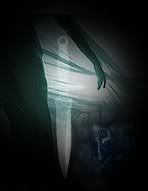
The iron blade of a witch's athame upon her altar is a perfect symbol for the rectification of evil and its elevation back into the realm of kedushah (holiness, sacredness). In the Jewish tradition, this rectification and re-elevation is called tikun olam (repair of the world).
The iron of knives and swords have historically been used to shorten life, making them typically antithetical for use upon a sacred altar, whose purpose is to enhance and lengthen life. However, in the "future world" (in Hebrew "leatid lavo" לעתיד לבא, a code for the transcendent rectified feminine sefirah Binah and her parzufim), our Sages teach that the Temple will be built using iron. Normally, it is forbidden to use tools of iron to cut stones for the Temple altar.
Kabbalistically, iron, one of the seven metals [1] corresponding to the seven mystical attributes of the heart, corresponds to the attribute of Malchut, the element of the heart most "vulnerable to negativity and egocentricity". Malchut symbolizes the feminine Kingdom of the world of action and expression (see sefirotic array here). It also symbolizes the Indwelling Divine Feminine, the Shechinah. In the supernal world of Atzilut, in Judaism, Malchut is called Eretz Yisrael (the Land of Israel). Other spiritual traditions have other names for it, but the message is similar - it represents the Land of the Divine Feminine.
Consequently, we can see that Jewish tradition teaches that iron found in the Land of the Divine Feminine is completely holy and invulnerable to the negativity normally associated with iron. This makes the iron blade of a witch's athame a perfect symbol for the completely holy Divine Feminine.
Footnote:
[1] Seven metal correspondences according to the Zohar, Shemot, Va'Era (hat-tip to Jack Nathanson):
silver - chesed (lovingkindness)
gold - gevurah (strength)
copper - tiferet (compassion)
lead - netzach (endurance)
iron pyrite - hod (empathy)
tin - yesod (foundation)
iron - malchut (kingdom)
Technorati tags: Torah Talmud Torah Judaism Kabbalah jewish mysticism mysticism jewish meditation meditation shamanism jewish shamanism kabbalah iyunit kabbalah maasit jewitchery jewitch jewish woman sacred feminine divine feminine shechinah lilith spiritual development spirituality kosher spirituality temple altar athame
Friday, January 05, 2007
B'Reishit, The Left Emanation In Unity
'כדאמרינן בראשית ואין ראשית אלא חכמה שנאמר ראשית חכמה יראת ה
Sefer HaBahir, verse 3 excerpt
Traditional interpretation: It is thus written (Bereshit 1:1), "In the beginning (bereshit) [G-d created the heavens and the earth." BeReishit is Beit Reishit. The word "beginning" (Reishit) is nothing other than Wisdom. It is thus written (Tehillim 111:10), "The beginning is Wisdom, the fear of G-d."
With a gematria of 911, Reishit ראשית has a digit sum of 11. The number 11 pertains to the sefirot of the feminine universe of Tohu and the complete rectification of evil [1]. This task is a woman's mitzvah. Consequently, we can see that while "Beit" may pertain to Wisdom, "Reishit" pertains to the rectified feminine Left Emanation. "With Reishit" (B'Reishit) elevates the rectified feminine Left Emanation back into the realm kedushah. With a gematria of 913, B'Reishit has a digit sum of 13, echad.
The "fear of G-d" is the Divine Feminine.
Footnote:
[1] Inner Space, R' Aryeh Kaplan (p. 86)
Technorati tags: Torah Talmud Torah Judaism Kabbalah jewish mysticism mysticism jewish meditation meditation shamanism jewish shamanism kabbalah iyunit kabbalah maasit jewitchery jewitch jewish woman sacred feminine divine feminine shechinah lilith spiritual development spirituality kosher spirituality mitzvot bahir
Saturday, December 23, 2006
Sacred Ritual Seals
 אתהפכא חשוכא לנהורא
Selah.
To seal a spell [1], witches say "so mote it be," meaning "it is so." In a similar manner, Jews seal prayer spells with the words amen (אמן) or selah (סלה). In the Temple, in place of amen, the words [2] are said:
Blessed be His Glorious Majesty forever and ever.
ברוך שם כבוד מלכותו לעולם ועד
The witch's "so mote it be" and "amen" mean the same thing. This seal reinforces Divine Will with the soul power of emunah (interincluded within all levels of one's soul) and kavanah to make the prayer spell manifest. It is a formula of confirmation and agreement. By pronouncing "so mote it be" and "amen" one becomes bound to that uttered. One doesn't say either "so mote it be" or "amen" in vain or with evil intent. It is a serious utterance of creation-making for which one is held accountable.
Selah is an untranslatable term found 71 times in Tehillim (Psalms) and 3 times in Habakkuk [3]. Interpreted as a musical or liturgical sign, it implies raising, lifting, extolling, exalting (the voice of the singers) and in medieval Hebrew texts, it means "forever".
Consequently, we can see that selah "seals" a prayer spell, by raising it up into the Presence of the Divine. Amen and the the witch's blessing seals a prayer spell, by bringing down the Divine Presence and becoming personally bound to it and to the Divine Will by confirming the contract contained within the prayer spell. The Inner Temple blessing is reserved for the Most Holy of prayer spells in the Most Holy of spacetime. It should only be uttered in complete kedushah with the purest kavanah. It contains hashra'ah of Divine Essence, as does the form of the Temple blessing which alludes to the Kingdom of the Divine Feminine:
ברוך שם כבוד מלכותה לעולם ועד, אמן
Blessed is the Glorious Name, Her Kingdom stands forever and ever.
Amen. So mote it be.
Footnotes:
[1] Power Spellcraft For Life, Arin Murphy-Hiscock
[2] Encyclopedia Of Jewish Concepts, Philip Birnbaum (pp. 46-7, 438-439)
[3] Habakkuk 3:3, 3:9 and 3:13
Technorati tags: Torah Talmud Torah Judaism Kabbalah jewish mysticism mysticism jewish meditation meditation shamanism jewish shamanism kabbalah iyunit kabbalah maasit jewitchery jewitch jewish woman sacred feminine divine feminine shechinah lilith spiritual development spirituality kosher spirituality spellcraft sealing spells ritual seals
Wednesday, October 25, 2006
Kli Hashem & The Mashpi'im
I dreamt.
My kids and I were sitting around a round table in our house in a mystical village outside of time. There was a bowl-like vessel in the middle of the wooden table into which we could draw water. I focused [1] to examine [2] our vessel more closely to see it more truthfully. Our vessel was not really a bowl - it looked like a minature water fountain with a protuberance in the center (emtza) [3] of it like one might see in a park, only it didn't have any water in it until we drew the water down.
Mostly, we drew (mashpi'im) the water down drop by drop through the motions of our lifted hands (a pintele fun oybin, a pintele fun untin) [3] in the air around it. In this manner (nesi'at kapayim), as mekubalim-kohanim, we would "form" the path each drop took. The drops of mystical water would fall focused onto the protuberance in the center of the vessel.
We were experimenting with how the whole dynamic of water drawing worked. As we put our hands into the air near the vessel when it had water in it, currents of energy [4] were drawn from our hands toward the water. I told my kids to be careful because we weren't quite sure how the process worked yet and the energy currents coming from us were powerful and could be dangerous if uncontrolled.
So, we experimented with the position of our water vessel, our hands and the drops of water as they fell into our place from beyond the periphery of the dream. At times, one of us would draw a bit more water and a whole big bunch of water would drop down, eliciting a "concentrated jumping" (dilug v' kefitzah) arc of powerful energy from the awesome current which flowed all through our bodies (which typically concentrated into our hands).
Oops. We didn't want to create an explosion by allowing the opposite forces (of water and fire) to come together too chaotically, in an uncontrolled manner. Our actions were shaping a "controlled chaos". In other words, with the water, we brought down and formed the great light of Tohu, and effectively "contained it" in a vessel of Tikun.
We were trying to make peace (oseh shalom) between and meld the forces together harmoniously, bit by bit, drop by drop. It was easy to do with the drops, and a more dangerous endeavor to try with large amounts of water, as the water elicited an equal "measured" response from the current running through our bodies.
It required skill to work with large amounts of water and energy, a skill which we were new to developing. So, we continued to work with small drops, and only occassionally would one of us draw down a bit more water. We were getting better at controlling the dynamical process of "water drawing" and working with the energy within us.
As we sat around our table, we heard an explosion from another house in the village. It was from a house next door where a woman lived there alone. She had been given a water bowl too. Her experiments had gotten out of her control, causing her bowl of water and the energy reaction to blow up in her face. She wasn't dead, the rescue workers told us as they raced by our house, but she was critically injured and burned badly. Nobody was sure if she'd survive the blast or not.
I woke up.
Footnote:
[1] "The ability to guard and focus one's sight correctly is the rectified "sense" of sight." (R. Yitzchak Ginsburgh) Rectified sight is associated with the 3 tribes of camp of Reuben - Reuben, Simeon and Gad - all situated in the south (see Possessing The Sea & The South).
[2] The ability to examine to discern truth and falsehood is a power of Binah.
[3] "What is an alef?" The Alter Rebbe continued melodically in Yiddish: "A pintele fun oybin, a pintele fun untin, a kav b'emtza-[The alef is] a dot above, a dot below, and a diagonal line suspended in between." Letters Of Light, Alef - The Difference Between Exile & Redemption, R' Aaron L. Raskin
[4] Here, in these currents (see link above), rests the power to harness the physical soul to effect change and influence reality.
Technorati tags: Torah Talmud Torah Judaism Kabbalah jewish mysticism dream interpretation oneiromancy nevuah chaos complexity mashpiim mekubal alef aleph kedushah sacred feminine nesiat kapayim
Thursday, October 19, 2006
Possessing The Sea & The South
In my previous entry I wrote:
The word בבי"ת in the Kook version is 'בב in the Kaplan version. The stand-alone accented letter is a funny looking chet in my Kaplan version, a beit in the Kook and a hei in Devarim (the quoted verse). I have used the accented beit as it is in the Kook version here in my excerpt, for reasons I will explain in my next post.
Now I will explain. A few nights ago, I dreamt.
I was on the sea (malchut in the world of atzilut) in a small boat, like a fishing boat, I think. Nevertheless, I was on the sea. Near me, almost on top of me, was an enormously powerful water fall. It was greater than Niagara Falls. In fact, the falls began "outside" the scope of my dream. The water "fell into my dream" from a place beyond my dream vision. I knew this even in the dream. The source of the powerful falls originated in the darkness beyond the edge of my vision.
I was situated slightly off center towards the right (corresponding to the south) of the falls (facing them). Had I not been, the powerful mass of falling water would have landed right on top of my head, sending me "underwater" into a powerful current. The falls were awesomely gorgeous and good, but it would not have been good for such power to land right on top of my head.
Anyway, for this reason, I choose the letter beit because I was "at" (a meaning of the letter beit as a prefix) the waterfall which "possessed the Sea and the South".
שנאמר ומלא ברכת ב' ים ודרום ירשה
Sefer HaBahir, verse 3 excerpt
Traditional interpretation: "Because it is written (Devarim 33:23): The filling is G-d's blessing possessing the Sea and the South."
Technorati tags: Torah Talmud Torah Judaism Kabbalah jewish mysticism mysticism jewish meditation meditation kabbalah iyunit jewitchery jewitch jewish woman sacred feminine divine feminine shechinah lilith spiritual development spirituality kosher spirituality sefer habahir bahir kedushah raz


 Posts
Posts


