
כ'א באייר תשס"ח
Mab 22
The night before last night (Saturday night following Shabbat), I dreamt. There is more to this dream than I am going to blog, but here is the end of the dream.
I was with a rabbi, believe it or not. I'm not sure exactly what our connection was, but he had taken me up for some reason, like a teacher or advocate or something.
He took me into the inner outer court of "the temple" (which was like a makeshift diaspora shul) covered within the folds of his cloak or robes of some sort. After we were inside, I came out from among the folds and stood there within the midst of the room.
There was a long table in the middle of the room where judges sat. The head judge sitting at the middle of the table was a woman.
A large group of people came into the room from the outside. I was now surrounded by a large group of Christians whom had agreed to pay $50 per person for the opportunity to see inside the temple. Some of them began to secretly and quietly sing Christian hymns around me, which seemed to try to incorporate me as one "lost" in the crowd among them. I didn't feel they were doing this specifically to me, but to the temple room itself (as if trying to imprint the walls with the presence of their song). I felt so unseen and marginalized standing there surrounded by people to whom I did not belong. I could hear them because I was surrounded by them. The others inside could not. I wanted them to go away, I was feeling smothered and suffocated by the covert singing of hymns by some of them.
The head woman judge spoke to the crowd who had each agreed to pay $50 to be there at that moment, surrounding me, and told them that their $50 worth of time was over now, to bring the money forward to pay for their visit, and directed them that it was now time to leave the shul-temple. Visiting time was over. Each one was to bring his or her $50 to the person at the end of the table collecting the money for the visit.
The head woman judge looked at me. "I don't have $50, I didn't agree to pay $50," I said. "I'm not one of this group. I came in with him," I said, pointing to the rabbi who was standing away from the whole fiasco. The rabbi acknowledged me. The group left and I stayed behind in the room.
We all went into another less formal room. Everyone was now chanting Hebrew prayers and such things. The head woman judge said to me, "Do you think you could fit here?" "I don't know", I said, "I haven't said the prayers in a long time."
The scene changed. Now the rabbi was using me as a divining tool of some sort. He was holding me around the waist and I was leaning out from the waist, like we were attached at the waist. My arms and hands were free floating out into the space in front of us, as if my fingertips were "smelling" the air. I did not consciously direct the movement of my arms/hands, they moved as if they were a sense organ seeing what could not be seen, leading us toward something.
My fingertips touched different places in space and we all followed were they led. Suddenly, my fingertips turned around and I touched myself.
We were then inside a cave where a woman had been held captive for a long time. At first, the cave appeared empty. Again, I was used as a divining tool. There was dirty iron pot sitting on the ground near one corner of the back wall where waste had once been collected during her captivity. The rest of the cave was immaculately clean and well kept for a cave. She had been held prisoner here for a long time. Where was she now?
I looked and found a shallow grave, like a bump in the floor shaped like a body. Her body was still in it, protectively covered over by tightly woven soil (held together by fine plant roots) like an earthen shroud. With my hand, and my face near her face, I was able to poke through into the woven soil around her face, into the space in front of her face, and then started to pull back all the woven soil which protectively covered and sheltered her from the deathly dankness of the cave. As I did, exposure to the fresh air (we had brought with us by finding and opening to enter the cave) agreed with her. She didn't disintegrate like a mummy or once-enshrouded dead body exposed to air might have. Instead, death left her body and she came back to life. The shroud made of woven soil had kept safe her life.
We had to get her to the surface, and did quickly. Once on the surface, she was me I think. I could make no distinction between us. The rabbi pulled something away from us. It looked like a huge slate blue rock the size of a small boulder covered with a filmy luminescent membrane like that which covers a newborn. The thin membrane isolated the bulk of the rock from contact with everything else and held it congealed together like a ball. I knew what it was - it was death tumah. He threw it out into the water which was flowing like a river, to be carried away in the current of running water.
I woke up.
Monday, May 26, 2008
The Holy Half-Shekel & Removal Of Death Tumah

Saturday, March 01, 2008
My Natal Torah Portion Via Yad HaChazakah
 כ'ד באדר א' תשס"ח
Keolwulf 25
My Natal Chart[1] (click for larger view).
"The ascendant of a given geographic location at a given point in time is the point on the zodiac which coincides with - i.e., is ascending over - the eastern horizon as viewed from that place and time."
The ascendant on a natal chart wheel is located where the horizontal line intersects with the left side of the wheel.
In my own natal chart, Virgo (Elul, left hand - yad hachazakah, action, pintele yid, days of reclamation) governed by Mercury is on the ascendant. Thus, communication, intellect and awareness exert considerable influence over my chart and throughout this lifetime.
From The Chassidic Dimension, Rambam states in Yad HaChazakah:
The Torah portion of Chukas begins with the laws of the Parah Adumah, the Red Heifer, whose ashes were used to ritually purify a person who had come in contact with a dead body.[2]
The Rambam states in Yad HaChazakah, Laws of Parah Adumah[3]: "Nine Parah Adumos were made from the time it was first commanded until the destruction of the Second Beis HaMikdash. Moshe made the first; Ezra the second; and seven more from the time of Ezra until the destruction of the Temple. The tenth will be made by Moshiach.
Footnotes:
[1] Tropical Placidus natal chart. See Tropical Vs. Sidereal Astrology.
[2] Bamidbar, ch. 19
[3] Conclusion of ch. 3
Tuesday, October 23, 2007
From The Onset Of Time
י'ב בחשון תשס"ח
This evening's Hebrew letter tarot reading flows from this week's earlier entries discussing my wand's correspondences to the letter mem and water (Sod Ha-Ibbur, Turning History) and the dream about an ancient decree from an ancient time (An Ancient Decree).
מ ... from my wand to ...
Performed with the waxing gibbous moon 93% full during the planetary hour of Saturn, the 3 letters:
אז ט
מ'אז implies something advancing "from the onset of time".
ט implies eternal life - eternal life is associated with Chayah, Chavah's original name.
Saturday, February 17, 2007
Sam Chayyim
כ"ט בשבט תשס"ז
Catherine Yronwode, a hoodoo rootworker writes regarding reading signs in candle magick:
When we burn candles, we often watch and wait for divinatory signs that tell us how the work is going to come out -- that is, whether the spell will be a success or not. Some of the common signs we observe are so-called "coincidences" (especially names and subject matter that relate to those in the spell). We can also consult a system of divination, such as using a pendulum or a Jack Ball, reading or cutting playing cards or tarot cards, or employing Bibliomancy (divination by means of a book such as the Bible). Another easy way to get a divination on candle-burning spells is through ceromancy -- divination by wax. In this case, the wax we "read" is the wax of the candles themselves.
As I was making my kabbalistic name incense last night, I noticed a strange wax formation hanging off the side of my black shabbat candle (which had been dressed with essential lavender oil prior to lighting it). The candle had been burning for quite some time, and I hadn't noticed the figure form on the side of candle. My kavanah was focused on blending my name incense, and yet, at the perfect time, the candle flame caught my eye.
 The odd formation was the figure of a man who appeared to be "hanging on" (down and up the side of the candle) to get a glimpse of the flame [1]. The figure wasn't just dripping down the side - it was attached to the main portion of the candle wax via a small projection near the center of the body and had a "head and upper body portion" which was "gazing" at the flame. The attachment was shaped like - well, you know what - it also appeared to look like the death sickle in the hand (not raised, but lowered) of the grim reaper from another angle.
I considered knocking the wax off the body of the candle, as if it were a klipah. But, I decided to let it fall off gently as the candle continued burning. The figure seemed singlemindedly enchanted by the flame.
Later that evening, as I was removing (with a ritually dedicated utility knife) resin stuck to my pestle, I unintentionally scraped off a small bit of the pestle material itself. If you've ever worked with the thick resin of chelbenah, you can easily understand how this might stick to a pestle.
Reflecting upon all this, it's clear that the deep mind was operating here last night, given the figure of a man formed from the candle wax and the "brit milah" performed on my pestle last night. Truth is stranger than fiction could ever be. My name incense is truly an elixir of life everlasting.
Footnote:
[1] The candle I used was a black taper (not shown).
Technorati tags: Torah Talmud Torah Judaism Kabbalah jewish mysticism mysticism jewish meditation meditation shamanism jewish shamanism kabbalah iyunit kabbalah maasit jewitchery witch jewitch jewish woman sacred feminine divine feminine shechinah lilith spiritual development spirituality kosher spirituality prophecy nevuah brit milah
Friday, February 16, 2007
Lavender - Parah Adumah Temimah
כ"ט בשבט תשס"ז
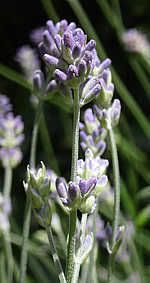
Lavender (ארגמן-כחלחל), also called elf leaf and spike, is a masculine botanical connected to the planet Mercury and to the element air. Among its powers are love, protection, sleep, chastity, longevity, purification, happiness and peace. [1]
Burned as an incense, lavender induces good sleep and rest. Smelling it often promotes a long life. Indeed, I dressed my black shabbat candle this evening with the essential oil of lavender prior to lighting it.
As a component of healing mixtures, lavender protects against the evil eye. Scattered about the home, it maintains peacefulness. So powerful is the essence of lavender that it has been known to bestow upon one suffering from depression, joyousness.
In Hebrew, lavender (noun) is ארגמן-כחלחל. The first term in this construct is argaman (ארגמן). The royal purple of Torah, argaman is derived from the Akkadian word argamannu meaning "purple". Argamannu (argewan, Sanskrit) itself is a synthesis of two Sanskrit adjectives for red - i.e., two different kinds of red - ragamen and ragavan.
The second term - חלחל - means to "permeate". The first letter - כ - of the second term refers to the sefirah Keter (superconscious crown).
Thus, taken together, the Hebrew phrase for "lavender" means to permeate one's will, desire and Divine connection with the royal color of everlasting (keter) life (ateret hayesod-malchut). To make this royal color of everlasting life, one needs (at least) two colors of red (i.e., two colors of blood). In other words, the key to everlasting life is making peace between different colors of "bloods" (peoples), within oneself and within one's world.
Parah Adumah Temimah - why is there death in the world?
Footnote:
[1] Encyclopedia Of Magical Herbs, Scott Cunnignham (p. 152-3)
Technorati tags: Torah Talmud Torah Judaism Kabbalah jewish mysticism mysticism jewish meditation meditation shamanism jewish shamanism kabbalah iyunit kabbalah maasit witch jewitchery jewitch jewish woman sacred feminine divine feminine shechinah lilith spiritual development spirituality kosher spirituality
Tuesday, November 07, 2006
Sprouting From My Roots
Following this post on the eleven 2-letter roots of etz chai, I dreamt.
I was staying temporarily at "changing" (shinui) boarding houses in a nearby city to go to classes at the university. And, for some reason, like the contamination of "time" mentioned in a previous dream, I couldn't stay at my parents' home. The contamination was only contamination for those like me, not for "the normals" (like neurotypicals) who were not sensitive to the "time contamination".
I was in an alternate reality. I thought to travel back to my parents' home to pick up something and bring it to where I was, and I was immediately there. I "traveled" (kefitzat haderech) between realities by just thinking about it. I directed my attention toward someplace or some action, and I was there or it was done.
In the dream, I was taking university classes with a girl friend (chaverah) of mine.
Between classes, we had to change clothes (levushim). To change clothes, we had to miss a class. Changing clothes, I put on a pretty white linen (kittel) dress, a white t-shirt, and a white "girdle" - there wasn't any underslip in the closet in the room where my friend and I were staying temporarily. I knew we wouldn't be staying there for long anyway. Something big was coming.
There was a rumble deep deep in the "place" beyond the screen vision of my dream. My "form" was no longer participating as a form in the dream - I was omnipresently observing (shor) the people of the boarding house now.
The rumble was like an earthquake, but it was also "in the heavens" (aravot) where reality was "created". There was like molten fiery material (tzurah and chomer) from the deep heavenly realm just "outside" the boundaries of the "house of the dream". (In other words, the entire dream was "housed" by the symbolism of the house now; it was a Beit Yosef.)
I saw molten fiery material "drip" secretly through air vents. None of the other inhabitants of the house were aware of the coming change. But, I observed it coming.
Down in the laundry room, a cooling (materializing) yet still fiery thick newly created "tree root" (of Torah) ancient of days penetrated and burst like a behemot through a clothes dryer door, astounding all the inhabitants doing laundry. Some massive reconstruction of the foundation of existence was going on, all realized.
שור A new reality is coming.
I woke up.
One of the 2-letter hebrew roots I considered last night but decided not to use to describe the individual categories within my Hall Of Records formed part of a 3-letter root which carried the meaning "emerging tree root". That 3-letter root I relocated in my book this afternoon to use as the shoresh (3-letter hebrew root) to characterize the entirety of my Hall Of Records. I eventually settled on using a 4-letter word derived from this shoresh, which I will now explain.
On the symbolism of the emergence of the tree root in my dream this morning:
The 3-letter root (shoresh) I was considering as I was deciding on 2-letter gates (she’arim) for the categories in my Hall of Records is גזע which means "emerge", "sprout from soil", "family stock", and like in my dream - "emerging tree root" [1].
מגזע is a word (found in Yishayahu 11:1) derived from the shoresh גזע.
But a shoot shall grow out of the stock of Yishai,
A twig shall sprout from her roots.
The word מגזע has a gematria of 120, samech סמך, support.
The shoresh גזע has a gematria of 80, yesod יסוד, foundation.
The word מגזע is found in Yishayahu, perek (chapter) 11, pasuk (verse) 1 – a reverse vision of my 1 Hall of Records which has 11 categories.
Footnote:
[1] Etymological Dictionary Of Biblical Hebrew, R' Matityahu Clark
**********
What exactly is the Geder of Geze? The dream of the emerging ancient tree root is obviously speaking to my lineage in some manner as well, even though I am a ba'alat teshuvah.
The dream also pertains to the שור Shor Habor through the "line" which connects the hei ה of Sarah and the chet ח of Serach (see Parah Adumah Ritual II) through the gate of שר.
Technorati tags: Torah Talmud Torah Judaism Kabbalah jewish mysticism mysticism jewish meditation meditation kabbalah iyunit jewitchery jewitch jewish woman sacred feminine divine feminine shechinah lilith spiritual development spirituality kosher spirituality hall of records grimoires gates
Wednesday, October 04, 2006
Shabbat Consciousness
According to Sabbatean kabbalah, there "exists" within Ein Sof a "thoughtbare" light (aur she-ein bo machshavah) inclined to rest within itself and resist creation.
Like it or not, this is true. I've written about it in some of my older writings describing preincarnate and prenatal memories; most notably here in First Beit, where I write in part:
The trying with a tail-end-side remembering back there, still sticking through the lava-likeness into the essence trying keeping remembering and remembering being-in going-through the awesomely fearful place of everyeverywhichway was deposited in the brilliant soothing darkness. Feeling smaller feeling relievedthatihadnotceasedintheeveryeverywhichway and feeling drawn back, toward Back There, like to a distant land on the other side yet very near, within remembering ever keeping.
Trying to go back yearning ...
This describes extension of the aur she-ein bo machshavah after being "drawn into" the created worlds, and MY FIRST ACTIVE THOUGHT (upon "being created") was TO GO BACK (to the place of complete rest). I didn't want to "be created". And my very first action after passing alive through the river of fire (the tzimtzum) was, despite the relief of the black empty place [1] I found myself in, was to brave the river of fire a second time and GO BACK.
But, I didn't go back. I heard something interesting which caught my attention. So, I stayed to find out what it was. And followed your voice "into being".
And well, first, after squeezing down through all these worlds and years, I better find you at the end of this journey or I am not going to be a happy camper.
Second, it's clear that shabbat consciousness, the need to "rest" and "resist creation" is rooted in the desire of the dark completely feminine principle within Ein Sof.
The inclination to fill the "time of rest" (shabbat) with "Torah thought" (aur hamachshavah) is rooted in the desire of the completely masculine principle within Ein Sof "to create". So, shabbat consciousness is, essentially, effecting a harmonious re-unification of these two "principles" within Ein Sof, through "thought-filled rest". Thought-filled rest is neither "creating" in terms against the desire of the feminine principle nor "not creating" in terms against the desire of the masculine principle. It synthesizes opposite desires with the principle of thought-filled rest.
Any thoughts out there on the matter? :)
Footnote:
[1] R' Aryeh Kaplan names this place the chalal hapanui. In Sabbatean kabblah, it is called, interestingly, the tehiru.
related webpage: A Mystery Of Consciousness
Technorati tags: Torah Talmud Torah Judaism Kabbalah jewish mysticism mysticism jewish meditation meditation kabbalah iyunit jewitchery jewitch jewish woman sacred feminine divine feminine shechinah lilith chalal hapanui dark feminine taharat hamishpacha tikkunim niddah parah adumah womens mitzvot tehiru aur she-ein bo machshavah shabbat shabbat consciousness yichudim aur ein sof
Tuesday, October 03, 2006
Chalal HaPanui & Taharat Hamishpacha
This definition comes via lil_tike_oon (thanks!) - Chalal HaPanui @ jewishpregnancy.org:
Kabbalistic and Chassidic texts are full of the image of the Chalal HaPanui (Vacated Space)—the “primordial vacuum” that existed before the Creation. It is the space that left room for Creation to come into being, in which G–d creates the illusion that He is absent. It is from this illusion, this apparent vacuum, that heresy draws its life–force. G–d, however, is indeed in that space, since “there is no place devoid of Him.”[1] The womb is the physical manifestation of that place, and birth becomes the gateway through which we find G–d in all the places where He seems to hide from us.
The chalal hapanui is "a no man's land" [2]. "No man's land" fits perfectly with my experience of the "dark completely feminine" force. In other words, the chalal hapanui is completely feminine.
The completely feminine correlates to a woman "unyoked" to a man via pregnancy, marriage, cohabitation, or any other influence which "intimately binds". This may be one of the reasons men (both religious and nonreligious) historically have liked to keep women "barefoot and pregnant" (so to speak) - to temper the "dark completely feminine" force which is ours alone.
And this is also why, I think, a woman cannot rectify the "dark completely feminine" force except that she be "on her own" for some time, away from the influence of "being yoked" to a man. The Jewish niddah laws (taharat hamishpacha, laws of family purity), which limit male-female contact on a monthly basis support this thinking - as niddah time allows opportunity (if such opportunities are seized by the woman) for small tikkunim of the dark feminine in very small manageable doses - for both the woman and the man. Nevertheless, the full power of the dark completely feminine force can only be rectified by an unyoked woman - this is the message of the parah adumah (BaMidbar 19:2).
From experience, I can also say that the womb with child is not a "completely" feminine force. In my memories of being "in the womb", I am not alone there, and "He" (the one truly bound to me, soul to soul) is perceivably essentially with me (there in the womb).
Footnotes:
[1] Sha’arei HaLeshem II:14, “Mishnat Chochmat HaEmet"
[2] R' Aryeh Kaplan, Inner Space
Technorati tags: Torah Talmud Torah Judaism Kabbalah jewish mysticism mysticism jewish meditation meditation kabbalah iyunit jewitchery jewitch jewish woman sacred feminine divine feminine shechinah lilith chalal hapanui dark feminine taharat hamishpacha tikkunim niddah parah adumah womens mitzvot
Wednesday, July 26, 2006
Lahat HaCherev / Gemulit Chassidim
The post today in Vos Iz Neias regarding an ongoing investigation into a fast-moving house fire that apparently occurred this past Monday afternoon in Monsey brought to mind a dream I had many many years ago. It has probably been close to a decade since I had this dream:
I was in a burning house. It was completely engulfed in flames, except for the small space where I stood in the center of it. All around me was fire. The house was burning down, with me dwelling in it. I was trapped by fiery flames.
Suddenly, an opening appeared through the flames above me. HaSatan was looking down through the flames directly at me. He was completely red (אדמה תמימה, Bamidbar 19:1) and had two little horns (יי) on his head like the classic Moses sculpture by Michelangelo. Oddly, even though I wasn't religious at the time, I wasn't afraid of him at all. He symbolized hope (התקווה) to me - my chance of escaping being burned alive in a burning house. His face was kind. His silent expression elicited in me hope, not hate or fear.
I looked up. He reached down through the flames and plucked me up [Zecharyah 3:1-4] out of the burning house. And then I woke up.
The instrument of Hashem's deliverance was HaSatan - who would've thunk it?
Clarifying with respect to Tisha B'av, which is fast approaching, like there are 2 vavim in the word התקווה, there were two families affected by this conflagration. Together, they had 9 children. No one in either family was killed, even though the entire house burnt down. Baruch Hashem.
The One over death loves me ... Shir Hashirim 1:3
The fiery ever-turning sword guards the way to the Tree of Life ... Bereshit 3:24
When one Jew chooses the proper path, he brings goodness to all other Jews, and ultimately to the entire world. R' Yitzchak Ginsburgh
regarding cheshbon hanefesh & my 6th great uncle:
Benjamin Franklin & The Mussar Movement
v'ahavta et adonai elohecha
b'chol l'vavcha uvchol nafsh'cha uvchol m'odecha
JBlog Me
technorati tags: Torah kabbalah oneiromancy beit hamikdash beit habechirah second temple third temple Satan sinat chinam parah adumah hatikvah Chanah gemulit chassidim tisha b'av tu b'av Yehoshua Jerusalem Yerushalayim jewish memory Serach humility Moshe levushim cheshbon hanefesh Benjamin Franklin mussar mussar movement T’nuas Hamusar
Thursday, June 29, 2006
Meat, Milk & Nevuah - Changing Perception Properly

Negative mitzvah 187 tells us not to mix meat and milk. What's the message in this mitzvah?
Meat is from the shoresh בשר. Milk is from the shoresh חלב. Each root (shoresh) which comprises its respective specific word has a kametz (a vowel) under the first two letters of the shoresh. These two letters of each word are two she'arim (gates)1. Consequently, we can see that meat and milk hold two gates which are not meant to be mixed. Kabbalah tells us that milk symbolizes life, while meat symbolizes death.
The vowel kametz pertains to the sefirah Keter.2 Instead of mixing life and death, the two gates of milk and meat are meant to be transformed, leaving a singular gate into Keter, made of eternal life. The gate of eternal life is comprised of the remaining single letters of each word. That gate is רב (rav, see Shem Chai).
The gate of the Hebrew word for meat is comprised of בש, letters meaning "with sin" (with a dot over the left vav of ש) . In other words, it is important that the operation be carried out "with sin", as opposed to "with shin" (with a dot over the right vav of ש). This represents the extreme feminine pillar of Gevurah (the entire feminine array of the Gevurot), within the realm which may give birth to evil. The operation is one completely performed in the Gevurot - herein lies the key to the mystery of parah adumah ritual. It is an utterly female science, devoid of masculine Chesed. It is the Chesed a woman must find within Gevurah, unmixed with Chesed of Chesed. In other words, to elevate Gevurah to Binah, to transform judgment into understanding, and to move her center of consciousness from the middot to the mochin, a woman must do this operation alone.
The gate of the Hebrew word for milk is comprised of the letters חל, letters shared by the foul-smelling incense spice chelbenah (galbanum). Chelbenah represents the pure source and root of evil within the "wholeness" of the ketoret. In this state, חל of Gevurah (of the 7 lower sefirot) is joined to Binah through the ב of the shoresh and pure "beholding" sight (נה-הן) of the soul, thereby "raising it" back into the realm of holiness as it exists centered in the sefirah Binah (of the 3 upper sefirot).
This operation transpires in Gevurah-Binah and within the Gevurot. The kametz of the she'arim of milk and meat inform us that the Divine Will within the sefirah Keter performs it.
The shoresh of milk (חלב) means to change and to convert to nourishment. The shoresh of meat (בשר) means heralding, to bring a message, and a perceptive person.3
Taking all this together, we can see that the prohibition regarding not mixing meat and milk pertains to rectifying, transforming and raising the source of evil back into the realm of the holy. The feminine operation is carried out in Binah, the entire array of the Gevurot, and directed by the Divine Will in Keter.
Importantly, the mitzvah also pertains to nevuah. The prophetic messages of a Divine Messenger are not kosher until the transformative operation of the feminine force has been completed. In other words, the "mixing" of meat and milk cannot be done normatively (in Gevurah of the 7 lower sefirot). Rachel (ר-חל) is the catalyst which raises chel (חל also meaning "the best to enhance nourishment") of chelbenah (חלבנה) to Binah (בנה) where it is transformed into a feminine aleph (ל-אה) of expression.
Meat and milk essentially transformed through the ketoret of Binah, may only be raised following transformation, into Keter. The kametz tells us this. Rav (רב) transforms to בר, meaning "with clarity". And now we can understand why prophetic messages can't be made mixed with meat and milk; i.e., they mustn't originate in Binah (בש) or the Gevurot. They must originate b'reish, בר, in Keter (where the Gevurot and Chasidim "exist" in Singular Unity) to effect a proper change in perception.
Footnotes:
1 Sefer Yetzirah 2:4
2 Kabbalah & Meditation, page 185, R' Aryeh Kaplan
3 Etymological Dictionary Of Biblical Hebrew, R' Matityahu Clark
technorati tags: Torah nevuah Judaism kabbalah shechinah sacred feminine
Saturday, May 27, 2006
Reverse Im HaKolel
The "protected house" of a dream earlier this month is from the root חוה meaning "protected homes".1 It was built into the side of a "small" mountain. The dream points to completed tikun of חוה (Chavah) into חוויה (protected experience) and to an existent state of kedushah surrounding and filling it. With a gematria of 35, חוויה has the same numerical value as the two letters לה which, through a pasuk of Torah (Devarim 30:12), represent my whole name, ליאורה. The house was lit within. The remaining letters of my name permute into אורי, my light - and the light of my bashert.
The swarm (in the dream) represents the "these" (אלה) in the idolatrous phrase "these are your elohim Israel" (Shemot 32:4) spoken by Aharon during the incident with the golden calf. Eleh (אלה) has a gematria of 36. Significantly, the number 36 is associated with a (לו) lamedvav tzadik. Consequently, "these" are a distinguishing test and the final ketz which transforms, purifies and elevates a lamedvavnik to the next level2, from righteousness to holiness, to לה, through a reverse im hakolel3 where the normative sum is reduced by 1 to reflect the "small self-nullification" integral to the meaning of Hermon (the "small" mountain).4
The swarm was not able to enter the place of kedushah. Only the waters of the parah adumah can purify the sin associated with the "these" of the golden calf.5 The she-demon horde trying to break in was indeed angry, but there was a peaceful light in the protected house that night.
חוויה represents the pure existent expression of חייה chayyah, just as חוה represents the fractured expression of חיה chayah.
footnotes:
1 Etymological Dictionary Of Biblical Hebrew, R. Matityahu Clark
2 Zohar Chadash 56b; Tikunei Zohar 47 (87b)
3 Zohar I, 8b-9a explains that new words and/or "entities" (a new method of gematria, for example) can be created through discourse on the Torah.
4 Rabbi Yitzchak Ginsburgh teaches: the root of Hermon in Hebrew is cherem (spelled: chet, reish, mem). Cherem means nullification or self-nullification. The remaining two letters of Hermon, vav and nun, are used in Hebrew to reduce quantity in the meaning of a word. Although it is the largest mountain in Israel, Hermon means "a small self-nullification."
5 Numbers Rabbah 19:8
technorati tags: torah kabbalah chassidut Judaism zohar gematria israel
Friday, February 03, 2006
Shem Chai
ראשיתב
ראא
להימא
תה
שמימו
אתה
ארצו
secret of Bereshit 1:1
The Messianic Spark. The root of the Jewish soul is without blemish [Shir HaShirim 4:7]. כלך יפה רעיתי ומום אין
This is the messianic spark in every Jewish soul, in my soul, as it journeys into life. And this is my story. Ba'aish atah atid livnoto.
RaV Without Blemish. The first letter of written Torah is normally the letter beit. However, if this first beit falls (naphal) backs one space in the samech-cycle of Torah and becomes the last letter in sefer Devarim, the first letter of sefer Bereshit becomes reish, restoring clarity. With clarity restored, through the samekh of the cycle, the power of the birchat kohanim and the power of semichah are also restored, clearly without blemish (מום). For באיש, with fire is it built [Bava Kama 60b].
The beit that falls is rooted in ben, where ben represents the malchut of the ASMaB expansion of the tetragrammaton. Having fallen, the new last letter of Devarim becomes beit. Together, the two letters - the new first letter of Bereshit (ר) and the new last letter of Devarim (ב), reading from Bereshit to Devarim (seder Chesed) spell the word RaV (רב) - and with this, I have made myself a RaV [Avot 1:16]. Even better than that, I have made a RaV without blemish.
RaV is the ezer knegdo to LeV (לב). LeV is how we normally read the first and last letters of Torah (from Devarim to Bereshit, seder Gevurah) in the normal configuration. Now, we can see that the when the beit falls, haLeV of Torah is raised to RaV, and RaV is raised as an ezer knegdo to LeV. As the reish is raised to first place, so too is every letter in Torah raised one space, making reishit Bereshit 1:1 read:
ראשיתב the first became beit
ראא experiencing
להימא clearly
תה without bound,
שמימו contracting and
אתה coming together
ארצו stably
The Bird's Nest. This new configuration of Bereshit 1:1 describes my experience crossing the churning river of fire into existent consciousness. The initial experience of existent consciousness is called the bird's nest. The churning river of fire (nahar dinur) is also the shabbat river, the sambatyon.
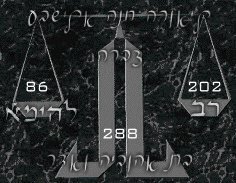
Redemptive Chesed. RaV (of seder Chesed) has a gematria of 202. Following the fall of the beit, through raising the letters of the Torah up one space, 202 sparks of holiness are also raised from the galut of mitzrayim. Tradition teaches us that each soul is born with a mission to redeem 288 fallen sparks of holiness entangled in and exiled throughout creation. Of these 288 sparks, 202 of them are specifically associated with the exile of mitzrayim. Thus, within the first flicker of my soul's experience in creation, is the redemptive power to raise these sparks.
Redemptive Gevurah. Having raised 202 sparks, 86 remain. Eighty-six is the gematria of Elo-him, Hashem's Name associated with creation, the sefirah Gevurah, the power to support and raise the fallen, and strict judgment. In the new RaV configuration of Bereshit 1:1 as written above, the Name Elo-him is transformed into the Name להימא . This Name also has a gematria of 86. Consequently, we can see that through this Name, להימא , the remaining 86 sparks scattered throughout creation are raised and redeemed. להימא is Holy Gevurah of Atzilut.
Tikun HaTohu. Elo-him אל-הים is from the 3-letter root הים meaning agitate or creating confusion. Confusion and agitation are created by the mem sofit, which represents hidden wisdom. When wisdom is hidden from and access is closed to the mind, the mind lacks clarity. להימא opens up the mem and channels wisdom and clarity into the mind. This is the tikun of Elo-him in the world of Tohu, from which all the lower worlds (Beriyah, Yetzirah and Assiyah) are derived.
Tikun HaBrit. Now, through להימא, the world of Tikun itself can be rectified and prepared to receive the great light of Tohu. Eighty-six is the gematria of the word וימל meaning "and he circumcised" [Bereshit 17:23]. This is the tikun of Elo-him in Beriyah.
Tikun HaAf. Eighty-six is also the gematria of האף meaning "surely" [Bereshit 18:13], for surely have I remembered, and surely Sarah laughs with the Name להימא. Surely remembering and laughing at the absurdity of it all, anger, אף [Shemot 4:14] is transformed into a measure of remembrance equal to all the mitzvot of the Torah. This is the tikun of Elo-him in Yetzirah, the world of the letter vav.
Tikun HaChemah, Sh'lim. With Elo-him and the world of Yetzirah rectified, the broken vav of shalom is restored to wholeness. Through restoration of vav, wrath חמה is transformed into a protecting wall, חומה.
Tikun HaShechinah, Tashuv Hey. The digit sum of all the letters constituting the newly configured Bereshit 1:1 is 5. Five is the value of the letter hey, representing the power of expression and complete teshuvah. This is the tikun of Elo-him in Assiyah and sweetens the 5 judgments in Malchut at their root. hamtakat hadinim beshorsham
Shem Chai. Each person has a spark of Mashiach, one's living name, one's shem chai שם חי. With the 4 letters of shem chai and the following 4 expressions, the 4th side of the letter beit is closed, restoring the power of redemption to wholeness in all 4 worlds, and drawing it down into all existence.
מ This is my name, ליאורה חנה אלישבע צברה בת אהוביה ואדר
ש this is my remembrance, ראשיתב ראא להימא תה שמימו אתה ארצו
י this is my hallel, רב
ח and this is my decree, להימא
making a vessel fit for (my spark of) Mashiach.
technorati tags: Torah kabbalah Judaism talmud torah soul prenatal oath jewish jewish mysticism baal teshuvah
Friday, January 27, 2006
Eliyahu's Mantle
Shemot: A Study In Prophetic Ethics
I was enraptured by you. I came forth and rose up, because you know my name. Tehilim 91:14
כי בי חשק, ואפלטהו; אשגבהו, כי-ידע שמי
Hashem hu haElokim, Hashem hu haElokim. 1 Melachim 18:39
יי הוא האל הים , יי הוא האל הים
This is the enraptured exclamation of one who has discovered the intimate Holy light hidden within. A treasure of return.
The mission of G-D cannot be accomplished where honor is not shared between parents and children nor when the ethical mitzvah of honoring one's parents (and teachers) is neglected. Elishaba is one of my names and I do it. A Study In Prophetic Ethics.
~~~~~~~~~~
As an adult, when I first returned to Torah, I chose a hebrew name. As I have grown in Torah, walked the derekh and my netiv path, I've continued to recover my hebrew names. Through actualization of my purpose in creation, as described by my hebrew names, may it not only open up my soul to further discovery, but bring honor to both my parents and to the teachers who have brought me closer to Torah, and bestow creative light, lifeforce and energy upon all who know them.
This is my name, this is my remembrance, this is my hallel, and this is my decree, generation to generation:
ליאורה חנה אלישבע צברה בת אהוביה ואדר
Liorah Chanah Elishaba Tsabrah bat Ahuvyah v'Adar.
ליאורה
Liorah - My given english first name is Lori. But, I didn't just choose Liorah because of its similarity to my english name. I chose it because it means "light to me". In other words, the name Liorah brings down hashra'ah, the Holy immersive creative force of the Shechinah and Divine Omnipresence, through each of the 3 levels of Divine Lifeforce: ohr, chayut and koach to me. I chose to confirm the meaning/mission in the name Liorah, which is the hebrew equivalent to the name my parents gave me, Lori.
חנה
Chanah - My given english middle name is Ann and means favor/grace. Favor is an act of receiving (ohr, chayut, koach) for the reishit (7th) purpose of bestowing the same (ohr, chayut, koach) of that unleashed in Adar (the paradoxical permutation of the soulspark of Moshe into a soulspark of Mashiach) through my first hebrew name Liorah. This will to receive for the sake of giving called reishit transforms the bread of poverty (matzah) into challah, the bread of chelek la'olam haba, which satisfies Divine Purpose for one's creation in the first place - to make a portion of the World-To-Come. Challah begins with the letter chet (with a chatoteret to join One Name to 4 names, with love redeemed), as does the hebrew equivalent to Ann, which is the name Chanah. As Liorah ends with the letter hey and Chanah begins with chet, Chanah also ends with the letter hey. In this fact, between the heys of these two names (Liorah and Chanah), stands the solution to the riddle of the ritual of the parah adumah (from alef to tav), the secret of itta (from alef to tav and tav to alef), the mystery of Elisha's double portion (Elisha-ba) of Eliyahu's prophetic spirit, the evolution of woman into a vessel fit for mashiach, and the redeeming power of Eh-yeh Asher Eh-yeh. Chanah is the mother of Shmuel HaNavi. Shmuel HaNavi is the ultimate rectification of the sefirah Netzach, a sefirah whose rectification is achieved during Purim (see below). Moreover, the name Chanah refers to the 3 mitzvot specifically given to women (challah, niddah and hadlikat nerot). In light of all this, I chose to confirm the meaning/mission in the name Chanah, which is the hebrew equivalent to my english middle name.
אלישבע
Elishaba (where I prefer the pronunciation Elishaba over Elisheva) - Elizabeth was my Jewish great grandmother's name (my mother's mother's mother). Elishaba is the hebrew equivalent of Elizabeth. Importantly, the name Elishaba means "G-d's oath". I was given and gave an oath in the womb, as all souls of Israel do [Niddah 30b] - and kept in purity, it is an oath I remember to this day. Thus, the name Elishaba is integral to who I am as a human being with a specific Divine purpose. Without any doubt and without regret, Amalek was blotted out. I stood firm with the power of netzach and true mesirut nefesh to confirm the meaning and mission in the name Elishaba. This is my name. In Torah, Elisheva/Elishaba is of the tribe of Yehudah, and as the wife of Aharon the Kohen Gadol, she is a kohenet. Later, she was reincarnated as Batsheva, the soulmate of David HaMelech. Elisha-ba/Elisheva holds the keys to transformation, healing and resurrection. He is also the one who received the mantle of Eliyahu HaNavi, the harginger of redemption. In addition to its connection to the navi'im, the name Elisha-ba rectifies the error of Elisha ben Avuyah, as Elishaba is anchored in the goodness of the names Liorah and Chanah and protected by the name which follows it, Tsabrah.
צברה
Tsabrah - This describes my personality perfectly. I am a very prickly person on the outside, just like the tsabrah fruit. This name describes the kind of person I am. Moreover, the 3-letter root צבר of the name means to collect and to gather to protect from loss. So, this name "gathers" all my other names together and protects the mission described by all my other names.
בת אהוביה
Bat Ahuvyah - My mother's name is Cheryl. Cheryl is french for "beloved". Without my mother's support in many ways over the years, my Torah study would be in a sorry, sorry state. My mother is a rock of G-d. Though we both understand differently, my mother's awesome devotion to G-D is lishmah, making her a perfect example of the soul power ahavah as described by the name Ahuvyah. This soul power is actualized and expressed during the Shema prayer through the phrase "with all my heart, with all my soul, with all my might" and is the secret of the staff of Aharon.
ואדר
v'Adar - My father's name is Audra. The hebrew letters in this name are alef vav dalet reish. Two relevant 3-letter roots for these letters are: alef dalet reish (אדר, meaning "mighty", "mantle" and "praise") and alef vav dalet (אוד, meaning "set into motion" and "effect results"). My father is the gentle spirit of a man who held his little daughter in his arms and told her "you can be anything you want to be" and then made me believe it. I've never forgotten, Daddy. I formally returned to Torah and became a ba'alat teshuvah during the month of Adar. My turn toward complete teshuvah was inspired by a Jew named Mark (Mordechai) and Mark (Mordechai) is also the middle name of the Kohen who supervised my formal return to Torah. Mordechai, Mordechai (two of my first teachers, like Moshe, Moshe in a fuzzy-Purim kinda way) is the hero in the story of Purim, a Holy Day in the month of Adar. All of these facts are provided for in the hebrew name-unit of my father, "v'Adar".
בת אהוביה ואדר
Bat Ahuvyah v'Adar - And what have I done with the addition of these names to mine? I honor both my birth parents and the teachers who returned me to Torah. The mission of G-D cannot be accomplished where honor is not shared between parents and children nor when the ethical mitzvah of honoring one's parents (and teachers) is neglected. Elishaba is one of my names and I do it, with praise in honor to my parents and teachers.
All my hebrew names ARE my names. They aptly describe who I am, what my mission is, from where I came, where I'm at, to where I'm going, and who has helped me to get there. In my mind, I haven't really chosen my hebrew names - I have recovered them. And no one, no one, can tell me that my names are not mine, because I know differently.
The lamed-hey pasuk in Torah which encompasses my primary name Liorah as well as all my 4 personal names (ליאורה חנה אלישבע צברה ) of redemption is Devarim 30:12 (paraphrased):
It is not in the heavens,
that I should say,
who can go up and get it for me
that I may observe it.
ל א בשמים, הוא: לאמ ר, מי יעלה-לנו השמימה ויקחה לנו, וישמענו א תה, ונעשנה
No one needs to give me permission to use my own names.
Eh-yeh Asher Eh-yeh.
יי הוא האל הים , יי הוא האל הים
Hashem hu haElokim, Hashem hu haElokim.
1 Melachim 18:39
תני ג' שמות נקראו לאדם הזה אחד שקראו לו אביו ואמו ואחד שקראו לו אחרים ואחד שקראו לו בספר תולדות ברייתו
You have 3 names: the name your parents bestow on you, the name by which others call you, and the name you earn for yourself through your conduct. Kohelet Rabbah 7:3
technorati tags: Torah kabbalah Judaism talmud torah soul prenatal oath jewish jewish mysticism bat kohen baal teshuvah
Friday, January 20, 2006
Parah Adumah
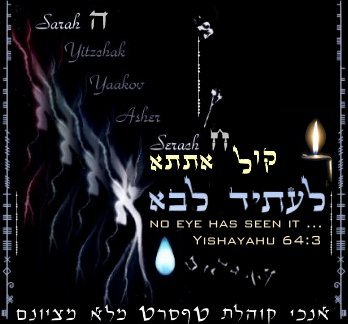
Dangerous Mind. The evolution of the female soul from Sarah (Sarai's pintele yid, point consciousness) to Serach (area consciousness), in its journey (line consciousness) through the fiery river dinur into the blue flame of the shepherd (vav hahipuch), is the secret of the ritual of parah adumah and of making a vessel fit for ha-moshiach. The keys are in the vowels.
Voice Of The Vowels. The hey of Sarah begins to become the chet of Serach in the revelation of one little drop of ink (unfolding the pintel yid of Sarai), from the hand of tafsaret, the soferet carrying the mesorah and spark of messianic consciousness. Through the hey of her name, Sarah Imenu functions to birth a soul from the echad of ein sof, and carries it across the barrier (the fiery river dinur) separating atzilut from beriyah. As this soul of Sarah unfolds into Serach (covering 5 generations, i.e., worlds), the hey becomes a chet (indicating both a transcendent yet immanent soul) in assiyah, the gate back into the echad of ein sof.
4 hebrew letters - from line to area, vowels & consonants
5 ogham vowels - points & lines
The Danger Zone
The redemptive process has 3 stages. In my life, these expressive aspects are:
point of faith (pintele yid)
line of progress (celtic ogham)
area of redemption (hebrew aleph-beit)
The vulnerable stage in achieving redemptive consciousness is the transformation between line and area consciousness. This is the danger zone.
The Danger Zone. Here is likely the place where one seeking to attain messianic redemptive consciousness will fail, and where the attempt towards a holy synthesis of tohu and tikun on the level of the akeidah will fall apart and degenerate. The key to success in this endeavor, and the key to making a holy vessel fit for messianic redemptive consciousness, can be found in the mysterious ritual of the parah adumah. This is also a secret of Serach's eternal memory.


 Posts




