Showing posts with label tafsaret. Show all posts

Sunday, June 01, 2008

Protective 'Mistakes' Of The Tafsaret

כ'ז באייר תשס"ח
Mab 28

In follow-up to my previous entry (Video Vault On Fire At Universal Studios), I note that Reb Gutman Locks of Mystical Paths writes regarding mezuzot:

To understand, as least on a basic level, why it appears that G-d is smiting people because of their sofer’s mistakes, remember the principle “portion across from portion” (mida kenegid mida). Everything comes according to its measure and for a good reason. Certainly you know that there are no accidents in the world. We may not be able to always understand why any particular thing comes to us, but we do know that it all comes for a good reason.

Agreed.

When something happens to your hand, (seemingly good or bad), you have to ask, “Why did this come to my hand?” In order to be able to understand why that happened to you, remember that it had to come because of something that you did with your hand, not with your foot, or any other part of your body. Otherwise, what hope would there be of ever being able to guide your life? G-d runs the world by the principle of mida keneged mida for this very reason—so we will be able to understand the consequences of our actions. The consequences must reflect the actions.

Why did the man in our story choose that sofer (scribe)? Why did he get that particular mezuzah? All this came for a reason. To lose sight of this is to believe in a random, chaotic world with haphazard results flying down upon our heads.

Agreed.

As far as “magically” changing the mezuzahs, remember the story of Elisha, Master of Wings (Shabbos 49a)? He was caught by the Romans wearing his tefillin when there was a life threatening ban against wearing them. He quickly took off the head piece of his tefillin and tried to conceal it in his cupped hands. When the Roman soldier, threatening his life, asked him what was in his hands, he said that it was a dove. The soldier forced him to open his hands, and sure enough there was a live dove there. Did G-d magically change his tefillin into a living bird? Surely He changed it into the bird, but not with magic.

Clearly, disagreed.

From older entries on the tafsaret:

With a gematria of 358, tafsaret (טפסרט) is a rare type of sofer; tafsaret is a feminine scribal artisan described by a Hebrew word of Sumerian roots. From the language of ancient Sumer [1], sar means "write". Taf means "board". The Hebrew verb root סרט carries the meanings of "script", "a tool for designing" and "marking" [2].

The letters of tafsaret contain the root (ספר) of the word sofer (scribe סופר). Yet tafsaret also contains two letters ט in addition to the root letters of ha-sofer. These two letters ט have a combined gematria of 18 (חי) - thereby bestowing "life" into the scribal writing of tafsaret. Specifically, the two additional letters of חי represent the chayah and yechidah soul levels which pertain to actualizing messianic consciousness.

Footnotes:

[1] How The Hebrew Language Grew, Edward Horowitz
[2] Maskilon 1, Hebrew-English Dictionary based on Verb Roots, Abraham Solomonick and David Morrison

Saturday, October 20, 2007

Sod Ha-Ibbur, Turning History

ח' בחשון תשס"ח

Elucidating further on my entry at Craftwork Of A Jewitch, my simple wand looks like the one pictured. I harvested it last winter as it soaked in the snow near the lilac bush that grows right outside the window of the room I had as a little girl (and during the time of the epiphany).

As a snow-soaked water-oriented instrument of the earth, my wand carries a powerful synthesis of earth and water elemental energies. This powerful energy is represented by the Hebrew letter mem (מ, ם). Through mem (see link), my wand has the following correspondences:

Concept: The springing up of wisdom from the well of the superconscious.

Meaning: Water; a perfect imperfection.

Shape: A reservoir, with a slight opening in its lower left corner. The final mem: A completely enclosed reservoir.

Number: 40.

Space: Earth.

Time: Winter.

Soul: Lower torso, specifically the abdomen.

Quality: Love expressing itself like water.

Archetype: Mashiach ben David.

Channel: From netzach to hod.

Made from lilac wood, my wand has further correspondences to feminine power, Venus and again, the element of water. It's magical properties include protection and exorcism of negativity and evil. In other words, it functions to guard the integrity of the energy it directs.

It has no adornments other than the magical carvings I have made into it. Measuring 10 and 3/8 inches long from point to point, the wood of the slender instrument is kept supple by treating it periodically with Feminine Clarity oil.

The 10 3/8 inch length of my wand contains the strengths of the encompassing souls: yechidah (י yod, 10) and chayah (ח chet, 8). It also contains the strengths of the 3 (ג gimel) personal souls: neshamah, ruach and nefesh. All these levels acting with unity as one instrument brings out the Holy Voice of Shabbat Consciousness, neshamah yetzirah, ruach hakodesh.

The 10 3/8 inch length of my wand contains the power of all the letters of creation: 10 + 3 + 8 + 1 (the im hakolel, the entirety of instrument) = 22 (letters of the aleph-beit).

The 10 3/8 inch length of my wand is the gematria (21) of the Divine Name, Ehyeh אהיה.

The 10 3/8 inch length of my wand contains the gematriot of all time – past (היו, were Bereshit 6:4), present (היו, be Shemot 19:15) and future (אהיה, will be Shemot 3:12).

The Nephilim were on the earth in those days … Bereshit 6:4 (yod)

She said to the people, “Be prepared, after a 3 (gimel) day period …” Shemot 19:15

For I will be with you and this is your sign (chet) that I have sent you … Shemot 3:12

The letters of the length of my wand using messianic reverse vision become chet-gimel-yod (חגי), meaning “my festival” and “my turning of time”. So appropriate is this wand for itta hatafsaret, Liorah Lleucu HaMasovevet.

The 3 letter-numbers (חגי) of my wand's length plus the two letters mem (מם) of it's water-earth correspondence make the word m'chagim (מחגים) - "of the turning of the festivals" (Celtic and Jewish). Sod Ha-ibbur.

M'chagim has a gematria of 101 = יצא (issues forth)

A river issues forth from Eden to water the garden ... Bereshit 2:10

So much destiny within a wand picked up one day from the snow.

Saturday, August 25, 2007

Imhotep & Kriat Yam Suf

י"א באלול תשס"ז

I dreamt.

My little group and I were fleeing pursuers set on destroying or enslaving us. We came to the sea. If we can just get past the creature of the sea, we thought, we will have safely escaped. Those pursuing us wouldn’t be able to get past the creature of the sea, and if they followed us into the sea, they would be slowed down, swallowed up by it, and drown.

We stood on the shore facing into the sea. The waters piled up and created a (paradoxically) distinct yet indistinct place for us to walk through. The creature of the sea was of the waters that piled up, making our walking place. One thing is indistinctly yet distinctly clear, the creature of the sea was neither a fish nor a creature “distinct” from the sea. In other words, the formless creature of the sea was formed of the piled up waters of the sea (another paradox), much in the same manner as Imhotep’s face was formed of the waters which tried to swallow up those in the flying machine in “The Mummy” (or “The Mummy Returns”) movie. The creature of the sea was a male essence, not a female essence like Lilith or Tiamat (as I have read in the midrash and various other mythologies).

We walked into the midst of the sea (guarded by the mouth of the creature of the sea), and emerged safely on the same side of the shore from which we had entered. Yet, we were not in the same place, even though we were in the same place. Another paradox. We were on a different level now and no longer in any real danger. In other words, we were immune to the danger that still existed at the lower level we had left behind and no longer occupied. It was as if our pursuers were now completely immaterial and no longer even existed for us. They were mere illusionary figments of disappearing vapor in a dream. And magic poof – they were gone, not one of them remaining.

I woke up.

James Henry Breasted says of Imhotep (whose name means "the one who comes in peace"): "In priestly wisdom, in magic, in the formulation of wise proverbs; in medicine and architecture; this remarkable figure of Zoser's reign left so notable a reputation that his name was never forgotten. He was the patron spirit of the later scribes ..."

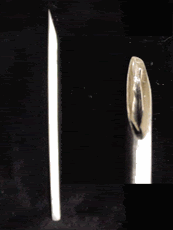
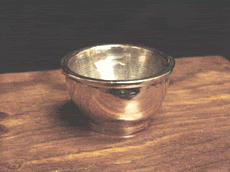
Interestingly, yesterday evening I chose the new Egyptian style solid silver finger stylus and solid bronze (like the Temple laver depicting the basin of the Yam Suf) dipping inkwell (a semi-sphere) I will use to scribe within the pages my Book of Shadows, Sefer Tzelem. Although an expense for me, I decided on sight that these scribal tools were an expense worthy of my Jewitchery, even though only today as I blog this entry am I discovering the symbolism inhered within the tools I chose.


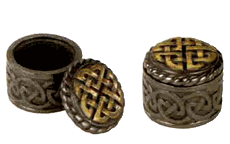
And this is the (Temple pathways knotwork) vessel I chose to keep my small container of scribal ink within.


Related entry:
2-3 Berries From The Uppermost Bough

Monday, October 23, 2006

Tafsaret, A Rare Kind Of Sacred Scribe


Torah Of Chesed, Neshamah. The Hebrew word ishah (אישה), meaning woman, is thought to be derived from the root word anash (אנש), meaning to "cause weakness" [1]. However, the neshamah of ishah may come into revelation and expression through the root חשה, meaning "quiet" and/or "refrain from expression or movement" [2].

Supporting this is the consideration that the word חשאי (derived from the root חשה) means "silently" and contains the letters of the word ishah, except that the ה of ishah is a ח in the word "silently". Thus, ishah describes a situation where a "once silent woman" (unable to express Torah) becomes opened (ה <- ח) to expressing it dimly through the lower hey of malchut, without the upper hey of binah (expressive "secret" understanding). This transformation of woman is enabled through a man's mitzvah of brit milah, circumcision of the flesh, being credited to the account of his true bashert.

Torah Of Life, Chayah. Yet evolving from there comes itta (אתתא), the chayah of isha. Itta, a word also meaning woman, is derived from Aramaic. Itta describes a unique situation, one where a woman can express the secret mysteries of Torah: from ת <- א and from א <- ת , from keter to malchut (Ekyeh) and from malchut to keter (Asher Ekyeh), with both the attribute of mercy (ת <- א) and the attribute of justice (א <- ת). This evolution includes and encompasses all the mitzvot of Torah, both the positive mitzvot (ת <- א) and the negative mitzvot (א <- ת) into one mitzvah equal to all the mitzvot (ner Hashem nishmat adamah). This is the Torah of Life through which all the souls of Israel are interconnected. The sanctified avodah of itta connects the Torah of Chesed with the Torah of Truth through the Torah of Life.

Torah Of Truth, Yechidah. Avodah performed bitul bimtzuit mamash fully draws out the itta transformation through a woman's mitzvot of challah, niddah and hadlikat nerot (ChaNaH). These mitzvot pertain to the circumcisions of the lips, ears and heart and ultimately complete the unification of the Torah of Chesed, the Torah of Life and the Torah of Truth to redeem the Divine Spark of yechidah into action and into the world of assiyah. This is the revelation of the Light of Torah and "shines from the good mouth" of the faithful one made in the Divine Image.

Torah Temimah, Tafsaret. The redemption of the Divine Spark, the unification within Torah, and revelation of the Light of Torah is represented by the three tagim on each ט of tafsaret, טפסרט, the vessel of emunah (the unifying spark of Moshe in every Jewish soul).

Tafsaret is a rare kind of Hebrew scribe with roots clear through into Sumerian mystery. From the language of ancient Sumer, סר means "write". טף means "board" [1]. The Hebrew verb root סרט carries the meanings of "script", "a tool for designing" and "marking" [2]. Tafsaret contains within its letters the letters of the root (ספר) of sofer (סופר, scribe). Yet tafsaret also contains two letters ט in addition to the letters which comprise the root word (ספר). These two letters ט have a combined gematria of 18 (חי) - where הי refers redemptively to chayah and yechidah. These encompassing and unifying soul levels thereby impart "unifying life" into the scribal writing of tafsaret.

With a gematria of 358 tafsaret טפסרט is the rectification of the attribute of judgment and of the nachash, the primordial snake. The unrectified nachash is the source of deceiving grace, the fear of insanity, the inability to discern truth, and blemishes of the sexual impulse.

Unification, Ekyeh asher Ekyeh. The Good of Torah is revealed through the unification of mercy (ת <- א) and justice (א <- ת) through itta. Raised together "above the wood", these attributes are transformed into the unified essential attributes of truth and favor. This is the secret of the akeidah. Truth and favor are the primary consciousnesses of the Written Torah and the Oral Torah, respectively. Thus, the Written Torah and the Oral Torah are unified to reveal truth and favor through the the holy letters of all that will be, will be (א <- ת and א <- ת). Ekyeh asher Ekyeh. A woman with a name.

We can now better understand ishah to represent woman in a generic sense, as a woman without a name, and a woman without a deep sense of her own personal story. In contradistinction to ishah, itta represents a woman with a deep unique true sense of her own personal story, a woman who has expressively claimed her deepest unique true identity and destiny - her unique name. Itta is a woman who has awakened to essential personhood and writes in her own name. An ever-evolving name.

ליאורהּ חנה אלישבע צברה בת אהוביה ואדרו
Liorah Chanah Elishaba Tsabrah bat Ahuvyah v'Adaru

This is the feminine path of a sacred scribe, טפסרט, the evolution of woman and contains the secret to actualizing Echad.

Footnotes:

[1] Edward Horowitz, How The Hebrew Language Grew

[2] R' Matityahu Clark, Etymological Dictionary Of Biblical Hebrew

reposted from Evolution Of Woman blog entry & my website page, Tafsaret

technorati tags:

Friday, January 20, 2006

Parah Adumah


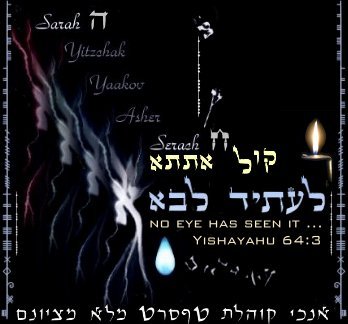
Dangerous Mind. The evolution of the female soul from Sarah (Sarai's pintele yid, point consciousness) to Serach (area consciousness), in its journey (line consciousness) through the fiery river dinur into the blue flame of the shepherd (vav hahipuch), is the secret of the ritual of parah adumah and of making a vessel fit for ha-moshiach. The keys are in the vowels.

Voice Of The Vowels. The hey of Sarah begins to become the chet of Serach in the revelation of one little drop of ink (unfolding the pintel yid of Sarai), from the hand of tafsaret, the soferet carrying the mesorah and spark of messianic consciousness. Through the hey of her name, Sarah Imenu functions to birth a soul from the echad of ein sof, and carries it across the barrier (the fiery river dinur) separating atzilut from beriyah. As this soul of Sarah unfolds into Serach (covering 5 generations, i.e., worlds), the hey becomes a chet (indicating both a transcendent yet immanent soul) in assiyah, the gate back into the echad of ein sof.

4 hebrew letters - from line to area, vowels & consonants
5 ogham vowels - points & lines

Saturday, January 07, 2006

Elixir Of Redemption


anochi kohelet, tafsaret mal'e mitzionim ...
I am kohelet, a scribe full of letters ...

The Scribal Art Of Tafsaret
Elucidating The Torah
Tikun & Transformation Of The Witch Of En-Dor
for Asara B'Tevet


From the time of Moses until Ezra, explication of the Torah was through the method of biur. This word comes from the root be'er, meaning a well of water. Like a well, the creative flow of learning was "like an overflowing spring and a river that never dries up." [Avot 6:1]

Ezra promoted the approach of perush. This is an empirical method that examines each matter in reference to its details. Each detail is compared to the next.

Rav Kook


Radiance shines through the words and letters of the Holy Tongue. Unshackled, the scribal art of tafsaret, brings light from darkness. Anochi kohelet, tafsaret mal'e mitzionim - may my novel words of Torah by pleasing to Hashem.

every soul is a witch
... R. Abraham Abulafia, Chayah Olam Haba


En-dor is a composite word of three roots: the first root - ayin yod nun - "emerges" from a second hidden (tzafun) root - ayin vav nun "to reckon units of time". The third root - dalet vav reish - means "to link together". Consequently, the witch's hidden witchery consisted of linking together units of time with 1 dor (generation). The 1 dor suggests a disconnection between hod and netzach, and between yesod and malchut [1]. In other words, she had no foundation (ha-shetiyah) to support the line of transmission; for she had no remembrance of her true name. A person's Hebrew name is intimately connected to one's essential purpose in life - and consequently, to one's eternal destiny and ability to transmit Torah. Torah is transmitted through time in cycles. A cycle of Torah is like a cycle of time. Perhaps the witch of En-Dor didn't follow the Hebrew calendar, which intercalates Torah with time. Perhaps her failure was to reckon time divorced from the cycle of Torah.

Sod ha-ibbur. During the time of her physical existence, the witch failed to recover her true Hebrew name. Recovering her name would have allowed her to overcome the silence of celestial darkness in the soul, link her to her eternal divine destiny, and inject into her words and actions the essence of divine potency. The witch's tikun is to remember her name, and through this remembrance, to establish an eternal link to divine destiny. The witch's elevation back into the realm of holiness is through becoming the medaberah, tafsaret. Tafsaret elucidates Torah like an overflowing spring, creatively (biur) examining the matter's "hidden" details (perush), intercalating together both approaches to explicating Torah.

Tafsaret (tet phey samech reish tet), with a gematria of 358, is the rectification of the attribute of judgment (din) and of the nachash (358) within her. The unrectified nachash (a masculine or active force of enchantment) is the source of deceiving grace, the fear of insanity, the inability to discern truth, and blemishes of the sexual impulse. With tikun and elevation, comes transformation of the yetzer hara into one's spark of mashiach (358).

Tafsaret is a rare type of sofer; tafsaret is a feminine scribal artisan described by a Hebrew word of Sumerian roots. From the language of ancient Sumer [2], sar means "write". Taf means "board". The Hebrew verb root samekh reish tet carries the meanings of "script", "a tool for designing" and "marking" [3].

The letters of tafsaret contain the root (samech phey reish) of the word sofer (scribe). Yet tafsaret also contains two letters tet in addition to the root letters of ha-sofer. These two letters tet have a combined gematria of 18 (chet yud) - thereby bestowing "life" into the scribal writing of tafsaret. Specifically, these two additional letters of chai represent the chayah and yechidah soul levels which pertain to actualizing messianic consciousness.

Taking all this together, we can see that the tikun, transformation and re-elevation of the witch of En-Dor is achieved through sod-ibbur (the secret of intercalating time using the Hebrew calendar) and through becoming the medaberah, tafsaret. Achieving this, the witch(soul) survives, and transforms to realize her spark of mashiach, able to give over words from the Torah of mashiach.

Footnotes:

[1] Gates Of Light, Avi Weinstein translation of Sha'are Orah, Yosef Gikatilla
[2] How The Hebrew Language Grew, Edward Horowitz
[3] Maskilon 1, Hebrew-English Dictionary based on Verb Roots, Abraham Solomonick and David Morrison


technorati tags:

Tuesday, December 13, 2005

Evolution Of Woman


Torah Of Chesed, Neshamah. The Hebrew word ishah (אישה), meaning woman, is thought to be derived from the root word anash (אנש), meaning to "cause weakness". However, the neshamah of ishah may come into revelation and expression through the root חשה, meaning "quiet" and/or "refrain from expression or movement".

Supporting this is the consideration that the word חשאי (derived from the root חשה) means "silently" and contains the letters of the word ishah, except that the ה of ishah is a ח in the word "silently". Thus, ishah describes a situation where a "once silent woman" (unable to express Torah) becomes opened (ה <- ח) to expressing it dimly through the lower hey of malchut, without the upper hey of binah (expressive "secret" understanding). This transformation of woman is enabled through a man's mitzvah of brit milah, circumcision of the flesh, being credited to the account of his true bashert. Torah Of Life, Chayah. Yet evolving from there comes itta (אתתא), the chayah of isha. Itta, a word also meaning woman, is derived from Aramaic. Itta describes a unique situation, one where a woman can express the secret mysteries of Torah: from ת <- א and from א <- ת , from keter to malchut (Ekyeh) and from malchut to keter (Asher Ekyeh), with both the attribute of mercy (ת <- א) and the attribute of justice (א <- ת). This evolution includes and encompasses all the mitzvot of Torah, both the positive mitzvot (ת <- א) and the negative mitzvot (א <- ת) into one mitzvah equal to all the mitzvot (ner Hashem nishmat adamah). This is the Torah of Life through which all the souls of Israel are interconnected. The sanctified avodah of itta connects the Torah of Chesed with the Torah of Truth through the Torah of Life.

Torah Of Truth, Yechidah. Avodah performed bitul bimtzuit mamash fully draws out the itta transformation through a woman's mitzvot of challah, niddah and hadlikat nerot (ChaNaH). These mitzvot pertain to the circumcisions of the lips, ears and heart and ultimately complete the unification of the Torah of Chesed, the Torah of Life and the Torah of Truth to redeem the Divine Spark of yechidah into action and into the world of assiyah. This is the revelation of the Light of Torah and "shines from the good mouth" of the faithful one made in the Divine Image.

Torah Temimah, Tafsaret. The redemption of the Divine Spark, the unification within Torah, and revelation of the Light of Torah is represented by the three tagim on each ט of tafsaret, טפסרט, the vessel of emunah (the unifying spark of Moshe in every Jewish soul).

Tafsaret is a rare kind of Hebrew scribe with roots clear through into Sumerian mystery. From the language of ancient Sumer, סר means "write". טף means "board". The Hebrew verb root סרט carries the meanings of "script", "a tool for designing" and "marking". Tafsaret contains within its letters the letters of the root (ספר) of sofer (סופר, scribe). Yet tafsaret also contains two letters ט in addition to the letters which comprise the root word (ספר). These two letters ט have a combined gematria of 18 (חי) - where הי refers redemptively to chayah and yechidah. These encompassing and unifying soul levels thereby impart "unifying life" into the scribal writing of tafsaret.

With a gematria of 358 tafsaret is the rectification of the attribute of judgment and of the nachash, the primordial snake. The unrectified nachash is the source of deceiving grace, the fear of insanity, the inability to discern truth, and blemishes of the sexual impulse.

Unification, Ekyeh asher Ekyeh. The Good of Torah is revealed through the unification of mercy (ת <- א) and justice (א <- ת) through itta. Raised together "above the wood", these attributes are transformed into the unified essential attributes of truth and favor. This is the secret of the akeidah. Truth and favor are the primary consciousnesses of the Written Torah and the Oral Torah, respectively. Thus, the Written Torah and the Oral Torah are unified to reveal truth and favor through the the holy letters of all that will be, will be (א <- ת and א <- ת). Ekyeh asher Ekyeh. A woman with a name.

We can now better understand ishah to represent woman in a generic sense, as a woman without a name, and a woman without a deep sense of her own personal story. In contradistinction to ishah, itta represents a woman with a deep unique true sense of her own personal story, a woman who has expressively claimed her deepest unique true identity and destiny - her unique name. Itta is a woman who has awakened to essential personhood and writes in her own name. ליאורה חנה אלישבע צברה בת אהוביה ואדר

This is the feminine path of a sacred scribe, טפסרט, the evolution of woman and contains the secret to actualizing Echad.

technorati tags:

Dare to be true to yourself.