Showing posts with label sofrut. Show all posts

Saturday, December 12, 2009

Choice Gold

כ"ו בכסלו תש"ע
Shamash 28

In follow-up to Between the Pages of Time, on the significance of the color orange (to scribal writing and to the time of faerie/niddah), Balashon writes:

Katom כתום - orange - is also a "new" color, coined for the first time in Modern Hebrew. Klein writes that it derives from ketem כתם - gold.

As far as the connection between gold and writing, Steinberg claims that ketem refers to choice gold, and was so named because it was marked to indicate its value (see a similar opinion here).

and

In post-Biblical literature, ketem refers exclusively to the signs of niddah (menstruation) blood.

Thus, the color orange in my most recent dream connects scribal writing directly to the archetypes of feminine leadership (and specifically to the time of faerie/niddah).

Sunday, June 01, 2008

Protective 'Mistakes' Of The Tafsaret

כ'ז באייר תשס"ח
Mab 28

In follow-up to my previous entry (Video Vault On Fire At Universal Studios), I note that Reb Gutman Locks of Mystical Paths writes regarding mezuzot:

To understand, as least on a basic level, why it appears that G-d is smiting people because of their sofer’s mistakes, remember the principle “portion across from portion” (mida kenegid mida). Everything comes according to its measure and for a good reason. Certainly you know that there are no accidents in the world. We may not be able to always understand why any particular thing comes to us, but we do know that it all comes for a good reason.

Agreed.

When something happens to your hand, (seemingly good or bad), you have to ask, “Why did this come to my hand?” In order to be able to understand why that happened to you, remember that it had to come because of something that you did with your hand, not with your foot, or any other part of your body. Otherwise, what hope would there be of ever being able to guide your life? G-d runs the world by the principle of mida keneged mida for this very reason—so we will be able to understand the consequences of our actions. The consequences must reflect the actions.

Why did the man in our story choose that sofer (scribe)? Why did he get that particular mezuzah? All this came for a reason. To lose sight of this is to believe in a random, chaotic world with haphazard results flying down upon our heads.

Agreed.

As far as “magically” changing the mezuzahs, remember the story of Elisha, Master of Wings (Shabbos 49a)? He was caught by the Romans wearing his tefillin when there was a life threatening ban against wearing them. He quickly took off the head piece of his tefillin and tried to conceal it in his cupped hands. When the Roman soldier, threatening his life, asked him what was in his hands, he said that it was a dove. The soldier forced him to open his hands, and sure enough there was a live dove there. Did G-d magically change his tefillin into a living bird? Surely He changed it into the bird, but not with magic.

Clearly, disagreed.

From older entries on the tafsaret:

With a gematria of 358, tafsaret (טפסרט) is a rare type of sofer; tafsaret is a feminine scribal artisan described by a Hebrew word of Sumerian roots. From the language of ancient Sumer [1], sar means "write". Taf means "board". The Hebrew verb root סרט carries the meanings of "script", "a tool for designing" and "marking" [2].

The letters of tafsaret contain the root (ספר) of the word sofer (scribe סופר). Yet tafsaret also contains two letters ט in addition to the root letters of ha-sofer. These two letters ט have a combined gematria of 18 (חי) - thereby bestowing "life" into the scribal writing of tafsaret. Specifically, the two additional letters of חי represent the chayah and yechidah soul levels which pertain to actualizing messianic consciousness.

Footnotes:

[1] How The Hebrew Language Grew, Edward Horowitz
[2] Maskilon 1, Hebrew-English Dictionary based on Verb Roots, Abraham Solomonick and David Morrison

Friday, April 11, 2008

Inside Out To Divine Consciousness

ז' בניסן תשס"ח
Annwyn 8

Encoding critical actions to Divine Consciousness, as described more explicitly in The Epiphany, turned inside out, שיד is the Divine Name שדי.

The 3-flamed letter shin (ש) corresponds to the active collapse of created consciousness (of Beriyah, Yetzirah and Assiyah) into the point at the base of the letter. Thus, shin corresponds to the actions of consciousness corresponding to this portion of my poem (The Epiphany):

all
my
thoughtsvavfeelingsvavquestionsvavanswers

vavmeanings
becoming being
mashing together, collapsing into my gut
then
a silence


The letter yod (י) is not a mere point. Rather, the letter yod is a point with a little tail that curls around, as if it is turning inside out. Thus, the letter yod corresponds to that which breaks through into the silence as described in this portion of The Epiphany:

cutting the bursting emptiness, when
eternity into a split mo-ment
percolating
then
a rush of
a whirlwind
bursting full
more than I could
ever understanding at once
coming out through my insides
surrounding filling
in the closet
trying
to hold this treasured possession
in my mind of edges
yet then
trusting and letting go
HaELeH going out
such a strange thing was this doing
I was doing
turning inside out


The letter dalet (ד) corresponds to the experience of selfless Atzilutic consciousness, attained once the self-consciousness characteristic of the created worlds "turns inside out". Thus, the letter dalet corresponds to this portion of The Epiphany:

becoming being within
one of infinite place
above without end and below without bound


Note that all three letters have a kotz (thorn, spike).

Saturday, November 24, 2007

It's Here!

י'ה בכסלו תשס"ח
Shamash 17

My handmade Shades Of Grey quill pen to be used for spellwork and writing in my Book Of Shadows arrived today. Yay! It's exquisite! It's gorgeous! Well worth the wait!

Saturday, September 01, 2007

Magic Of The Journey

י"ט באלול תשס"ז

I was sitting here at my computer thinking how it is going to take some time (and money) to acquire all the ritual items I want. Nothing I want costs alot of money really, but it does add up. Yet, I wasn't bothered by the idea of "taking time". I don't feel compelled to "have it all now." In fact, it struck me that there is so much magic in just the journey alone of planning, gathering and preparing one's tools and rituals. Then I thought that this must be true for sofrim as well. The act of preparation is itself sacred, soul-developing and magical.

It is definitely true - the magic is with the witch and she makes her tools magical!

Scribal Ink Base

י"ח באלול תשס"ז

I've found a recipe for the base ink I will handmake as an alternative to using archival black India ink in my original Temple Pathways scribal ink. The recipe I will use for the base is one used in sofrut that I've modified for my own work. My modified base ink recipe can be found here. The Temple Pathways scribal ink recipe in which the base will be an ingredient can be found here. The acid-free archival India ink base will be used in the preparation made for writing in my Book of Shadows, while the handmade base will be used in the preparation made for spellwork.

Of course, I may change my mind about the India ink base if I find or create a better base recipe for acid-free archival ink.

Bone Stylus

י"ח באלול תשס"ז

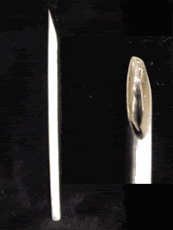
I'm looking for an online resource for scribal supplies. Particularly, I am at the moment looking to purchase a bone stylus or a suitable unfinished bone that I can make into a stylus. If anyone can link me to a supplier, please post a link in the comments.

What kind of bone would make a good stylus? A beef rib bone perhaps? Maybe I can just find a good bone at the grocery store to make a scribal stylus. I need to look for the right bone to use.

I'm going to do it. I'll have both a bone stylus handmade by me and a silver finger stylus to use for writing in my Sefer Tzelem (Book of Shadows) and craftwork.

Sunday, August 26, 2007

Yechidah Lock & Key

י"ב באלול תשס"ז

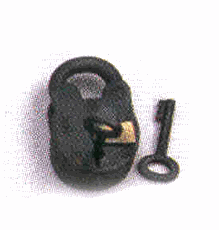
In follow-up to yesterday's entry, Chest of Manifestation, which describes the arba'ah olamot (4 worlds) connection of the Ark and Chest boxes I have chosen in which to incubate my scribal tools and to create, form and do craftwork, today I make note that the old ways Lock and Key which fits the Ark box represents the Unity of Yechidah. Yechidah is represented by the letter aleph (א) in the female version of the tetragrammaton (האה), as described in A Feminine Equation of the Tetragrammaton.

The Chest of Manifestation, with a ה-pointed pentacle on each side of the א box with 3 (האה) shelves brings down the Unity of Yechidah in fit devekut with Chayah of Atzilut (the א Ark box with it's הה lock and key).

The top (third shelf from the bottom) shelf of the Manfestation Chest will be inscribed with the Shema. The bottom (first shelf from the bottom) shelf will be inscribed with the Malchuto blessing. I haven't decided on the inscription for the middle shelf yet. I may wait until I marry and inscribe my bashert's name on it.

Saturday, August 25, 2007

Abracadabra

י"א באלול תשס"ז

Dave of Balashon writes on the etymology of the magic word abracadabra:

Despite the temptation to connect the term to Hebrew or Aramaic, I'm inclined to follow Klein, who writes: [the word is] "Late Latin, from Greek abracadabra, in which the letter c (= s) was misread for k. It was originally written as a magical formula on abraxas stones, whence its name."

Interestingly, this bit of magical information connects to my entries Perspective On Ceridwen Transliteration, Torah Of Peace, Deal With It and Chest Of Manifestation.

אברא כדברא - avra k'davra - I create (peace) as I combine, and that's not "Greek" (in terms of "foreign") to me

Chest Of Manifestation

י"א באלול תשס"ז

The Ark box (representing Atzilut) which will shelter my scribal tools (described previously in Ark of an Enigma) will rest upon this base (representing Beriyah, Yetzirah and Assiyah). I call the base a Chest of Manifestation. Together, the Ark and Chest of Manifestation, represent the 4 worlds (arba'ah olamot) which "emerge out of Ein Sof and culminate in our finite physical universe."

ה
א Chest Of Manifestation האה
ה

Temple Pathways Scribal Ink

י"א באלול תשס"ז

My newest original recipe, Temple Pathways scribal ink here.

Ark Of An Enigma

י"א באלול תשס"ז

In follow-up to my previous post describing some of my newly chosen scribal tools, Imhotep & Kriat Yam Suf, here is a picture of the Ancient Ark I chose in which to store my scribal tools. Inside the cover of the Ancient Ark, I will engrave my Hebrew and Celtic Craft names, along with the Shema and Malchuto blessing.


I also have chosen the Old Ways Ancient Lock & Key which fits it.

Imhotep & Kriat Yam Suf

י"א באלול תשס"ז

I dreamt.

My little group and I were fleeing pursuers set on destroying or enslaving us. We came to the sea. If we can just get past the creature of the sea, we thought, we will have safely escaped. Those pursuing us wouldn’t be able to get past the creature of the sea, and if they followed us into the sea, they would be slowed down, swallowed up by it, and drown.

We stood on the shore facing into the sea. The waters piled up and created a (paradoxically) distinct yet indistinct place for us to walk through. The creature of the sea was of the waters that piled up, making our walking place. One thing is indistinctly yet distinctly clear, the creature of the sea was neither a fish nor a creature “distinct” from the sea. In other words, the formless creature of the sea was formed of the piled up waters of the sea (another paradox), much in the same manner as Imhotep’s face was formed of the waters which tried to swallow up those in the flying machine in “The Mummy” (or “The Mummy Returns”) movie. The creature of the sea was a male essence, not a female essence like Lilith or Tiamat (as I have read in the midrash and various other mythologies).

We walked into the midst of the sea (guarded by the mouth of the creature of the sea), and emerged safely on the same side of the shore from which we had entered. Yet, we were not in the same place, even though we were in the same place. Another paradox. We were on a different level now and no longer in any real danger. In other words, we were immune to the danger that still existed at the lower level we had left behind and no longer occupied. It was as if our pursuers were now completely immaterial and no longer even existed for us. They were mere illusionary figments of disappearing vapor in a dream. And magic poof – they were gone, not one of them remaining.

I woke up.

James Henry Breasted says of Imhotep (whose name means "the one who comes in peace"): "In priestly wisdom, in magic, in the formulation of wise proverbs; in medicine and architecture; this remarkable figure of Zoser's reign left so notable a reputation that his name was never forgotten. He was the patron spirit of the later scribes ..."

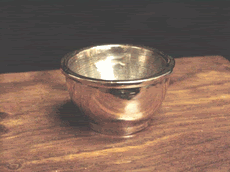
Interestingly, yesterday evening I chose the new Egyptian style solid silver finger stylus and solid bronze (like the Temple laver depicting the basin of the Yam Suf) dipping inkwell (a semi-sphere) I will use to scribe within the pages my Book of Shadows, Sefer Tzelem. Although an expense for me, I decided on sight that these scribal tools were an expense worthy of my Jewitchery, even though only today as I blog this entry am I discovering the symbolism inhered within the tools I chose.


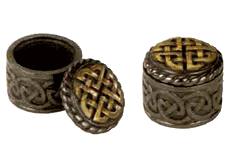
And this is the (Temple pathways knotwork) vessel I chose to keep my small container of scribal ink within.


Related entry:
2-3 Berries From The Uppermost Bough

Monday, October 23, 2006

Tafsaret, A Rare Kind Of Sacred Scribe


Torah Of Chesed, Neshamah. The Hebrew word ishah (אישה), meaning woman, is thought to be derived from the root word anash (אנש), meaning to "cause weakness" [1]. However, the neshamah of ishah may come into revelation and expression through the root חשה, meaning "quiet" and/or "refrain from expression or movement" [2].

Supporting this is the consideration that the word חשאי (derived from the root חשה) means "silently" and contains the letters of the word ishah, except that the ה of ishah is a ח in the word "silently". Thus, ishah describes a situation where a "once silent woman" (unable to express Torah) becomes opened (ה <- ח) to expressing it dimly through the lower hey of malchut, without the upper hey of binah (expressive "secret" understanding). This transformation of woman is enabled through a man's mitzvah of brit milah, circumcision of the flesh, being credited to the account of his true bashert.

Torah Of Life, Chayah. Yet evolving from there comes itta (אתתא), the chayah of isha. Itta, a word also meaning woman, is derived from Aramaic. Itta describes a unique situation, one where a woman can express the secret mysteries of Torah: from ת <- א and from א <- ת , from keter to malchut (Ekyeh) and from malchut to keter (Asher Ekyeh), with both the attribute of mercy (ת <- א) and the attribute of justice (א <- ת). This evolution includes and encompasses all the mitzvot of Torah, both the positive mitzvot (ת <- א) and the negative mitzvot (א <- ת) into one mitzvah equal to all the mitzvot (ner Hashem nishmat adamah). This is the Torah of Life through which all the souls of Israel are interconnected. The sanctified avodah of itta connects the Torah of Chesed with the Torah of Truth through the Torah of Life.

Torah Of Truth, Yechidah. Avodah performed bitul bimtzuit mamash fully draws out the itta transformation through a woman's mitzvot of challah, niddah and hadlikat nerot (ChaNaH). These mitzvot pertain to the circumcisions of the lips, ears and heart and ultimately complete the unification of the Torah of Chesed, the Torah of Life and the Torah of Truth to redeem the Divine Spark of yechidah into action and into the world of assiyah. This is the revelation of the Light of Torah and "shines from the good mouth" of the faithful one made in the Divine Image.

Torah Temimah, Tafsaret. The redemption of the Divine Spark, the unification within Torah, and revelation of the Light of Torah is represented by the three tagim on each ט of tafsaret, טפסרט, the vessel of emunah (the unifying spark of Moshe in every Jewish soul).

Tafsaret is a rare kind of Hebrew scribe with roots clear through into Sumerian mystery. From the language of ancient Sumer, סר means "write". טף means "board" [1]. The Hebrew verb root סרט carries the meanings of "script", "a tool for designing" and "marking" [2]. Tafsaret contains within its letters the letters of the root (ספר) of sofer (סופר, scribe). Yet tafsaret also contains two letters ט in addition to the letters which comprise the root word (ספר). These two letters ט have a combined gematria of 18 (חי) - where הי refers redemptively to chayah and yechidah. These encompassing and unifying soul levels thereby impart "unifying life" into the scribal writing of tafsaret.

With a gematria of 358 tafsaret טפסרט is the rectification of the attribute of judgment and of the nachash, the primordial snake. The unrectified nachash is the source of deceiving grace, the fear of insanity, the inability to discern truth, and blemishes of the sexual impulse.

Unification, Ekyeh asher Ekyeh. The Good of Torah is revealed through the unification of mercy (ת <- א) and justice (א <- ת) through itta. Raised together "above the wood", these attributes are transformed into the unified essential attributes of truth and favor. This is the secret of the akeidah. Truth and favor are the primary consciousnesses of the Written Torah and the Oral Torah, respectively. Thus, the Written Torah and the Oral Torah are unified to reveal truth and favor through the the holy letters of all that will be, will be (א <- ת and א <- ת). Ekyeh asher Ekyeh. A woman with a name.

We can now better understand ishah to represent woman in a generic sense, as a woman without a name, and a woman without a deep sense of her own personal story. In contradistinction to ishah, itta represents a woman with a deep unique true sense of her own personal story, a woman who has expressively claimed her deepest unique true identity and destiny - her unique name. Itta is a woman who has awakened to essential personhood and writes in her own name. An ever-evolving name.

ליאורהּ חנה אלישבע צברה בת אהוביה ואדרו
Liorah Chanah Elishaba Tsabrah bat Ahuvyah v'Adaru

This is the feminine path of a sacred scribe, טפסרט, the evolution of woman and contains the secret to actualizing Echad.

Footnotes:

[1] Edward Horowitz, How The Hebrew Language Grew

[2] R' Matityahu Clark, Etymological Dictionary Of Biblical Hebrew

reposted from Evolution Of Woman blog entry & my website page, Tafsaret

technorati tags:

Tuesday, December 13, 2005

Evolution Of Woman


Torah Of Chesed, Neshamah. The Hebrew word ishah (אישה), meaning woman, is thought to be derived from the root word anash (אנש), meaning to "cause weakness". However, the neshamah of ishah may come into revelation and expression through the root חשה, meaning "quiet" and/or "refrain from expression or movement".

Supporting this is the consideration that the word חשאי (derived from the root חשה) means "silently" and contains the letters of the word ishah, except that the ה of ishah is a ח in the word "silently". Thus, ishah describes a situation where a "once silent woman" (unable to express Torah) becomes opened (ה <- ח) to expressing it dimly through the lower hey of malchut, without the upper hey of binah (expressive "secret" understanding). This transformation of woman is enabled through a man's mitzvah of brit milah, circumcision of the flesh, being credited to the account of his true bashert. Torah Of Life, Chayah. Yet evolving from there comes itta (אתתא), the chayah of isha. Itta, a word also meaning woman, is derived from Aramaic. Itta describes a unique situation, one where a woman can express the secret mysteries of Torah: from ת <- א and from א <- ת , from keter to malchut (Ekyeh) and from malchut to keter (Asher Ekyeh), with both the attribute of mercy (ת <- א) and the attribute of justice (א <- ת). This evolution includes and encompasses all the mitzvot of Torah, both the positive mitzvot (ת <- א) and the negative mitzvot (א <- ת) into one mitzvah equal to all the mitzvot (ner Hashem nishmat adamah). This is the Torah of Life through which all the souls of Israel are interconnected. The sanctified avodah of itta connects the Torah of Chesed with the Torah of Truth through the Torah of Life.

Torah Of Truth, Yechidah. Avodah performed bitul bimtzuit mamash fully draws out the itta transformation through a woman's mitzvot of challah, niddah and hadlikat nerot (ChaNaH). These mitzvot pertain to the circumcisions of the lips, ears and heart and ultimately complete the unification of the Torah of Chesed, the Torah of Life and the Torah of Truth to redeem the Divine Spark of yechidah into action and into the world of assiyah. This is the revelation of the Light of Torah and "shines from the good mouth" of the faithful one made in the Divine Image.

Torah Temimah, Tafsaret. The redemption of the Divine Spark, the unification within Torah, and revelation of the Light of Torah is represented by the three tagim on each ט of tafsaret, טפסרט, the vessel of emunah (the unifying spark of Moshe in every Jewish soul).

Tafsaret is a rare kind of Hebrew scribe with roots clear through into Sumerian mystery. From the language of ancient Sumer, סר means "write". טף means "board". The Hebrew verb root סרט carries the meanings of "script", "a tool for designing" and "marking". Tafsaret contains within its letters the letters of the root (ספר) of sofer (סופר, scribe). Yet tafsaret also contains two letters ט in addition to the letters which comprise the root word (ספר). These two letters ט have a combined gematria of 18 (חי) - where הי refers redemptively to chayah and yechidah. These encompassing and unifying soul levels thereby impart "unifying life" into the scribal writing of tafsaret.

With a gematria of 358 tafsaret is the rectification of the attribute of judgment and of the nachash, the primordial snake. The unrectified nachash is the source of deceiving grace, the fear of insanity, the inability to discern truth, and blemishes of the sexual impulse.

Unification, Ekyeh asher Ekyeh. The Good of Torah is revealed through the unification of mercy (ת <- א) and justice (א <- ת) through itta. Raised together "above the wood", these attributes are transformed into the unified essential attributes of truth and favor. This is the secret of the akeidah. Truth and favor are the primary consciousnesses of the Written Torah and the Oral Torah, respectively. Thus, the Written Torah and the Oral Torah are unified to reveal truth and favor through the the holy letters of all that will be, will be (א <- ת and א <- ת). Ekyeh asher Ekyeh. A woman with a name.

We can now better understand ishah to represent woman in a generic sense, as a woman without a name, and a woman without a deep sense of her own personal story. In contradistinction to ishah, itta represents a woman with a deep unique true sense of her own personal story, a woman who has expressively claimed her deepest unique true identity and destiny - her unique name. Itta is a woman who has awakened to essential personhood and writes in her own name. ליאורה חנה אלישבע צברה בת אהוביה ואדר

This is the feminine path of a sacred scribe, טפסרט, the evolution of woman and contains the secret to actualizing Echad.

technorati tags:

Dare to be true to yourself.