Showing posts with label akkadian words. Show all posts

Sunday, May 11, 2008

Forming Light & The Staff Of Gazing

ו' באייר תשס"ח
Mab 7

In a vision this morning right before waking, in the place between moments I beheld, as if the gaze of my "looking" was carving into a reality made of pure light. No light was removed from the original matrix of light, as the line of light I was seeing "carved" was formed.

Instead, mountains made of light were pushed up and valleys also made of light were sunk low, by the act of carving and forming through beholding. The line formed by gazing was "connected" to a line I had carved into my magic staff before going to sleep last night! For a moment, I perceived with clarity the perfection with which the two were one - the carvings on my witch's staff and the astral double of those carvings imprinted into a matrix of pure light.

It was an electrifying sight to behold.

Update

Perusing the blogosphere, I find this tidbit at Balashon:

Degel דגל is an interesting word. Ask any Israeli - or any Hebrew speaker for that matter - and they will tell you that it means "flag". That certainly is the uncontested meaning in Modern Hebrew. But I imagine that only a precious few will know the meaning the word had in Biblical Hebrew (do you?).

In the Tanach, the word degel primarily appears in the beginning of the book Bamidbar, in the section describing the arrangement of the camp. Verse 1:52 says:

וְחָנוּ, בְּנֵי יִשְׂרָאֵל, אִישׁ עַל-מַחֲנֵהוּ וְאִישׁ עַל-דִּגְלוֹ, לְצִבְאֹתָם

The JPS translation is: "The Israelites shall encamp troop by troop, each man with his division and each under his standard". The translation of degel here is "standard", which originally meant a "flag or other conspicuous object to serve as a rallying point for a military force".

Similarly, verse 2:2 -

אִישׁ עַל-דִּגְלוֹ בְאֹתֹת לְבֵית אֲבֹתָם, יַחֲנוּ בְּנֵי יִשְׂרָאֵל: מִנֶּגֶד, סָבִיב לְאֹהֶל-מוֹעֵד יַחֲנוּ.

is translated, "The Israelites shall camp each with his standard, under the banners of their ancestral house; they shall camp around the Tent of Meeting at a distance"

However Milgrom, in his (JPS) commentary on Bamidbar, disagrees with the translation of degel as "standard". On 2:2 he writes:

Hebrew degel possibly originally meant a military banner. This is supported by the Akkadian dagalu, "to look", and diglu, "sight". The meaning "banner" was later extended by association to include the army division, just as shevet and matteh, the two terms for "tribe", were probably derived from the "rod" that served as the official tribal insignia (cf. 1:45; 14:17-18).

Interestingly, both shevet and matteh not only can mean mean tribe, they can also both mean staff (like a magic staff or walking stick). Consequently, by way of connection to shevet and matteh, Hebrew degel or Akkadian dagalu, may refer to a staff of gazing - as in my vision this morning.

Dave of Balashon also notes:

There are those who claim that the Akkadian word dagalu can be traced even further than its Semitic roots, and is related to the Indo-European root *deik, meaning "to show", and is the source of many English words including "teach" and "diction".

Indeed, I was "shown" in a vision of gazing, thereby taught the direct theurgic effect of my carving from the world of action on the creative matrix of light.

My witch staff is a real and awesome magical tool.

Saturday, August 04, 2007

Argaman Earth Royal Ritual Goblet

כ" באב תשס"ז

This is my new ritual witch's goblet. It's handcrafted with a green basin raised upon a purple stem and base. To me, the royal purple argaman color symbolizes synthesis of the universes of tikun and tohu. The green represents all life of the earth (signifying all existent reality). In the structure of my witch's goblet, all life of the earth (once cast down) now is raised up by the royal purple. ס

As I've posted before regarding lavender:

The royal purple of Torah, Hebrew argaman is derived from the Akkadian word argamannu meaning "purple". Argamannu (argewan, Sanskrit) itself is a synthesis of two Sanskrit adjectives for red - i.e., two different kinds of red - ragamen and ragavan.

Fred at On The Main Line writes regarding the etymology of the Hebrew word for purple:

Talmudists or people who actually read Daniel (ch. 5:7) know that Hebrew argaman, ארגמן, purple, is Aramaic argavana, ארגוונא.

Green (ירוק) is from the Hebrew root ירק meaning "cast down".

Friday, February 16, 2007

Lavender - Parah Adumah Temimah


כ"ט בשבט תשס"ז

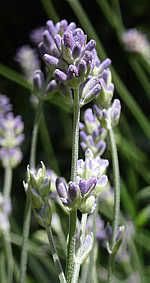
Lavender (ארגמן-כחלחל), also called elf leaf and spike, is a masculine botanical connected to the planet Mercury and to the element air. Among its powers are love, protection, sleep, chastity, longevity, purification, happiness and peace. [1]

Burned as an incense, lavender induces good sleep and rest. Smelling it often promotes a long life. Indeed, I dressed my black shabbat candle this evening with the essential oil of lavender prior to lighting it.

As a component of healing mixtures, lavender protects against the evil eye. Scattered about the home, it maintains peacefulness. So powerful is the essence of lavender that it has been known to bestow upon one suffering from depression, joyousness.

In Hebrew, lavender (noun) is ארגמן-כחלחל. The first term in this construct is argaman (ארגמן). The royal purple of Torah, argaman is derived from the Akkadian word argamannu meaning "purple". Argamannu (argewan, Sanskrit) itself is a synthesis of two Sanskrit adjectives for red - i.e., two different kinds of red - ragamen and ragavan.

The second term - חלחל - means to "permeate". The first letter - כ - of the second term refers to the sefirah Keter (superconscious crown).

Thus, taken together, the Hebrew phrase for "lavender" means to permeate one's will, desire and Divine connection with the royal color of everlasting (keter) life (ateret hayesod-malchut). To make this royal color of everlasting life, one needs (at least) two colors of red (i.e., two colors of blood). In other words, the key to everlasting life is making peace between different colors of "bloods" (peoples), within oneself and within one's world.

Parah Adumah Temimah - why is there death in the world?

Footnote:

[1] Encyclopedia Of Magical Herbs, Scott Cunnignham (p. 152-3)

Technorati tags:

Monday, October 23, 2006

Tafsaret, A Rare Kind Of Sacred Scribe


Torah Of Chesed, Neshamah. The Hebrew word ishah (אישה), meaning woman, is thought to be derived from the root word anash (אנש), meaning to "cause weakness" [1]. However, the neshamah of ishah may come into revelation and expression through the root חשה, meaning "quiet" and/or "refrain from expression or movement" [2].

Supporting this is the consideration that the word חשאי (derived from the root חשה) means "silently" and contains the letters of the word ishah, except that the ה of ishah is a ח in the word "silently". Thus, ishah describes a situation where a "once silent woman" (unable to express Torah) becomes opened (ה <- ח) to expressing it dimly through the lower hey of malchut, without the upper hey of binah (expressive "secret" understanding). This transformation of woman is enabled through a man's mitzvah of brit milah, circumcision of the flesh, being credited to the account of his true bashert.

Torah Of Life, Chayah. Yet evolving from there comes itta (אתתא), the chayah of isha. Itta, a word also meaning woman, is derived from Aramaic. Itta describes a unique situation, one where a woman can express the secret mysteries of Torah: from ת <- א and from א <- ת , from keter to malchut (Ekyeh) and from malchut to keter (Asher Ekyeh), with both the attribute of mercy (ת <- א) and the attribute of justice (א <- ת). This evolution includes and encompasses all the mitzvot of Torah, both the positive mitzvot (ת <- א) and the negative mitzvot (א <- ת) into one mitzvah equal to all the mitzvot (ner Hashem nishmat adamah). This is the Torah of Life through which all the souls of Israel are interconnected. The sanctified avodah of itta connects the Torah of Chesed with the Torah of Truth through the Torah of Life.

Torah Of Truth, Yechidah. Avodah performed bitul bimtzuit mamash fully draws out the itta transformation through a woman's mitzvot of challah, niddah and hadlikat nerot (ChaNaH). These mitzvot pertain to the circumcisions of the lips, ears and heart and ultimately complete the unification of the Torah of Chesed, the Torah of Life and the Torah of Truth to redeem the Divine Spark of yechidah into action and into the world of assiyah. This is the revelation of the Light of Torah and "shines from the good mouth" of the faithful one made in the Divine Image.

Torah Temimah, Tafsaret. The redemption of the Divine Spark, the unification within Torah, and revelation of the Light of Torah is represented by the three tagim on each ט of tafsaret, טפסרט, the vessel of emunah (the unifying spark of Moshe in every Jewish soul).

Tafsaret is a rare kind of Hebrew scribe with roots clear through into Sumerian mystery. From the language of ancient Sumer, סר means "write". טף means "board" [1]. The Hebrew verb root סרט carries the meanings of "script", "a tool for designing" and "marking" [2]. Tafsaret contains within its letters the letters of the root (ספר) of sofer (סופר, scribe). Yet tafsaret also contains two letters ט in addition to the letters which comprise the root word (ספר). These two letters ט have a combined gematria of 18 (חי) - where הי refers redemptively to chayah and yechidah. These encompassing and unifying soul levels thereby impart "unifying life" into the scribal writing of tafsaret.

With a gematria of 358 tafsaret טפסרט is the rectification of the attribute of judgment and of the nachash, the primordial snake. The unrectified nachash is the source of deceiving grace, the fear of insanity, the inability to discern truth, and blemishes of the sexual impulse.

Unification, Ekyeh asher Ekyeh. The Good of Torah is revealed through the unification of mercy (ת <- א) and justice (א <- ת) through itta. Raised together "above the wood", these attributes are transformed into the unified essential attributes of truth and favor. This is the secret of the akeidah. Truth and favor are the primary consciousnesses of the Written Torah and the Oral Torah, respectively. Thus, the Written Torah and the Oral Torah are unified to reveal truth and favor through the the holy letters of all that will be, will be (א <- ת and א <- ת). Ekyeh asher Ekyeh. A woman with a name.

We can now better understand ishah to represent woman in a generic sense, as a woman without a name, and a woman without a deep sense of her own personal story. In contradistinction to ishah, itta represents a woman with a deep unique true sense of her own personal story, a woman who has expressively claimed her deepest unique true identity and destiny - her unique name. Itta is a woman who has awakened to essential personhood and writes in her own name. An ever-evolving name.

ליאורהּ חנה אלישבע צברה בת אהוביה ואדרו
Liorah Chanah Elishaba Tsabrah bat Ahuvyah v'Adaru

This is the feminine path of a sacred scribe, טפסרט, the evolution of woman and contains the secret to actualizing Echad.

Footnotes:

[1] Edward Horowitz, How The Hebrew Language Grew

[2] R' Matityahu Clark, Etymological Dictionary Of Biblical Hebrew

reposted from Evolution Of Woman blog entry & my website page, Tafsaret

technorati tags:

Argamannu, Bridging The Mind & Heart

Fred at On The Main Line writes regarding the etymology of the hebrew word for purple:

Talmudists or people who actually read Daniel (ch. 5:7) know that Hebrew argaman, ארגמן, purple, is Aramaic argavana, ארגוונא.

As I've written previously at Walking On Fire, the website:

Argaman is a hebrew word derived from the akkadian word argamannu meaning purple. Argamannu itself contains a synthesis of two sanskrit adjectives for red, (i.e., two kinds of red) ragamen and ragavan.

Woven together, these adjectives may directly derive from the PIE (proto-indo-european) ancestor to both semitic and indo-european language families, and represent the point of initial bifurcation and eventual reunification. Consequently, argaman (purple) represents the mystical link unifying the semitic (heart, blue) and indo-european (head, red) faculties, and within its history, is the secret of yayin, the rectification of da'at & the elevation of tiferet.

The difference between ragamen and ragavan is mem-vav, 46, and/or b/veit-mem, 42 (yocheved), bereshit bashalom, veshinantam levanecha vedibarta bam.

"By speaking in them (bam) from beginning (bereshit of the written torah) to end (bashalom of the oral torah), one reveals one's innate spark of moshiach." [R. Ginsburgh, The Hebrew Letters, on the letter beit, p. 42]


Technorati tags:

Akkadian Names Of Jewish Months

I don't want to lose track of this information provided on the Akkadian names [1] of the Jewish months by Fred at On The Main Line:

Nisanu..................................Nisan
Ayaru...................................Iyar
Simanu.................................Sivan
Tamuzu................................Tamuz
Abu.....................................Av
Ululu....................................Elul
Tashritu..............................Tishrei
Varahshamnu.......................Marheshvan
Kislimu................................Kislev
Shabatu..............................Tevet
Tebetu...............................Shevat
Adaru..................................Adar

Fred also writes: "As can be plainly seen from the list, the consonants /m/ interchange with /b/ or /v/ (and those with /y/)."

Footnote:

[1] "The Fifth-Century Jewish Calendar at Elephantine" by S. H. Horn; L. H. Wood, Journal of Near Eastern Studies, Vol. 13, No. 1. (Jan., 1954), pp. 1-20.

more on the akkadian origin of cheshvan at DovBear

Technorati tags:

Dare to be true to yourself.