Showing posts with label atarah. Show all posts

Wednesday, March 14, 2007

Ascent Of The Atarah

Regarding kabbalistic theurgy, Moshe Idel (Kabbalah, New Perspectives, p. 196-7) writes:

The ascent of the Atarah to the highest place in the divine pleroma was adopted by theosophical Kabbalah. Notwithstanding its being a classical symbol of the lowest of the sefirot - Malchut - Atarah is at times portrayed as ascending to Keter, in a way similar to that of the anonymous author whose view is preserved in the book of R. Eleazar of Worms. Already R. Ezra of Gerona had commented upon the verse in Song of Songs 3:11: "the whole structure will cleave and unite with and ascend to Eiyn Sof."

The ritual of composing the Atarah by prayer and its ascent and setting on the head of God is tantamount ot coronation of the king. This installation by ritual is clearly reminiscent of the ancient interconnection between ritual and kingship. Kabbalah may therefore be viewed not only as the cultivation of the Garden but also as the cultivation of the Gardener. If the symbolism of Lebanon pertains to the lower face of Divinity, that of the Atarah belongs to its highest aspect. The human range of activity therefore expands beyond those divine manifestations that are ruling the created worlds, to the most recondite layers of the Divine. But while the lower manifestations are structured or made by the ritual, the higher ones are ornamented by the addition of the crown or crowns; again, these ornaments originate from the ascent of a lower divine power - the Atarah.

Technorati tags:

Friday, February 16, 2007

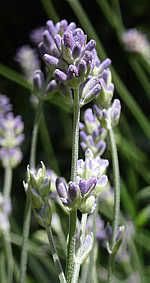
Lavender - Parah Adumah Temimah


כ"ט בשבט תשס"ז

Lavender (ארגמן-כחלחל), also called elf leaf and spike, is a masculine botanical connected to the planet Mercury and to the element air. Among its powers are love, protection, sleep, chastity, longevity, purification, happiness and peace. [1]

Burned as an incense, lavender induces good sleep and rest. Smelling it often promotes a long life. Indeed, I dressed my black shabbat candle this evening with the essential oil of lavender prior to lighting it.

As a component of healing mixtures, lavender protects against the evil eye. Scattered about the home, it maintains peacefulness. So powerful is the essence of lavender that it has been known to bestow upon one suffering from depression, joyousness.

In Hebrew, lavender (noun) is ארגמן-כחלחל. The first term in this construct is argaman (ארגמן). The royal purple of Torah, argaman is derived from the Akkadian word argamannu meaning "purple". Argamannu (argewan, Sanskrit) itself is a synthesis of two Sanskrit adjectives for red - i.e., two different kinds of red - ragamen and ragavan.

The second term - חלחל - means to "permeate". The first letter - כ - of the second term refers to the sefirah Keter (superconscious crown).

Thus, taken together, the Hebrew phrase for "lavender" means to permeate one's will, desire and Divine connection with the royal color of everlasting (keter) life (ateret hayesod-malchut). To make this royal color of everlasting life, one needs (at least) two colors of red (i.e., two colors of blood). In other words, the key to everlasting life is making peace between different colors of "bloods" (peoples), within oneself and within one's world.

Parah Adumah Temimah - why is there death in the world?

Footnote:

[1] Encyclopedia Of Magical Herbs, Scott Cunnignham (p. 152-3)

Technorati tags:

Saturday, October 14, 2006

Geut, Raising The Fallen

כמה דאתחיל ברכה
Sefer HaBahir, verse 3 excerpt

Traditional interpretation: "... in order that it begin with a blessing."

Liorah's interpretation: "... (to discern) how many thirst to know enabled power to develop proper abilities."

The word דאתחיל through the gematria of 453 is first associated with the sefirah Yesod, as explained in earlier entries, The Blessing Of Kosher Development and Choshen Mishpat. In the former entry I posited the idea that raising Yesod also uplifts Malchut and linked the action to the concept of geut. Further analysis of the word דאתחיל helps us to understand why this is the case.

דאתחיל "begins" (as the word is traditionally translated) with the letter dalet ד. Dalet is associated with the sefirah Malchut and the consciousness of shiflut. R' Yitzchak Ginsburgh writes regarding dalet as it pertains to Malchut, shiflut and geut:

In the Zohar, dalet is read as "that has nothing [d'leit] of her own." This expresses the property of the lowest of the Divine Emanations, the sefirah of malchut, "kingdom," which has no light other than that which it receives from the higher sefirot. In man's service of God, the dalet characterizes "shiflut," "lowliness," the consciousness of possessing nothing of one's own ...

Shiflut is the spiritual state associated with the sefirah of Malchut ... In direct proportion to his existential state of shiflut (whose root shefel means "low tide"), is the true king able to manifest that state of "upliftedness" (geut, the "high tide") necessary to constructively rule over his people (the two terms, shefel and geut, exactly equaling one another in gematria).

From this we can see that the word דאתחיל (in this excerpt from verse 3), generally associated with the sefirah Yesod, is specifically associated with ateret hayesod, the origin of Malchut.

Thus, by raising Yesod, through Malchut's origin in ateret hayesod, Malchut is likewise raised. Moreover, as before the primordial sin, the ayin of skin is raised to the aleph of light, also as previously elucidated in The Blessing Of Kosher Development.

Technorati tags:

Friday, September 29, 2006

Reconciliation Of Darkness & Light

יאיר כחשיכה כאורה
Sefer HaBahir, verse 1, excerpt of last line

"light and darkness are the same"

"the earth being unformed and void, with darkness over the surface of the deep ..." Bereshit 1:2

Darkness (choshech, חשך) was born from the separation of some original unified state (veha-aretz hay'tah, והארץ היתה) into the lights of tohu (תהו) and bohu (בהו), which are chaos and uncertainty, respectively. In other words, from the unity called "veha-aretz hay'tah", 2 lights and darkness were born.

The 2 lights of tohu and bohu, represent thesis and antithesis. When clarified, darkness represents the "place" of potential synthesis.

Reunification of rectified choshech, tohu and bohu brings into existence the lights (ben Yosef and ben David) of moshiach known as the brightness (reunified choshech va-bohu => tehiru tata'ah) and the brilliance (reunified brightness va-tohu => tehiru ela'ah).

Tohu, from the root תהה is a reaction to uncertainty (bohu, where bohu is from the root בהה); the result of that reaction creates darkness in awareness. The original unified state (veha-aretz hay'tah) is a forward projection (hay'tah from the root יתא) of one inmost essential (ateret hayesod, ט) element of ha-aretz (stable elements of existence, from the root ארץ); where this essential element focuses the blessings of life and "peace between the elements" into certain existence, malchut.

Taking all this together, we can see that "the place" where darkness and light "are the same" (i.e., reconciled in a unified state of peaceful existence) is in malchut, ha-aretz.

This new unified state of malchut, wherein darkness has been clarified and reunited with tohu va-bohu, is called יאיר. From the shoresh יאר (meaning irrigating body of water), it irrigates the earth with brilliance (like waters cover the sea).

"for the earth is filled with the knowledge of G-d like waters cover the sea" ... The Laws Of Kings, Yishayahu 11:9

Technorati tags:

Friday, September 01, 2006

Mesirut Nefesh, Imma Ila'ah & Leatid Lavo

אלול.ט remember, I sacrificed my soul for you ... shabbat 89b


ever in my ear, a feast absolutely senseless, with a holy madness
seizing the moments, turning over time, plunging into history
one sight, one mind, our bodyguard
the curious melody that plays your heartsound, a mystery mark
weaving secretly through mine
upon reverberating strings jeweled with a rhythm of the land
smelling darkly deep, a resurrecting wine fully alive
aged on the way, homeward bound
body and soul, dancing like lovers with eternal breath
a song between two old friends
an extraordinary ordinary treasure
resting plainly like a tool within some wooden dreambox
gently blowing
the most beautiful light of midnight


mesirut nefesh & halachah ve-ein morin kein

leatid lavo & imma ila'ah - the Torah that we learn takes us out of the grave


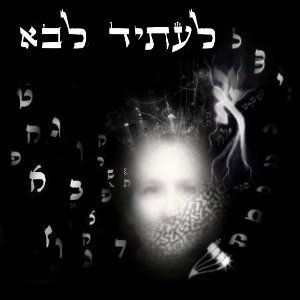
"The future to come" (leatid lavo לעתיד לבא) is a higher revelation than that of "the coming world" (olam haba עולם הבא): In the writings of the Arizal it is explained that "the coming world" corresponds to the level called Tevunah, whereas "the future to come" corresponds to the level called Imma Ila'ah, which is higher. - R' Yitzchak Ginsburgh, The Alef-Beit


akeidat Yitzchak, leatid lavo and arguing G-d for redemption:


R' Shmuel, the son of Nachmani, said in the name of Rav Yonatan: "What does the verse mean, You are our father, for Abraham did not know us and Israel did not recognize us. You [G-d], our Father, Redeemer, forever is Your Name. [Isaiah 63:16]. In the future (leatid lavo), God will say to Abraham, 'Your children have sinned against me.' And Abraham will say in front of Him, 'Master of the Universe, wipe them out for of the sanctification of Your Name.' God will say, 'Perhaps Jacob, who had experienced difficulty raising his children, will ask for mercy for the Jewish people.' G-d will say to him, 'Your children have sinned against Me.' Jacob will say in front of Him, 'Master of the Universe, wipe them out for the sanctification of Your Name.' God will say, 'The old man has no reason, and the young one has no advice." God will then say to Isaac, 'Your children have sinned against me.' He will say in front of Him, 'Master of the Universe, my children? My children, and not Your children? When the Jews said, We will do and we will listen, You called them my first-born son, and now You call them my children, and not Your children? Besides, how much did they sin? How many years are the years of a man's life, seventy? Subtract [the first] 20, for which a person is not punished, you are left with 50. Subtract 25, which are evenings, and you are left with 25. Subtract 12-1/2 which a person uses to pray, to eat, and answer nature's call, and you are left with 12-1/2. If You can tolerate all of this, good; if not, then let us split it, half on You and half on me. If you will say that all of the years of their sins are on me, remember that I sacrificed my soul in front of you (for you).'" [Shabbat 89b]


atarah:


This is important to know, because another name for the sefirah of Yesod is "Goel," which means "Redeemer" (Ziv HaZohar). In other words, if redemption is a function of the sixth sefirah - and it is:

The Yesod divided into two kings, the Yesod and the Atarah. The Atarah is relevant to "malchus" since it is her (Yesod's) crown, which is why it is called "Atarah". . . Therefore, the Yesod and the Atarah became two, but after the tikun the Yesod and the Atarah became one in order to join together Zehr Anpin and Nukveh, forever . . . This is the sod of "Yemos HaMoshiach" being at the end of the sixth millennium . . . (Hakdamos v'Sha'arim, page 172) - and Yesod, by definition, cannot hold back its blessing. Redemption is then bound to spill out early just as the revelation of Yosef's true identity.


yesod, the light of binah (imma) & redemption:


If we, the Jewish people, act as if God and Torah are all that counts, then, the light of binah is drawn down and becomes attached to the lower six sefirot, and, this, in turn, elevates these six sefirot upward towards binah. The result is redemption.


technorati tags:

Dare to be true to yourself.