Showing posts with label sanskrit words. Show all posts

Monday, February 26, 2007

Murder Near Bat Ayin, A Tarot Connection

ח' באדר תשס"ז

Carl at Israel Matzav and Israel National News are reporting today that a Jewish Israeli was stabbed to death near Bat Ayin yesterday. INN reports:


A resident of Bat Ayin, in Gush Etzion, was stabbed to death Sunday evening not far from his home. The victim, Erez Levanon, 42 and father of three, was found late last night in an abandoned village near Beit Omar, some ten miles south of Jerusalem.

Eliyahu Mendelovitch, a neighbor of the victim who participated in the search and retrieval of Levanon's body, told Arutz-7 that the murderers most likely waited in ambush for him. Erez often went to the same spot at the same time each day to pray alone, in the custom of Breslover Hassidim.

Erez was also a talented musician, who "did wonders with his music and lyrics. He put out a disc that is unlike those sold in stores; something very unique." The Maariv NRG Hebrew website article on the murder includes a link to hear the song "The Heart and the Well," written and composed by the victim.

Erez spent the last seven summers in India - first in Manali and afterwards in Bela - meeting with young Israelis seeking to "clean their heads." "What he managed to do there was simply amazing," Yosefi told Radio Kol Chai. "I always wondered where such a talent came from... He had a special strength of faith."

ברך דיין האמת

We are all connected in the web of life. Adar 7 seems to be connected to ayin ע and Bela, as well. The only card (the Tower) from the major arcana which fell out into my Adar 7 tarot reading concerned both ayin and Bela (Bala Lake symbolism of the Tower card). My tarot reading occurred as Adar 7 had begun. The man's brutal murder occurred as Adar 7 concluded (approximately 6:00 pm Sunday). Ayin and "BLA" connected them - although I'm not sure how or why. Nevertheless, a small connection exists, so I am documenting it.

Another point of connection - while neither Bela nor Bala (of Bala [1] Lake) are rooted in Hebrew, and are of the Indian and Celtic languages, respectively - the phonetic Hebrew root of "BLA" is בלע which means to "swallow completely" [2] - just like in my dream early this morning where an adversarial ship was swallowed up completely by the sea. I posted the dream early today (unusual for me) because I was up getting ready to take my father for a medical checkup.

Footnotes:

[1] Bala is derived from the Celtic “Belago” meaning the efflux of a river from a lake. In Indian-Hindu Sanskrit, bala means "young".

[2] Etymological Dictionary Of Biblical Hebrew, R' Matityahu Clark; the Hebrew root בלע can also mean "calamity striking".

Note: Chicago Sun Times reported Sunday that a 330-foot deep sinkhole in Guatemala opened up this past Friday, killing at least 3 people and swallowing up a huge chunk of populated land.

UPDATES & more coverage:

Israellycool
IsraelReporter
Elder Of Ziyon

Technorati tags:

Friday, February 16, 2007

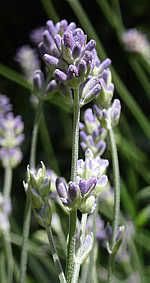
Lavender - Parah Adumah Temimah


כ"ט בשבט תשס"ז

Lavender (ארגמן-כחלחל), also called elf leaf and spike, is a masculine botanical connected to the planet Mercury and to the element air. Among its powers are love, protection, sleep, chastity, longevity, purification, happiness and peace. [1]

Burned as an incense, lavender induces good sleep and rest. Smelling it often promotes a long life. Indeed, I dressed my black shabbat candle this evening with the essential oil of lavender prior to lighting it.

As a component of healing mixtures, lavender protects against the evil eye. Scattered about the home, it maintains peacefulness. So powerful is the essence of lavender that it has been known to bestow upon one suffering from depression, joyousness.

In Hebrew, lavender (noun) is ארגמן-כחלחל. The first term in this construct is argaman (ארגמן). The royal purple of Torah, argaman is derived from the Akkadian word argamannu meaning "purple". Argamannu (argewan, Sanskrit) itself is a synthesis of two Sanskrit adjectives for red - i.e., two different kinds of red - ragamen and ragavan.

The second term - חלחל - means to "permeate". The first letter - כ - of the second term refers to the sefirah Keter (superconscious crown).

Thus, taken together, the Hebrew phrase for "lavender" means to permeate one's will, desire and Divine connection with the royal color of everlasting (keter) life (ateret hayesod-malchut). To make this royal color of everlasting life, one needs (at least) two colors of red (i.e., two colors of blood). In other words, the key to everlasting life is making peace between different colors of "bloods" (peoples), within oneself and within one's world.

Parah Adumah Temimah - why is there death in the world?

Footnote:

[1] Encyclopedia Of Magical Herbs, Scott Cunnignham (p. 152-3)

Technorati tags:

Saturday, February 10, 2007

Appropriation Of Divine Lifeforce

כ"ג בשבט תשס"ז

I discussed in a previous entry that I plan to begin my reversal ritual on the Dark Moon of February 17th during the void of course moon. In this discussion I linked the moon's void courses to rectified Tohu, and to opening to receive the Light of rectified Tohu (with which to power manifestation of the ritual's intent) via the procedure of opening a new jar of black sesame seeds.

Interestingly, the day I plan to do all this, February 17th, is also the birthday of Hindu goddess Kali Mah [1]. Kali is a Sanskrit word meaning both "time" and "black", just like the Dark Moon is both "time" and "black". Importantly, in terms of ritual intent, Kali Mah (or alternatively, Mah Kali) is a Divine Feminine archetype of compassion, liberation and enlightenment. A fierce goddess of chaos and complexity, Kali Mah is nevertheless an epitome of compassion. The "compassion of chaos" is kabbalistically called chasdei David hane'emanim [2] and is linked to a doubling of the 50 Gates of Understanding. In other words, Kali Mah is linked to 100 Gates of Understanding.

Transliterated into Hebrew letters, Kali Mah is כלי מאה, meaning "my all" and "multiplying". In other words, all that I know and understand will be multiplied in holiness. How can I say in holiness? Because מאה also means one-hundred (Gates of Understanding, for example) [3], the value of the letter of holiness which is ק kuf. מאה can mean two-hundred too [3]. Thus, there is a multiplying double portion of knowledge and understanding tied into the symbolism of Kali Mah.

The double portion associated with Kali Mah further supports her connection to the idea of rectified chaos, just as the mitzvah of challah and its double portion (of loaves) is associated with the rectification of chaos. In terms of enlightenment, Kali Mah's double portion is additionally connected to the double portion of nevuah received by Elisha HaNavi.

Kali Mah is a Dark Goddess, like the moon of February 17th this year is a Dark Moon. Considering the transcendent magick of void of course moontimes of the upcoming ritual, the Hebrew letter kuf through the Mah of Kali's name corresponds to the power of the material realm to expropriate transcendent Divine lifeforce. Thus, this detail of the day further supports the ritual endeavor toward success.

Footnotes:

[1] Witches' Spell A Day 2007 Almanac, Llewellyn Publishers

[2] Sha'are Orah, R. Yosef Gikatilla (p. 107) and here

[3] Etymological Dictionary Of Biblical Hebrew, R' Matityahu Clark (p. 135)

Technorati tags:

Saturday, October 28, 2006

Celebrating The Sacred Feminine

Samhain, the holy day of the Ancestors, is observed [1] from sundown October 31 through November 1. Samhain honors the dark Divine Feminine, the "dark half" of the year, marks the onset of winter, and is the Celtic New Year.

As a time when one cycle ends and a new one begins, Celtic tradition teaches that the veil separating the manifest world from the supernal realms is particularly thin and open during Samhain. In consequence to the "break" in the flow of time, Samhain is an opportunity for profound mystical transformation. Like Lag B'Omer, mystical bonfires have a role in the observance of Samhain.

The word Samhain derives from the Proto-Celtic word samani, which means "assembly" (cognate to Sanskrit sámana). [2] The Hebrew equivalent to Samhain is the word כינוס from the root כנס meaning "assembling", "gathering" and "bringing together". This root is found in Tehilim 147:2 ...

"The L-rd rebuilds Jerusalem; She gathers in the exiles of Israel."

:בונה ירושלם יהוה; נדחי ישראל יכנס

The first word in this pasuk is "boneh" בונה from the same root as Binah, a feminine sefirah of the "dark" left emanantion. Literally, the first part of this pasuk reads like a command "build Jerusalem Hashem!" The Divine She is She who commands it be done.

Thus, the secret of Samhain, a holy day of proto-Celtic origin, is mystically connected to the commands to rebuild Jerusalem and to ingather the exiles. Moreover, these commands are directly related to the "dark" Divine Feminine principle, which indeed, Samhain celebrates.

Also, given the bonfire connection to both Lag B'Omer and Samhain, and where Lag B'Omer is called the "Scholars' Festival" (pertaining to men), I hereby dedicate Samhain to be the "Scholars' Festival" (pertaining to women).

Footnotes:

[1] see here for date for astronomical Samhain

[2] W. Stokes in KZ 40:245 (1907), see here

Technorati tags:

Monday, October 23, 2006

Argamannu, Bridging The Mind & Heart

Fred at On The Main Line writes regarding the etymology of the hebrew word for purple:

Talmudists or people who actually read Daniel (ch. 5:7) know that Hebrew argaman, ארגמן, purple, is Aramaic argavana, ארגוונא.

As I've written previously at Walking On Fire, the website:

Argaman is a hebrew word derived from the akkadian word argamannu meaning purple. Argamannu itself contains a synthesis of two sanskrit adjectives for red, (i.e., two kinds of red) ragamen and ragavan.

Woven together, these adjectives may directly derive from the PIE (proto-indo-european) ancestor to both semitic and indo-european language families, and represent the point of initial bifurcation and eventual reunification. Consequently, argaman (purple) represents the mystical link unifying the semitic (heart, blue) and indo-european (head, red) faculties, and within its history, is the secret of yayin, the rectification of da'at & the elevation of tiferet.

The difference between ragamen and ragavan is mem-vav, 46, and/or b/veit-mem, 42 (yocheved), bereshit bashalom, veshinantam levanecha vedibarta bam.

"By speaking in them (bam) from beginning (bereshit of the written torah) to end (bashalom of the oral torah), one reveals one's innate spark of moshiach." [R. Ginsburgh, The Hebrew Letters, on the letter beit, p. 42]


Technorati tags:

Tuesday, July 18, 2006

Katyusha & Ekateros

In investigating the word katyusha, Balashon ends with writing:

And to give this some Hebrew connection, we see that in the Septuagint the word ekateros appears often as a translation for שניהם - "both" as in Bereshit 40:5. There are even those (if I understand correctly) who translate ekateros as "one and another", which connects it to the Sanskrit eka meaning one, and the Hebrew אחד echad.

It is interesting that he links rockets, the phrase "both" and the word "echad". So does my dream In Five Days.

technorati tags:

Monday, December 19, 2005

Sticks And Stones


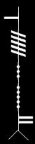
Liorah (ogham, left; cursive hebrew, right)

The Druidic mystical alphabet of the Celtoi is called the Ogham. Ogham is pronounced "aum", like the Sanskrit word "ohm" and the Hebrew root word "alef-vav-mem". Ogham, aum and alef-vav-mem אום refer to the foundation of existence; to the ability to hold a "spark" of no-thing in physical existence. Each represents the emergence of light from darkness. Like Moshe Rabbeinu of Torah and the Dati of today, the Druidic class of the ancient Celtoi are givers and faithful guardians of the Law.

Not by sword or spear, not by strength, not by might, but with spark's of Hashem's spirit ... throwing ogham sticks and hebrew stones ... 1 Shmuel 17:47; Zachariyah 4:6

Dare to be true to yourself.