
The ancient Indo-European homeland has been postulated to be connected to an ancient Near Eastern people called the Guti. Interesting to me, my own deep genetic ancestry (as discovered in my ancestral DNA results from DNA Tribes) is in Sweden, where Guti is an old Swedish-Nordic name on the surface meaning "Gotlander".
Showing posts with label indo-european roots. Show all posts
Showing posts with label indo-european roots. Show all posts
Friday, September 06, 2013

Monday, June 11, 2012
A Northwestern European Jewish Neanderthal in the Data Hole

Well, here I am again in the data hole among Middle Eastern and Jewish populations. By high resolution Principal Component Analysis using 100,000 autosomal SNP's and Stanford's Interpretome tool, just like in the European panels as an individual of Northwestern European ancestral descent, I am an outlier as an individual of ancestral Jewish descent in this Middle Eastern panel. My closet genomic neighbor on this graph are the Iranians.
It is interesting that in the high resolution panels containing data from both of my primary ancestral ethnicities (Northwestern European and Jewish), I am an outlier.
My genome is strange, I think. Yes, as I wrote in the earlier post, maybe I am mostly Neanderthal (just kidding, I think).
Sunday, June 10, 2012
Me in the Northwestern European Data Hole Again & Again Using 100,000 Autosomal SNP's


At high resolution, using 100,000 autosomal SNP's, here I am again by region (and again, in more regional detail) in the data hole where very likely other Northwestern Europeans rest as well.
Okay, I admit it - I'm really half Neanderthal. :)
Big Hole in the Reference Population Data and I am in It

In followup to earlier posts, this graph shows my genomic position among the reference populations in the database (which lacks a clear reference population for Northwestern Europeans, which is a significant population for accurately assessing my ancestral links). I'm really disappointed that Northwestern Europe is not clearly referenced. This lack of representation represents a big hole in the reference population data which is further highlighted by the many world graphs in which I am an outlier. My populations are very likely in this BIG HOLE in the data.
My Position Among (POPRES) European Populations By Principal Component Analysis Using 1000 SNP's

Wow. I am a huge outlier on this graph.
UPDATE - I was supposed to use PC1 vs. PC4 (instead of PC1 vs. PC2 as I did in this graph). Here is the corrected graph.
My Position Hubs Specific European (HGDP) Populations By Principal Component Analysis Using 1000 Autosomal SNP's

In followup to an earlier post, this graph provides more detail as to my genomic position among specific European HGDP populations. According to this plot, my most proximal genomic neighbors are Orcadian, French and Basque, with some Tuscan, North Italian, Russian and Sardinian. Like in the previous European graph, my genome falls in the hub of the entire cluster. This makes sense, given my mtDNA motherline haplogroup is U5 (specifically U5b), the oldest motherline in Europe.
My Position Among European (HGDP) Populations By Principal Component Analysis Using 1000 Autosomal SNP's

In follow-up to my previous post (looking at my position among world HGDP populations), using 1000 autosomal SNP's and Stanford's Interpretome tool, this graph plots my genomic position among European (HGDP) populations (PC1 vs. PC2). I don't fall within the Basque (mostly to the right of me), Eastern European (to the left of me) or Southern European (also mostly to the right of me) clusters. I clearly fall within the Northern European cluster which is situated pretty much like a central hub connecting all of the other European clusters. This plot suggests to me (in my layperson's opinion anyway) that the prehistoric beginnings of modern Europeans may have sparked out into other areas of Europe from Northern Europe. In other words, Northern Europe is the ancient ancestral homeland of all modern Europeans (of primarily European ancestry). By what name are we known today as a people way back then? Will investigate, stay tuned ...
Sunday, May 11, 2008
Forming Light & The Staff Of Gazing
ו' באייר תשס"ח
Mab 7
In a vision this morning right before waking, in the place between moments I beheld, as if the gaze of my "looking" was carving into a reality made of pure light. No light was removed from the original matrix of light, as the line of light I was seeing "carved" was formed.
Instead, mountains made of light were pushed up and valleys also made of light were sunk low, by the act of carving and forming through beholding. The line formed by gazing was "connected" to a line I had carved into my magic staff before going to sleep last night! For a moment, I perceived with clarity the perfection with which the two were one - the carvings on my witch's staff and the astral double of those carvings imprinted into a matrix of pure light.
It was an electrifying sight to behold.
Update
Perusing the blogosphere, I find this tidbit at Balashon:
Degel דגל is an interesting word. Ask any Israeli - or any Hebrew speaker for that matter - and they will tell you that it means "flag". That certainly is the uncontested meaning in Modern Hebrew. But I imagine that only a precious few will know the meaning the word had in Biblical Hebrew (do you?).
In the Tanach, the word degel primarily appears in the beginning of the book Bamidbar, in the section describing the arrangement of the camp. Verse 1:52 says:
וְחָנוּ, בְּנֵי יִשְׂרָאֵל, אִישׁ עַל-מַחֲנֵהוּ וְאִישׁ עַל-דִּגְלוֹ, לְצִבְאֹתָם
The JPS translation is: "The Israelites shall encamp troop by troop, each man with his division and each under his standard". The translation of degel here is "standard", which originally meant a "flag or other conspicuous object to serve as a rallying point for a military force".
Similarly, verse 2:2 -
אִישׁ עַל-דִּגְלוֹ בְאֹתֹת לְבֵית אֲבֹתָם, יַחֲנוּ בְּנֵי יִשְׂרָאֵל: מִנֶּגֶד, סָבִיב לְאֹהֶל-מוֹעֵד יַחֲנוּ.
is translated, "The Israelites shall camp each with his standard, under the banners of their ancestral house; they shall camp around the Tent of Meeting at a distance"
However Milgrom, in his (JPS) commentary on Bamidbar, disagrees with the translation of degel as "standard". On 2:2 he writes:
Hebrew degel possibly originally meant a military banner. This is supported by the Akkadian dagalu, "to look", and diglu, "sight". The meaning "banner" was later extended by association to include the army division, just as shevet and matteh, the two terms for "tribe", were probably derived from the "rod" that served as the official tribal insignia (cf. 1:45; 14:17-18).
Interestingly, both shevet and matteh not only can mean mean tribe, they can also both mean staff (like a magic staff or walking stick). Consequently, by way of connection to shevet and matteh, Hebrew degel or Akkadian dagalu, may refer to a staff of gazing - as in my vision this morning.
Dave of Balashon also notes:
There are those who claim that the Akkadian word dagalu can be traced even further than its Semitic roots, and is related to the Indo-European root *deik, meaning "to show", and is the source of many English words including "teach" and "diction".
Indeed, I was "shown" in a vision of gazing, thereby taught the direct theurgic effect of my carving from the world of action on the creative matrix of light.
My witch staff is a real and awesome magical tool.
Sunday, August 12, 2007
Perspective On Ceridwen Transliteration
כ"ח באב תשס"ז
Elisheva commented on my Livejournal regarding today's earlier entry, Distinctive Cover, that she envisions the correct Hebrew transliteration of Ceridwen to be קרידואן because a Gaelic "C" seemingly always has a "K" sound. Consequently, I should clarify my chosen Hebrew transliteration (שׂרדון) of Ceridwen.
There is no rule that says I must use a Gaelic "K" sound in my Hebrew transliteration of Ceridwen as it pertains to my own archetypal experience. I am an American-Celtic Jew whose primary spoken language is English, an Indo-European derivative (as is Gaelic). The American English letter "C" certainly may have an "S" sound. Consequently, as far as my own soul experience is concerned, it is quite legitimate for me to ascribe the "S" sound to the "C" of Ceridwen. I don't have to use a Gaelic "K" to describe my intimate experience of the Ceridwen archetype. I can legitimately use the sound which truly correlates to my experience of the archetypal reality in my own life. I'm admittedly not of purely Gaelic/Celtic ancestry. I am a tapestry of many ancestries, including Gaelic/Celtic - all of my ancestries rightly influence my experience and perspective of the Ceridwen archetype.
Thus, regardless of other equally valid ways to transliterate Ceridwen into Hebrew, in my life the Ceridwen archetype manifests through the shoresh שׂרד (being distinctive) and not through the shoresh קרד (to cut off). My vision of Ceridwen comes through שׂרד. In this way, Elisheva and I differ. Our experience of Ceridwen is not the same.
Monday, February 26, 2007
Murder Near Bat Ayin, A Tarot Connection
ח' באדר תשס"ז
Carl at Israel Matzav and Israel National News are reporting today that a Jewish Israeli was stabbed to death near Bat Ayin yesterday. INN reports:
A resident of Bat Ayin, in Gush Etzion, was stabbed to death Sunday evening not far from his home. The victim, Erez Levanon, 42 and father of three, was found late last night in an abandoned village near Beit Omar, some ten miles south of Jerusalem.
Eliyahu Mendelovitch, a neighbor of the victim who participated in the search and retrieval of Levanon's body, told Arutz-7 that the murderers most likely waited in ambush for him. Erez often went to the same spot at the same time each day to pray alone, in the custom of Breslover Hassidim.
Erez was also a talented musician, who "did wonders with his music and lyrics. He put out a disc that is unlike those sold in stores; something very unique." The Maariv NRG Hebrew website article on the murder includes a link to hear the song "The Heart and the Well," written and composed by the victim.
Erez spent the last seven summers in India - first in Manali and afterwards in Bela - meeting with young Israelis seeking to "clean their heads." "What he managed to do there was simply amazing," Yosefi told Radio Kol Chai. "I always wondered where such a talent came from... He had a special strength of faith."
ברך דיין האמת
We are all connected in the web of life. Adar 7 seems to be connected to ayin ע and Bela, as well. The only card (the Tower) from the major arcana which fell out into my Adar 7 tarot reading concerned both ayin and Bela (Bala Lake symbolism of the Tower card). My tarot reading occurred as Adar 7 had begun. The man's brutal murder occurred as Adar 7 concluded (approximately 6:00 pm Sunday). Ayin and "BLA" connected them - although I'm not sure how or why. Nevertheless, a small connection exists, so I am documenting it.
Another point of connection - while neither Bela nor Bala (of Bala [1] Lake) are rooted in Hebrew, and are of the Indian and Celtic languages, respectively - the phonetic Hebrew root of "BLA" is בלע which means to "swallow completely" [2] - just like in my dream early this morning where an adversarial ship was swallowed up completely by the sea. I posted the dream early today (unusual for me) because I was up getting ready to take my father for a medical checkup.
Footnotes:
[1] Bala is derived from the Celtic “Belago” meaning the efflux of a river from a lake. In Indian-Hindu Sanskrit, bala means "young".
[2] Etymological Dictionary Of Biblical Hebrew, R' Matityahu Clark; the Hebrew root בלע can also mean "calamity striking".
Note: Chicago Sun Times reported Sunday that a 330-foot deep sinkhole in Guatemala opened up this past Friday, killing at least 3 people and swallowing up a huge chunk of populated land.
UPDATES & more coverage:
Israellycool
IsraelReporter
Elder Of Ziyon
Technorati tags: Bat Ayin murder bat ayin Erez Levanon Israel news terrorism tarot nevuah prophetic path
Friday, February 02, 2007
Beith, Lady Of The Woods
ט"ו בשבט תשס"ז
Tu B'Shevat - New Year For Trees
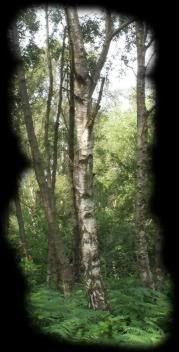
The first letter of the ogham is beith, represented by the lady of the woods (עצם), the birch tree (the tree corresponding to my personality type).
Beith astrologically corresponds to the archetypes of Yaakov, Beli Mawr, Torah leatid lavo, the hebrew letter dalet and dirah, and the elements of fire/air (like my chotimah).
Beith's proto-Indo-European root means "resin, gum", like that used to make incense blends [1]. Celtic myth teaches us that "in birch was the Ogham first written." [2]
Phonetically, beith corresponds to the "b" sound like the Hebrew letter beit ב. Hebrew beit, like beith of the Ogham in which all was first written, is the first letter in the first word (Bereshit בראשית) of Torah and that with which all was created.
Footnotes:
[1] for example, my kabbalistic name incense
[2] Calder, George (1917 (reprint 1995)). Auraicept na n-Éces: The Scholars' Primer. Edinburgh (reprint Dublin): John Grant (reprint Four Courts Press), pp.273-4.
Unity In Dirah Betachtonim
Technorati tags: Torah Talmud Torah Judaism Kabbalah jewish mysticism mysticism jewish meditation meditation shamanism jewish shamanism kabbalah iyunit kabbalah maasit jewitchery jewitch jewish woman sacred feminine divine feminine shechinah lilith spiritual development spirituality kosher spirituality ogham
Wednesday, December 13, 2006
Divine Feminine, Druidry & Chanukah
In follow up to my post on the Oak Of Asherah where I wrote:
The goddess archetype Asherah is associated with the oak tree ... Some of the meanings of the shoresh (root) אלה include: master, combine elements for control, G-d who combines all natural force ... the gematria of the physical oak tree אלון in reality is 87. This value is the gematria of Elohim אלהים plus 1 (im hakolel).
One could posit that the "oak tree" symbolizes the "place"where "complete unity of multiplicity" may be actualized in nature.This "feminine" actualization would be a powerful transcendental yet simultaneously immanent "feminine force" to be reckoned with, a unified field even - a unification of all physical forces of nature - on par with Havayah.
and also in follow up to my post about my dream this morning where I was initiated as Celtic-Jewish hybrid Druid priestess, I note two related ideas. First, chanukah is coming up later this week. With respect to both chanukah and the concept of "initiation", Dave @ Balashon writes on the etymology of the word chanukah חנוכה:
This article by Prof. Stefan Reif shows how the basic meaning of the root חנך is "to begin, initiate". He writes that the places where the verb חנך is used in regards to the Mishkan or Beit HaMikdash (Bamidbar 7:10, Divrei HaYamim II 7:5-9) a good translation would be "initation" or "starting upon their course of beneficial service". ...
Rashi on Bereshit 14:14 writes that "the word חנך signifies introducing a person or a thing, for the first time, to some particular occupation in which it is intended that he should remain".
Second, on the etymology of the word Druid:
Druid comes to English from Latin druides (pronounced /dru'i.des/), which is the same as the term used by Ancient Greek writers, the first to discuss the Celts: Δρυίδης[3] (Druides), associated by folk etymology with drus (δρύς, pronounced /drys/ meaning "oak tree") and -ides (-ιδης meaning "the son of" as per Aristides). The Latin and Greek terms trace via Proto-Celtic *druwid (also reconstructed as *druwis and *druwids) to the Proto-Indo-European roots *deru- and *weid-.
*deru-[1] is reconstructed as meaning "to be firm, solid, steadfast".
The defining "Druidic" characteristics of firm and steadfast were evident in another recent dream, Key To The Temple, and also discussed here, Binyamin & The Dark Feminine.
Taking all this together, we can see that all the ideas of:
- being initiated as a Celtic-Jewish Druid priestess
- unifying the Divine Feminine into a configuration on par with Havayah
- building the Mishkan and/or Beit HaMikdash
- Chanukah as a time of mystical initiation
Technorati tags: Torah Talmud Torah Judaism Kabbalah jewish mysticism mysticism jewish meditation meditation shamanism jewish shamanism kabbalah iyunit kabbalah maasit jewitchery jewitch jewish woman sacred feminine divine feminine shechinah lilith spiritual development spirituality kosher spirituality dreams druids keltoi druid priestess chanukah mystical initiation
Monday, October 23, 2006
Itta & The Secret Of Yayin
As I've written previously at Walking On Fire, the website:
We can understand ishah אשה to represent woman in a generic sense , a woman without name, a woman without a deep sense of her own personal story. In contradistinction to ishah, itta אתתא represents a woman with a deep unique true sense of her own personal story, a woman who has expressively claimed her deepest unique true identity and destiny - her unique name.
Itta is a woman who has awakened to essential personhood and writes in her own name. Thus, itta is a woman with a name, a unique name - this is the crown of a good name, a keter shem tov, the fourth crown. The four ketarim are represented by the four heads (of the letter shin) joined and brought together into the present world through itta, the holy four headed shin of the future world.
The presence of the light of the future world (represented by the four headed shin of Hashem) in the present world (represented by the three headed shin of Elokim) reflects actualized oneness of Elokim and Hashem, a oneness perceived beyond the eye and brought through the very center (תת) of itta's being into reality like a secret wine of awareness. Awakened awareness acts as a vehicle through which the primeval light of creation is channeled into existence. The primeval light of creation is the light hidden and revealed with and between the lines and letters of our Holy Torah. The sod of Torah is the inheritance of itta.
Yayin, the Hebrew word for wine has a gematria of 70, the same gematria as sod, the Hebrew word for secret. Yayin is a mysterious word of unknown etymology. It is a word found in both ancient Semitic and ancient Indo-European language families. Scholars [ref. How The Hebrew Language Grew, Edward Horowitz] tell us that this ancient word for wine, yayin, may have been borrowed by both ancient language families (Semitic and Indo-European) from a common now lost or unknown language. Thus, the secret of yayin is rooted in prehistory and is key to awareness and to understanding the inner essence of a primeval shared language - of a shared story brought out like an exodus of prehistory into history. This is the inheritance of itta, an inheritance redeemed and brought forth into being through rectification of the primeval feminine energy.
The light of awareness which shines from the darkness of prehistory is the "more" light and truth unsealed and opened toward expression which comes from the hidden Essence of G-d. The two letters tav in the center of itta "gives" release to expression of rectified primordial knowing into history. Thus, itta represents completion of the rectification of the tree of knowledge.
Technorati tags: Torah Talmud Torah Judaism Kabbalah jewish mysticism mysticism jewish meditation meditation kabbalah iyunit jewitchery jewitch jewish woman sacred feminine divine feminine shechinah lilith spiritual development spirituality kosher spirituality yayin sod hatorah evolution of woman
Argamannu, Bridging The Mind & Heart
Fred at On The Main Line writes regarding the etymology of the hebrew word for purple:
Talmudists or people who actually read Daniel (ch. 5:7) know that Hebrew argaman, ארגמן, purple, is Aramaic argavana, ארגוונא.
As I've written previously at Walking On Fire, the website:
Argaman is a hebrew word derived from the akkadian word argamannu meaning purple. Argamannu itself contains a synthesis of two sanskrit adjectives for red, (i.e., two kinds of red) ragamen and ragavan.
Woven together, these adjectives may directly derive from the PIE (proto-indo-european) ancestor to both semitic and indo-european language families, and represent the point of initial bifurcation and eventual reunification. Consequently, argaman (purple) represents the mystical link unifying the semitic (heart, blue) and indo-european (head, red) faculties, and within its history, is the secret of yayin, the rectification of da'at & the elevation of tiferet.
The difference between ragamen and ragavan is mem-vav, 46, and/or b/veit-mem, 42 (yocheved), bereshit bashalom, veshinantam levanecha vedibarta bam.
"By speaking in them (bam) from beginning (bereshit of the written torah) to end (bashalom of the oral torah), one reveals one's innate spark of moshiach." [R. Ginsburgh, The Hebrew Letters, on the letter beit, p. 42]
Technorati tags: Torah Talmud Torah Judaism argaman argamannu purple red ragamen ragavan hebrew sanskrit akkadian indoeuropean etymology
Wednesday, July 26, 2006
Lahat-Light / The Hod Connection
In brief follow-up to my previous post regarding deliverance from a burning house, it is interesting to note that the etymology of the word lahat להט (from Bereshit 3:24 which refers to the fiery ever-turning sword that guards the way to the Tree of Life) is also the root from which the English word light is derived [1]. The path by which we arrive at the word light is:
להט to old English leoht to middle English liht to modern English light. It makes more sense phonetically that the word "light" is originally and directly derived from this Hebrew root as opposed to the Indo-European root leuk as some authorities have suggested.
It is possible however, that the root להט (meaning to burn intensely) did indirectly evolve in parallel into leuk by way of acquiring the additional transformative etymon להק, which means to "gather together for (intense) study". Naturally, intense study transforms darkness into light [2], "lights up the mind", and brings illumination. This connection is supported also by the fact that the letter hey ה (in the center of להק) is the origin of the English vowel e [3], which can carry the short sound eh. Vowelized with a kubbutz (associated significantly with the feminine sefirah Hod [4]) under the ק, the pronunciation of the root להק would be leuk.
Given this association of the word light and the roots להט and להק with Hod, we can see that reconstructing light's pathway into existence via Hod may offer us insights pertaining to reconstructing Hod on a national level. Baruch Hashem.
Footnotes:
[1] The Word, Isaac Elchanan Mozeson
[2] אתהפכא חשוכא לנהורא, ithapcha chashocha lenehora
[3] Mysteries Of The Alphabet, R' Marc-Alain Ouaknin
[4] Meditation & Kabbalah, R' Aryeh Kaplan
JBlog Me
technorati tags: Torah kabbalah Hod temple defense system etymology archeography shorashim Hebrew ivrit Indo-European leoht liht light lahat kruvim cherubim etz chaim sacred feminine shechinah ithapcha chashocha lenehora
Subscribe to:
Posts (Atom)


 Posts
Posts


