
ב' באלול תשס"ז
Yesterday evening I prepared the incense with which to consecrate my Book of Shadows. The blend was made with the waxing crescent moon 9% full, begun during the planetary hour of Mars, and completed during the planetary hour of the Sun. גוד
Everything is in place to initiate my Book of Shadows into active use this shabbat, shabbat Shoftim.
Showing posts with label incense. Show all posts
Showing posts with label incense. Show all posts
Thursday, August 16, 2007
Prepared

Saturday, June 09, 2007
Let Them See
כ"ד בסיון תשס"ז
In follow-up to a previous entry, Dominion Over The Land, for the upcoming parashah (Korach), we read (Bamidbar 17:11) that Moshe stopped the plague using incense. Rashi (Shabbat 89a) comments:
When Moshe ascended to heaven to receive the Torah, each of the ministering angels, even the Angel of Death, taught him a secret. The Angel of Death's lesson was that the incense can check a plague.
The people had maligned the service of incense, saying that it had caused the deaths of Nadab and Avihu as well as Korach's followers. G-d said, therefore, "Let them see that the incense is not lethal. To the contrary, it will stop the plague; it is sin that is deadly" (Rashi to v. 13). [Reference: Artscroll Chumash]
With respect to my dream, chapter 17 continues (verses 12 and 13):
And Aaron took as Moses spoke, and ran into the midst of the assembly; and, behold, the plague was begun among the people; and he put on the incense, and made atonement for the people.
And he stood between the dead and the living; and the plague was stayed.
Technorati tags: Torah Talmud Torah Judaism Kabbalah jewish mysticism mysticism jewish meditation meditation shamanism kabbalah iyunit kabbalah maasit witchcraft jewitchery jewitch witch sacred feminine divine feminine shechinah lilith spiritual development spirituality kosher spirituality incense ketoret parsha korach
Thursday, April 05, 2007
The Eleven Incense Spices
י"ז בניסן תשס"ז
In response to my friend's request for more information on the eleven Temple incense spices, an excerpt (pages 85-86) from R' Aryeh Kaplan's Inner Space:
All evil comes from the universe of Tohu (chaos), which existed before the creation of the Partzufim (archetypal personas). It was at this stage, while the Sefirot (10 primary emanations of the Divine) existed as simple points, that the shattering of the vessels occurred. The purpose of the shattering was to allow free will to exist. Without a realm of evil it would be impossible to choose between good and evil.
In discussing the death of the Kings of Edom (the 7 Malchuyot-Kingdoms of the 7 "immanent" Sefirot), we pointed out that the shattering of the vessels began with the quasi Sefirah Da'at (knowledge). The first 3 Sefirot, Keter (Crown), Chochmah (Wisdom) and Binah (Understanding), did not shatter because they fulfilled their primary function to a certain extent. Because they were able to cooperate with each other in bringing the lower Sefirot to a stage of independent existence, they were merely reduced. The eight Sefirot from Da'at to Malchut, however, did not fulfill their primary functions. As a result, they were overwhelmed and shattered.
It is significant to note that this is the only time that eleven Sefirot are mentioned as constituting one unit. It is only in the universe of Tohu that Keter-Crown and Da'at-Knowledge are both present simultaneously. As we have explained, this leads to the paradoxical situation where God's knowledge of the future (Da'at) constrains His free will (Keter).
In order to rectify this and allow for the possibility of free choice, God must constrict and withdraw His Da'at-Knowledge from creation. This is accomplished by shattering the vessels from Da'at to Malchut. As a result of their descent into Beriyah (the universe of Creation), the possibility of evil, and hence free choice, is brought into existence.
In elucidating this point, the Ari (an esteemed Jewish kabbalist of history) identifies these eleven Sefirot of Tohu with the eleven incense spices of the Torah (Bible, Exodus 30:34). The incense consisted of ten spices or perfumes with good fragrances, and an eleventh spice, galbanum (chelbaneh, in Hebrew) with a vile odor. These spices were each ground separately and then blended together to be used in the Temple. Since these eleven spices (used in the Temple incense) parallel the eleven Sefirot of the universe of Tohu, they are therefore said to represent the complete rectification of evil. This is indicated by the addition of the eleventh spice, galbanum, which alludes to the elevation of evil back into the realm of the Holy.
The Talmud teaches that Moses was taught the mystery of the incense by the Angel of Death. It is for this reason that when a plague broke out among the Israelites in the wilderness Moses ordered Aaron to walk through the camp with the incense. This is the concept that the eleven incense perfumes have the power to overcome death and evil.
Following the idea of the ten fragrant spices and the single unpleasant one, the Talmud states: "every fast that does not include sinners of Israel (likewise any religious or spiritual community, for that matter) is not a fast." This is derived from the fact that the incense included galbanum. Just as galbanum was necessary to give the other spices exactly the right fragrance, a congregation is not complete without someone who has also fallen and who must reelevate him/herself through teshuvah (repentence, return to Holiness). In particular, when a difficult punishment has been decreed against Israel (or any religious-spiritual congregation) because of some evil deed, this very evil must be taken and elevated. Thus, the idea of transforming evil by elevating it back to its source in Holiness is intimated by the incense. It is for this reason that a (congregational ritual) fast must include "the sinners of Israel" (and likewise for any other biblically-based religious-spiritual congregation).
Saturday, March 24, 2007
Witch's Brew - "Goblet Of Peace"
ה' בניסן תשס"ז
Vayikra - "The peace-offering (shlamim) has the spiritual capacity of increasing peace in the world." [Rashi]
Tzav - On the "strange fire" of Nadav and Avihu, the role of being a "pure vessel" for peace is the role of Woman, not Man.
The following incense recipe brings together into the world of action a link to the supernal Goblet Of Fire (Eliyahu's Cup) as discussed in a previous post.
The Goblet of Fire corresponds to the "place" on the Tree of Life where Keter of Beriyah (water) and Tiferet of Atzilut (fire) are One. In other words, in Keter of Beriyah (which is Tiferet of Atzilut) peace is made between fire and water. Thus, the goblet of fire is exactly this place where peace is made in the heavens [1]. Importantly, we can also understand from this information that the Goblet of Fire is also the Goblet of Peace.
גבעי = 85 = 8 + 5 = 13 = "my goblet"
Brew ingredients by gender and elemental correspondences:
Masculine & Feminine Ingredient (1):
2 parts benzoin (m & f)* - air (avir)
Feminine Ingredients (4)
1 part vanilla (f) - water
1 part white sandalwood (f) - water
1 part myrrh (f) - water
1 part barley (f) - earth
Masculine Ingredients (4):
1 part pomegranate juice (m) - fire
1 part cinnamon (m) - fire
1 part nutmeg (m) - fire
1 part mugwort (m) - earth
Essential Oils (4):
1 drop hyssop (m) - fire
1 drop spikenard (f) - water
1 drop myrrh (f) - water
1 drop cinnamon bark (m) - fire
In this blend there are 9 (a vessel for peace ט) primary ingredients and 4 (Malchut ד) essential oils, for a total of 13 ingredients.
Benzoin is the ingredient where both fire (atzilut, feminine pillar) and water (beriyah, masculine pillar) combine in peace, resulting in elemental "air" (yetzirah and avir kadmon, the middle pillar as above, so below). The entire formula, written out and performed through actually making the incense is the "earth" (assiyah) where One Peacefully Dwells. Just like in the conclusion of the Amida.
Footnotes:
[1] He who makes peace in His heavens, may He make peace for us and for all Israel; and say, Amen. (Oseh Shalom, Conclusion of the Amida)
* Benzoin is a "masculine botanical" by virtue of its hexagonal aromatic ring and is a "feminine botanical" by virtue of its vanilla-like scent, where the hexagonal aromatic ring corresponds to the masculine partzuf zer anpin and where vanilla is etymologically derived from a Latin word meaning "vagina".
Technorati tags: Torah Talmud Torah Judaism Kabbalah jewish mysticism mysticism jewish meditation meditation shamanism jewish shamanism kabbalah iyunit kabbalah maasit witchcraft jewitchery jewitch witch jewish woman sacred feminine divine feminine shechinah lilith spiritual development spirituality kosher spirituality

Thursday, March 08, 2007
Peregrinating Among The Te'amim
י"ט באדר תשס"ז
Without the sense of smell, human beings can only distinguish five tastes: sweet, salty, sour, bitter, and savory. The single number "five" of physically discernable tastes corresponds to Binah, where all tastes are in complex unity. The forms which this "five" takes - sweet, salty, sour, bitter, and savory - correspond to categories of "taste expression" in Malchut.
If one looks at the shapes of the tropes (te'amim), it can be observed that there are five sets of shapes that comprise the structures of all the tropes:
point (dot-diamond)
single line (straight or 90 degree angled)
curved line
parallel lines (straight or curved)
circle (open and closed)
Smell and taste are chemical senses, and by some, are regarded as one sense. Nearly 80% of our ability to taste is due to our sense of smell. Without smell, as written above, we can only distinguish the basic five tastes and lack the ability to distinguish the over 10,000 different odor molecules which contribute to distinguishing the "nuances" of taste.
Olfaction (the sense of smell) is located in the parts of the brain which influence creativity, memory and emotions. Consequently, even through smell alone, burning incense can profoundly influence us in all these areas.
Technorati tags: Torah Talmud Torah Judaism Kabbalah jewish mysticism mysticism jewish meditation meditation shamanism jewish shamanism kabbalah iyunit kabbalah maasit jewitchery jewitch jewish woman sacred feminine divine feminine shechinah lilith spiritual development spirituality kosher spirituality
Monday, March 05, 2007
Unique Abramelin Blend
ט"ו באדר תשס"ז
The following unique blend is my modified version of both the biblical Holy anointing oil (Shemot 30:22-25) and an incense oil described by Abramelin the mage.
Liorah-Lleucu's experimental Abramelin recipe:
2 parts myrrh
1 part cinnamon
1 part clove
2 parts labdanum
7 parts olive oil
Cinnamon, clove and myrrh all function to augment, raise (in terms of making energy available) and lift spiritual vibrations. From experience, in my own spellwork, cinnamon when burned has certainly proven to pack a whollop. I'm ready to try it again. This time however, I am focusing that previously unfocused power toward recollection of preincarnate memories.
In contradistinction to the typical Abramelin/anointing recipes, I am substituting labdanum for cassia and clove for calamus.
Clove, like cassia, is cinnamon-like. Clove also functions to drive away hostile and negative vibrations.
Labdanum penetrates the deep mind to bring out subconscious and superconscious memory.
My experimental blend has been formulated to bring more fully my preincarnate memories into conscious awareness. I plan to make the incense on Wednesday, under the influence of the archetypes of Moshe and Rhiannon.
I'm currently working on a ritual to accompany using this incense. Likely, I will precede any use of my "Abramelin" incense by banishing negativity using the incense described in the previous entry.
Technorati tags: Torah Talmud Torah Judaism Kabbalah jewish mysticism mysticism jewish meditation meditation shamanism jewish shamanism kabbalah iyunit kabbalah maasit jewitchery jewitch jewish woman sacred feminine divine feminine shechinah lilith spiritual development spirituality kosher spirituality
Sunday, March 04, 2007
Incense Named "The Delight"
ט"ו באדר תשס"ז
My newest incense recipe to banish negativity is called "The Delight" השעשע.
2 parts frankincense (olibanum) שש
2 parts organic rosemary עע
1 part dragon's blood ה
The kabbalistic Hebrew letter correspondence for each ingredient is listed above and was abstracted from a standard table of correspondences, with the exception of rosemary. The Hebrew letter correspondence for rosemary was derived as follows:
Rosemary = כליל-הר
total gematria = 90 + 205 = 295
digit sum = 16
The 16th letter of the aleph-beit is ayin ע.
Shashua is the first level of revelation of the Essence of the Divine Aur Ein Sof. From the Inner Dimension:
The twice repeated syllable sha (shin ayin) represents in Kabbalah the number (370) of lights that radiate from the countenance of God. When they shine out of and then back into the consciousness of the Divine countenance a sha'ashuah, delight, is born.
I prepared my first batch of השעשע this evening, 15 Adar 5757, during the 6th night hour, under the "planetary" influence of the moon, which holds the keys to heaven and earth [1].
Footnote:
[1] Sefer Yetzirah, R' Aryeh Kaplan (p. 180)
Technorati tags: Torah Talmud Torah Judaism Kabbalah jewish mysticism mysticism jewish meditation meditation shamanism jewish shamanism kabbalah iyunit kabbalah maasit jewitchery jewitch jewish woman sacred feminine divine feminine shechinah lilith spiritual development spirituality kosher spirituality
Monday, February 26, 2007
Imperial Dragon

Today I came upon and acquired a few more essential oils for spellwork - among them are Dragon's Breath and Witch's Brew. On dragon symbolism, Mark Schumacher writes:
"In both Chinese and Japanese mythology, the dragon is closely associated with the watery realm, and in artwork is often surrounded by water or clouds. In myth, there are four dragon kings who rule over the four seas (which in the old Chinese conception limited the habitable earth). In China, a fifth category of dragon was added to these four, for a total of five dragon types:
Celestial Dragons who guard the mansions of the gods
Spiritual Dragons who rule wind & rain but can also cause flooding
Earth Dragons who cleanse the rivers & deepen the oceans
Treasure-Guarding Dragons who protect precious metals & stones
Imperial Dragons; dragons with five claws instead of the usual four"
After acquiring these oils, I looked up dragon mythology and symbolism. Interestingly, in my dream this morning, the ideas and symbols of guarding, ruling the wind (sailing), a deepening ocean and protecting were all present.
Of course, the five claws pertain to the letter hei ה, the letter of feminine expression, and the stone surviving to tell of it. Hebrew letters are also called "stones" in kabbalah. [1]
Footnote:
[1] The Hebrew Letters, R' Yitzchak Ginsburgh (p. 5)
Technorati tags: Torah Talmud Torah Judaism Kabbalah jewish mysticism mysticism jewish meditation meditation shamanism jewish shamanism kabbalah iyunit kabbalah maasit jewitchery witch jewitch jewish woman sacred feminine divine feminine shechinah lilith spiritual development spirituality kosher spirituality dragon
"In both Chinese and Japanese mythology, the dragon is closely associated with the watery realm, and in artwork is often surrounded by water or clouds. In myth, there are four dragon kings who rule over the four seas (which in the old Chinese conception limited the habitable earth). In China, a fifth category of dragon was added to these four, for a total of five dragon types:
Celestial Dragons who guard the mansions of the gods
Spiritual Dragons who rule wind & rain but can also cause flooding
Earth Dragons who cleanse the rivers & deepen the oceans
Treasure-Guarding Dragons who protect precious metals & stones
Imperial Dragons; dragons with five claws instead of the usual four"
After acquiring these oils, I looked up dragon mythology and symbolism. Interestingly, in my dream this morning, the ideas and symbols of guarding, ruling the wind (sailing), a deepening ocean and protecting were all present.
Of course, the five claws pertain to the letter hei ה, the letter of feminine expression, and the stone surviving to tell of it. Hebrew letters are also called "stones" in kabbalah. [1]
Footnote:
[1] The Hebrew Letters, R' Yitzchak Ginsburgh (p. 5)
Technorati tags: Torah Talmud Torah Judaism Kabbalah jewish mysticism mysticism jewish meditation meditation shamanism jewish shamanism kabbalah iyunit kabbalah maasit jewitchery witch jewitch jewish woman sacred feminine divine feminine shechinah lilith spiritual development spirituality kosher spirituality dragon
Saturday, February 17, 2007
Sam Chayyim
כ"ט בשבט תשס"ז
Catherine Yronwode, a hoodoo rootworker writes regarding reading signs in candle magick:
When we burn candles, we often watch and wait for divinatory signs that tell us how the work is going to come out -- that is, whether the spell will be a success or not. Some of the common signs we observe are so-called "coincidences" (especially names and subject matter that relate to those in the spell). We can also consult a system of divination, such as using a pendulum or a Jack Ball, reading or cutting playing cards or tarot cards, or employing Bibliomancy (divination by means of a book such as the Bible). Another easy way to get a divination on candle-burning spells is through ceromancy -- divination by wax. In this case, the wax we "read" is the wax of the candles themselves.
As I was making my kabbalistic name incense last night, I noticed a strange wax formation hanging off the side of my black shabbat candle (which had been dressed with essential lavender oil prior to lighting it). The candle had been burning for quite some time, and I hadn't noticed the figure form on the side of candle. My kavanah was focused on blending my name incense, and yet, at the perfect time, the candle flame caught my eye.
 The odd formation was the figure of a man who appeared to be "hanging on" (down and up the side of the candle) to get a glimpse of the flame [1]. The figure wasn't just dripping down the side - it was attached to the main portion of the candle wax via a small projection near the center of the body and had a "head and upper body portion" which was "gazing" at the flame. The attachment was shaped like - well, you know what - it also appeared to look like the death sickle in the hand (not raised, but lowered) of the grim reaper from another angle.
I considered knocking the wax off the body of the candle, as if it were a klipah. But, I decided to let it fall off gently as the candle continued burning. The figure seemed singlemindedly enchanted by the flame.
Later that evening, as I was removing (with a ritually dedicated utility knife) resin stuck to my pestle, I unintentionally scraped off a small bit of the pestle material itself. If you've ever worked with the thick resin of chelbenah, you can easily understand how this might stick to a pestle.
Reflecting upon all this, it's clear that the deep mind was operating here last night, given the figure of a man formed from the candle wax and the "brit milah" performed on my pestle last night. Truth is stranger than fiction could ever be. My name incense is truly an elixir of life everlasting.
Footnote:
[1] The candle I used was a black taper (not shown).
Technorati tags: Torah Talmud Torah Judaism Kabbalah jewish mysticism mysticism jewish meditation meditation shamanism jewish shamanism kabbalah iyunit kabbalah maasit jewitchery witch jewitch jewish woman sacred feminine divine feminine shechinah lilith spiritual development spirituality kosher spirituality prophecy nevuah brit milah
Wednesday, January 31, 2007
Kabbalistic Name Incense 1.1
י"ב בשבט תשס"ז
Here is an example of creating a kabbalistic incense blend corresponding to one's name in Hebrew. The following is a recipe for my names Liorah Chanah (לֵיאורהּ חנה ) and Lleucu (ללאכי), revised from a previous recipe as described here.
The new recipe is as follows:
5 parts chelbenah (galbanum) - 3 lameds, 2 alephs
2 parts daffodil (shin kokonoe) - 2 yods
2 parts dragon's blood - 2 heys
1 part storax (benzoin) - 1 vav
1 part saffron (כרכם karkom) - 1 kaf
1/2 part onycha (שחלת shechelet) - 1 chet
1/2 part labdanum (שחלת shechelet) - 1 chet
1/2 part olibanum (frankincense) - 1 resh
1/2 part cinnamon - 1 resh
1 part opononax (sweet myrrh) - 1 nun
9 drops olive oil
8 drops red wine
7 raisins
6 drop of honey or juice from a date
5 drops essential vanilla oil
1 drop Night Queen oil
The night of the Dark Moon, following preparation of the raisins as described in the procedure post, the onycha and labdanum will next be ground and mixed together into the 9 drops of olive oil, then set aside in a cauldron mortar.
To the midnight mortar, add and grind all 5 parts of the chelbenah (32 paths of wisdom, לללאא).
יהיה
Add 1 part shin kokonoe, grind together.
Add 1 part dragon's blood, grind together.
Add 1 part shin kokonoe, grind together.
Add 1 part dragon's blood, grind together.
כור
Add saffron, grind together.
Add benzoin (storax), grind together.
Add olibanum and cinnamon, grind together.
חן
Add opoponax to the onycha-labdanum-olive oil mixture previously set aside, grind together.
Add this mixture to the mixture in the mortar.
Add drops of red wine (used to soak raisins), mix. Add raisins, mix and grind. Add dates, mix and grind. Add drops of essential vanilla oil, mix. Add drop of Night Queen oil, mix.
Dry overnight and store in sealed vessel.
Technorati tags: Torah Talmud Torah Judaism Kabbalah jewish mysticism mysticism jewish meditation meditation shamanism jewish shamanism kabbalah iyunit kabbalah maasit jewitchery jewitch jewish woman sacred feminine divine feminine shechinah lilith spiritual development spirituality kosher spirituality
Aromatic Roots Deliciously Delightful
י"ב בשבט תשס"ז
In my previous post, I wrote the final 4 word phrase - ארץ-זית שמן ודבש - which ends Devarim 8:8, and translated the word זית as olive. This is the way the word is translated traditionally. However, the shoresh [1] of olive is זות, not זית.
Consequently, there is room to suggest that the word זית in this pasuk is not olive from the root זות meaning to "flow out slowly". I think the word in this pasuk is from the root זיו meaning "brighten" and "being bright and shiny". The word זית therefore, can be implying a "tree" (another meaning of זית)-root or botanical which "brightens". The Hebrew root of the tree-root which brightens is זיו.
Another root [2] that is bright and shiny is shechelet (onycha), an ingredient of the Temple incense. Incense is often mixed with oil - like the next word in the 4 word phrase following זית is oil, shemen (שמן). Controversy exists regarding the identity of onycha. While many believe onycha comes from the operculum of a shell fish from the Red Sea, there are equally as many who believe it is an oil derived from a plant. Thus, as easily as זית שמן could mean olive oil, it could also mean onycha oil.
The last word in the phrase derives from the root דבש which implies "delicious", "fat" or "thick" - these are all descriptors of Asher, the epitome of pleasure and happiness.
Taking all this together, we have here in the 4 word phrase a code for "a woman who brightens reality with onycha oil, making it deliciously delightful and thick with happiness and pleasure."
I imagine no one has ever heard those 4 words translated quite this way before, yes? I just love being a Jewitch. It makes me so happy.
HeBrew Cauldron
Footnotes:
[1] Etymological Dictionary Of Biblical Hebrew, R' Matityahu Clark (p. 66)
[2] Rashi believes that shechelet is "an aromatic root that is smooth and shiny like a fingernail" - Kjeld P. Nielsen, Incense in Ancient Israel (Leiden: E. J. Brill, 1986), 65
Technorati tags: Torah Talmud Torah Judaism Kabbalah jewish mysticism mysticism jewish meditation meditation shamanism jewish shamanism kabbalah iyunit kabbalah maasit jewitchery jewitch jewish woman sacred feminine divine feminine shechinah lilith spiritual development spirituality kosher spirituality tu b'shevat
Wednesday, January 24, 2007
Nataf - A Blend From Within
 ה' שבט ה'תשס"ז
Three substances in Torah allude to the entire 11-component blend of the Temple incense. They are nataf (storax, commonly known as benzoin), shechelet (onycha) and chelbenah (galbanum). Significantly, each one has a unique feature - making the Temple incense a blend of uniqueness, like my 3-name blend is unique to me. Nataf (נטף) flows from within [1]. Shechelet (שחלת) grows from the earth (malchut). Chelbenah (חלבנה) is seemingly evil (reflected in the 11 original components of tohu [2]), but in truth, is holy (reflected in the 16 rectified and elevated components of b'yad ramah).
Footnotes:
[1] Etymological Dictionary Of Biblical Hebrew, R' Matityahu Clark
[2] Inner Space, R' Aryeh Kaplan (p. 86)
Technorati tags: Torah Talmud Torah Judaism Kabbalah jewish mysticism mysticism jewish meditation meditation shamanism jewish shamanism kabbalah iyunit kabbalah maasit jewitchery jewitch jewish woman sacred feminine divine feminine shechinah lilith spiritual development spirituality kosher spirituality
3-Fold Circle Of Har Karkom
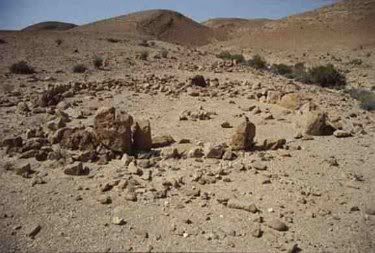
Circle Of Stones at Har Karkom
ה' שבט ה'תשס"ז
Saffron (karkom כרכם) is noted to be among the ingredients of a blend constituting my "3-name incense". Karkom is specifically a contribution of my name, Lleucu - where Lleucu is my circle (craft) name within the title Lleucu HaMasovevet.
Karkom is derived from the shoresh (root) כרך, which means "envelop" and "permeate" [1]. This fits well with and further supports the concept that Lleucu is a name which encircles, surrounds and envelops completely.
Har Karkom is also hypothesized to be Har Sinai, the site of the epiphany. Interestingly, there are several circles of stones associated with the "burned platforms" of site HK 301. As my 3-name incense will be burned over 3 consecutive full moon esbats, so too, are there 3 theophanies associated with matan Torah at Har Sinai:
The Lord came from Sinai and rose up from Seir to them; and shone forth from Mount Paran (Devarim 33:2).
Footnote:
[1] Etymological Dictionary Of Biblical Hebrew, R. Matityahu Clark
Technorati tags: Torah Talmud Torah Judaism Kabbalah jewish mysticism mysticism jewish meditation meditation shamanism jewish shamanism kabbalah iyunit kabbalah maasit jewitchery jewitch jewish woman sacred feminine divine feminine shechinah lilith spiritual development spirituality kosher spirituality
Chelbenah-Kapet & B'Yad Ramah
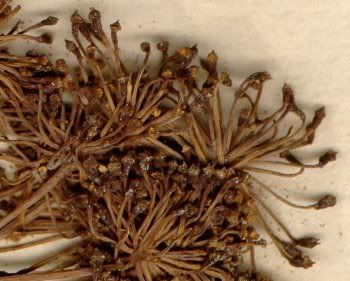
chelbenah-galbanum
ה' שבט ה'תשס"ז
During the same first Dark Moon on which I will prepare the first reversal candle as described earlier, I will ritually prepare my "name" incense. This is one recipe for my names Liorah Chanah (לֵיאורהּ חנה ) and Lleucu (ללאכי).
5 parts chelbenah (galbanum) - 3 lameds, 2 alephs
2 parts daffodil (shin kokonoe) - 2 yods
2 parts dragon's blood - 2 heys
1 part storax - 1 vav
1 part saffron (כרכם karkom) - 1 kaf
1 part onycha (labdanum, שחלת shechelet) - 1 chet
1/2 part olibanum (frankincense) - 1 resh
1/2 part cinnamon - 1 resh
1/2 part siamese benzoin - 1 nun
1/2 part opononax - 1 nun
9 drops olive oil
8 drops red wine
7 raisins
6 drops honey
5 drops vanilla oil
1 drop Night Queen oil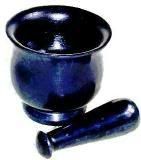
midnight mortar and pestle
One night preceding the Dark Moon, in an earthenware vessel, completely cover raisins with red wine and soak until the Dark Moon. Cover loosely while soaking.
To the sound of Native American drumming (on CD):
On the night of the Dark Moon, before midnight, add chelbenah to midnight mortar and grind into a nearly fine powder with pestle. Add the other resins and dry herbs or spices to the ground chelbenah and grind all into a fine powder.
Add drops of olive oil, mix. Add drops of red wine (used to soak raisins), mix. Add raisins, mix and grind. Add drops of honey, mix. Add drops of vanilla, mix. Add drop of Night Queen oil, mix.
Allow to dry loosely covered within the mortar overnight. The next afternoon as the sun sets, place the incense into a glass jar and seal until use (during reversal and protection ritual during full moon esbats).
~~~~~
There are 10 primary dry ingredients and 6 adorning moist ingredients in this unique chelbenah-kapet incense blend - for a total of 16 (ביד) unique components - which when burned, whose smoke will rise (רמה).
Mortar - A vessel in which substances are crushed or ground with a pestle.
עברית (Hebrew)
n. - מדוכה, מכתש, מרגמה
v. tr. - הפגיז (במרגמה)
v. intr. - הופגז במרגמות
n. - טיח, מלט
v. tr. - טייח
Pestle - A club-shaped hand tool for grinding and mixing substances in a mortar.
עברית (Hebrew)
n. - עלי
v. tr. - כתש בעלי
v. intr. - השתמש בעלי
Technorati tags: Torah Talmud Torah Judaism Kabbalah jewish mysticism mysticism jewish meditation meditation shamanism jewish shamanism kabbalah iyunit kabbalah maasit jewitchery jewitch jewish woman sacred feminine divine feminine shechinah lilith spiritual development spirituality kosher spirituality
Monday, January 08, 2007
Kabbalistic Mysteries Of The Incense 1
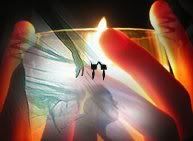
In a previous post describing a ritual I've written for Shabbat (on my Craftwork of A Hewitch blog), incorporating into it elements of witchcraft, the blessing over incense is:
Blessed is She, Mistress of the mysteries of spices and perfumes, the One over Death, and She who loves me.
Ritually, the smoke of incense represents the element of air. Unlike the other elements, in both Celtic witchcraft and Zohar (an ancient kabbalistic text of the Jewish mystical-magickal tradition), the element of air corresponds to the eastern quarter-watchtower. Among the kabbalistic sefirotic correspondences, the east likewise corresponds to the sefirah Tiferet located along the central (air) axis of the sefirotic array.
If we look at the 3-letter root TVL (תבל) for the Hebrew word for "spice", tevel (e.g., incense spices used during Temple service), we see a connection to both the transcendant feminine sefirah Binah (Understanding, the Higher Shechinah) operating above the 7 lower sefirot of normal consciousness and the most immanent feminine sefirah Malchut (Kingdom, the Lower Shechinah) operating within the domain of the 7 lower sefirot of normal consciousness.
From a Hebrew Lesson in the root T-V-L:
Then there is the fact that two distinct words use the three letters of our root ת-ב-ל (tav, vet, lamed). We have תבל (tevel, accent on the first syllable), a masculine noun meaning "spice," and תבל (tevel, accent on the second syllable), a feminine noun meaning "the world." The first meaning probably derives from an older, primary root, ב-ל-ל (bet, lamed, lamed), meaning "to mix." When you add spices to food you are creating a savory mixture; alternatively, many spices added to foods are in fact mixtures of different spices. As to the second use, the word (tevel), world, comes from the root י-ב-ל (yod, vet, lamed), to be fruitful, that also gives us the noun יבול(yevul), "produce."
Linguistically, first we can see that the feminine form of tevel pertaining to the "world" corresponds to Malchut (the Kingdom of the world - in other words, the physical world of action). Second, we can see that the primary root י-ב-ל of tevel is also the root of the word yovel, meaning (the) redemptive Jubilee (of the 50th year) . Sha'are Orah (Gates Of Light, R' Yosef Gikatilla) teaches us that yovel יובל corresponds to both the sefirah Binah and to redemptive mystical consciousness - in other words to Goddess/God-consciousness.
Thus, we can see that ritual incense "spices" (using the masculine emphasis) serves to connect the Higher Shechinah (Binah) with the Lower Shechinah (Malchut) through Tiferet, the sefirah "focused" in the east but which is kabbalistically symbolic of all 6 spacial directions in the physical world - north, south, east, west, up and down.
Taken together, the sefirotic correspondences are:
the elemental spices of the incense itself -> Malchut
the smoke - Tiferet
the smell of the incense as it burns - Binah
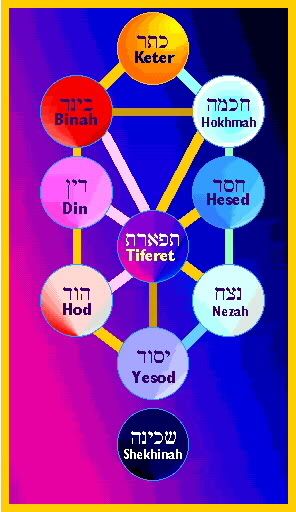
Note: Din is also called Gevurah and Shechinah is aclso called Malchut.
Technorati tags: Torah Talmud Torah Judaism Kabbalah jewish mysticism mysticism jewish meditation meditation shamanism jewish shamanism kabbalah iyunit kabbalah maasit jewitchery jewitch jewish woman sacred feminine divine feminine shechinah lilith spiritual development spirituality kosher spirituality yovel
Wednesday, January 03, 2007
Mashiach's Brew
In my previous entry I "engraved YaH", the letters of the tetragrammton pertaining the the higher unification of The Name and brought down how this higher unification was naturally evident in the Venus Transit. In follow-up to this idea, we note that the 11th of Shevat reveals the secret to the lower unification of VH (the secret of messianic consciousness) [1]. To raise up the lower unification into revelation, I've created a recipe for the following brew:
2 parts frankincense (olibanum) לבונה
1 part myrrh המור הטוב
1 part dragon's blood דם-תנין (spell in Hebrew?)
1 drop olive oil שמן-זית
1 drop vanilla וניל
1 drop red wine אודם יין
With the onset of the full moon which began this morning, through this month until rosh chodesh Shevat, I will be burning black candles rolled in the above brew I'll name Mashiach's Blend. What is the symbolism here?
First, frankincense in Hebrew (לבונה) clearly corresponds to the sefirah Binah בינה, the feminine Left Emanation, and also to the sefirah Malchut through the ASMaB expansion ben בן. Both correspondences are connected via the 2-letter root (sha'ar) BN, and its shorashim, BVN and BNH. Within these roots is the feminine power to perceive, build and bring down understanding to the level of action. Frankincense resin is white.
Second, regarding myrrh, through the Hebrew words המור הטוב comprising this botanical exists the power to transform and raise up the bitterness into The Good - in other words, into the ultimate good which is redemptive revelation of Torah. Myrhh resin is reddish-brown, like soil of the earth.
Dragon's Blood has been discussed previously, notably here and here. This botanical puts the power of rectified feminine expressive energy (mashpia) into the cauldron.
Olive oil anoints and infuses the ritual with the power of transcendent miraculous transformation. Vanilla represents a feminine organ of reception. And wine reveals the secret.
Initiated with the full moon, this small ritual is empowered to work toward complete accomplishment. As the moon wanes, bitterness is transformed and raised. With the dark moon comes the month of Shevat, an empty vessel, a pail. A watercarrier.
The Ba'al Shem Tov said that when one meets a water-carrier carrying pitchers full of water, it is a sign of blessing. On Shevat
Footnote:
[1] Studies In Ecstatic Kabbalah, Moshe Idel
Technorati tags: Torah Talmud Torah Judaism Kabbalah jewish mysticism mysticism jewish meditation meditation shamanism jewish shamanism kabbalah iyunit kabbalah maasit jewitchery jewitch jewish woman sacred feminine divine feminine shechinah lilith spiritual development spirituality kosher spirituality spellcraft
Saturday, December 16, 2006
In The Hands Of The Tongue
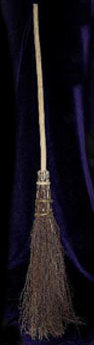 Death and life lie in the hands of the tongue ...
Shlomoh HaMelech, Mishlei 18:21
מות וחיים, ביד-לשון
A traditional witch's broom is called a besom. Like besomim (sweet-smelling havdalah spices), the besom concerns "cutting".
The word besomim בשׂמים is from the shoresh בשׂם meaning "cut up" [1]. Words are like thought-pieces cut from the stream of consciousness to communicate that contained within the inner stream to others or to oneself during the process of self-discovery. Words, like spices, can be sweet or foul smelling.
As spices are "cut" from plants like words are "cut" from thought, the besom "cuts" life from death. Like the havdalah spices specifically, the besom "separates" between realities. The havdalah besomim separate between sacred and profane realities. The besom separates between the realities of life and death. How do we know this?
In addition to the "cutting" connection of the besom with its phonetic Hebrew root, there is also a "cutting" connection within the mythology surrounding the witch's broom. In ancient Rome midwives used special brooms to "cut the ties between the world of the living and the realm of the dead after childbirth" [2]. Interestingly, this directly calls to mind within the mythic symbolism the proverb of Shlomoh HaMelech - death and life lie in the hands of the tongue.
The besom-broom even looks like a tongue (held in the hands). Besomim are the words which fill it. When we breathe the sweet-smelling havdalah spices, we are breathing in the essence of good words born of shabbat consciousness, which hopefully will find expression throughout the week. When a witch sweeps out negative energy from her sacred space with her besom, she is "cutting off" evil words before they are even conceived.
The witch's besom in a witch's hand is the "hand of the tongue" crafting a path of life and cutting off the path of death. Besomim are the essence and expression of words the tongue may speak.
Footnotes:
[1] Etymological Dictionary Of Biblical Hebrew, R' Matityahu Clark
[2] Solitary Witch, Silver Ravenwolf; and The Woman's Dictionary Of Symbols And Sacred Objects, B. Walker
Technorati tags: Torah Talmud Torah Judaism Kabbalah jewish mysticism mysticism jewish meditation meditation shamanism jewish shamanism kabbalah iyunit kabbalah maasit jewitchery jewitch jewish woman sacred feminine divine feminine shechinah lilith spiritual development spirituality kosher spirituality besom besomim
Tuesday, May 30, 2006
Holy Chaos
As mentioned in a previous entry, the "mother" letters (א, ה, ו, י) of the divine name Ehevi function as both vowels (nekudot, of Binah and the worlds of Beriyah1 and Tohu, specifically Olam HaNekudim) and consonants (otiot, of Malchut and the world of Assiyah1). Thus, in Ehevi (the origin of the divine feminine principle in Da'at), both "Leah" and "Rachel" (Imma - through Tevunah, and Nukvah, respectively) are re-unified; and woman speaks with her unique voice.
Importantly, achieving this "feminine" re-unification signals complete tikun of "the tree of knowledge" and elevation of "evil" (femininity and tohu2) back into the realm of the holy as taught regarding Moshe and the eleven incense spices3.
Moreover, proper preparation of these eleven incense spices leads to nevuah.4
Footnotes:
1 R. Aryeh Kaplan, Meditation & Kabbalah (p. 212)
2 The Ari identifies the 11 incense spices with the sefirot of the world of tohu, where both da'at and keter exist simultaneously, as opposed to the sefirotic situation as found in the world of tikun. See Eitz Chaim 9:2 (p. 120); 48:1 (p. 370); 49:3 (p. 383ff.)
3 Sha'ar HaKavanot, Drush Tefilat HaShachar p. 87ff.; cf. Eitz Chaim 49:8 (p. 390f.
4 R. Aryeh Kaplan, Inner Space; Cf. Exodus 30:30:35-36; Vayikra 10:1, 15:12; Bamidbar 17:4, see Ibn Ezra, Ramban on Vayikra 30:9
technorati tags: torah kabbalah chassidut chaos tikkun olam Judaism sacred feminine
Subscribe to:
Posts (Atom)


 Posts
Posts


