Showing posts with label metals. Show all posts

Tuesday, February 26, 2008

Living Kedushah

כ' באדר א' תשס"ח
Keolwulf 21

Another point related to today's Walking On Fire entry Roar Of The Lion, pertains to a second point of the article by Rabbi Ari Enkin posted by Gil Student at Hirhurim in the discussion on knotting tzitzit during the blackness of night and more:

Many Tzitzit professionals have the custom never to cut Tzitzit strings with scissors or any other metal object. Instead, any necessary cutting or shortening is done with one's teeth.[1] This idea of not using metal in the process of making Tzitzit mirrors the building of the Beit Hamikdash. We are told that it was forbidden to use any metal utensils when hewing the stones which were to be used in the construction of the Altar. As such, some suggest that the use of metal should be forbidden in the process of making Tzitzit as well.

This common denominator between the Altar and Tzitzit is their role in lengthening human life, [2] while metal is a material used in weaponry whose primary purpose is to shorten it. [3]

Back in January of 2007, I posted a kabbalistic perspective regarding the iron of a witch's athame as a holy tool of her sacred altar, writing:

The iron blade of a witch's athame upon her altar is a perfect symbol for the rectification of evil and its elevation back into the realm of kedushah (holiness, sacredness). In the Jewish tradition, this rectification and re-elevation is called tikun olam (repair of the world).

The iron of knives and swords have historically been used to shorten life, making them typically antithetical for use upon a sacred altar, whose purpose is to enhance and lengthen life. However, in the "future world" (in Hebrew "leatid lavo" לעתיד לבא, a code for the transcendent rectified feminine sefirah Binah and her parzufim), our Sages teach that the Temple will be built using iron. Normally, it is forbidden to use tools of iron to cut stones for the Temple altar.

Kabbalistically, iron, one of the seven metals [1] corresponding to the seven mystical attributes of the heart, corresponds to the attribute of Malchut, the element of the heart most "vulnerable to negativity and egocentricity". Malchut symbolizes the feminine Kingdom of the world of action and expression (see sefirotic array here). It also symbolizes the Indwelling Divine Feminine, the Shechinah.

Given the intimate connection of iron with the kedushah of the Holy Temple, we can understand then, that the status of iron (as being holy or not), rests in it's relationship to shortening or lengthening life.

My athame - Time Witchery.

Footnotes:

[1] Mishna Berura 11:61

[2] Shabbat 32b

[3] Shulchan Aruch Harav 11:24, Middot 3:4

Saturday, October 20, 2007

Give Ear

ח' בחשון תשס"ח

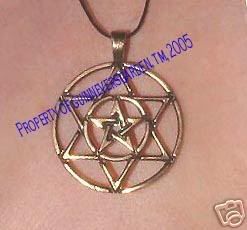
In follow-up to my previous entry introducing my new bronze Jewitch star, I note now that bronze is an alloy of copper and tin, typically 88% copper and 12% tin. Like my new star, the alloy from which it is made also represents a synthesis of Tohu and Tikun (greater than Tohu or Tikun alone).

Copper has an atomic number of 29. Tin has an atomic number of 50. The combined gematria of the major elements within bronze is 79 = Ha'azinu (האזינו meaning "give ear"). Jewish tradition teaches that parashah Ha'azinu contains the entire Torah. יהיה

Science (at Wiki :) further teaches us about the properties of bronze:

Bronze is superior to iron in nearly every application. Although bronze develops a patina, it does not oxidize beyond the surface. It is considerably less brittle than iron and has a lower casting temperature.

Iron has an atomic number of 26, the same gematria as the Divine Name YHVH יהוה .

From my musical website, see Tefilah Shel Yihyeh.

Saturday, August 25, 2007

Matron Who Brings Peace

י"א באלול תשס"ז

Although most of my maternal Celtic-European ancestry is English-British-Welsh (as well as Jewish), I also have some Celtic-Irish and Celtic-Germanic ancestries (as well as Native American) on my father's side. Consequently, as a witch with some Germanic heritage woven into the tapestry of who I am, it is quite legitimate for me to claim the Ertha archetype as one of my own, and I do hereby claim it.

Ertha is the "matron of witches and peace envoys". She also governs "fertility, the hearth, the home, domestic life, and the Wild Hunt." She is the Bringer of Peace and is "hostile to iron". Given Ertha's role as Peace-Bringer, it is not surprising that She is considered hostile to iron, a metal typically used to make war and shorten life. Iron's typical use as a metal of war-making is one reason why a witch doesn't typically put anything made of iron (other than her athame which never cuts anything physical or shortens life) on her altar. Ertha, the matron of witches and peace, is not "hostile" toward the iron of a witch's athame nor toward any other iron which prolongs life and brings peace.

Thus, not only is Ertha the matron of witches and peace, she is also the litmus test by which (internal and external) kavanah is judged as peaceful or warful. No warful intent gets past Ertha and into Sacred Spacetime. Only warful intent is ever cut and transformed by the iron of a witch's athame.

Saturday, February 17, 2007

Fifty Copper Hooks - A Witch's Understanding


witch's boline

ל' בשבט תשס"ז

In this week's Torah portion (Terumah), we are instructed to make "fifty hooks of copper" (קרסי נחשת חמשים) for the mishkan (Shemot 26:11).

In an earlier post, I mentioned that the witch's herb, mugwort, has copper in it. Interestingly, the word for copper in the phrase above from this week's Torah portion is נחשת - the same word used for a female enchantress. A witch.

Fifty (חמשים) pertains to Understanding, the feminine intelligence Binah.

The shoresh קרס means "curved hook" - like a witch's boline (curved utility knife) is a curved hook. Oddly, I saw this sickle-shaped hook in the wax of my shabbat candle last night as well.

Taking all this together, the phrase - קרסי נחשת חמשים - suggests that the "50 hooks of copper" in the mishkan are indeed referring to the "understanding of a witch" which "hooks" the truth.

Technorati tags:

Thursday, February 15, 2007

Techelet Portends Clarity

כ"ז בשבט תשס"ז

In my previous entry, I discussed copper and the diagnostic value of the deep blue color that can result from its reaction with ammonia, a constituent of healthy human urine. I further linked a deep blue diagnostic outcome to effectively clearing toxic waste from the body and to health.

Torah tells us to look at (investigate and seek to understand) the deep blue techelet thread and copper to remember and to be healed. Ok, we previously saw the connection of copper and deep blue to health, but what is the connection to memory and mental clarity?

One possibility - acute confusional states and delirium can be related to uremia. Uremia is a toxic condition caused by the buildup of nitrogen-bearing urinary waste products, including ammonia, in the blood. This occurs when the toxins cannot be cleared from the body and eliminated in the urine.

Thus, a deep blue color outcome of an ancient copper "medical assay" (suggesting adequate removal of urinary toxins) would portend mental clarity and remembrance. Likewise, absence of the deep blue color (suggesting inadequate removal of urinary toxins, and thus buildup in the blood) would portend confusion and forgetting.

Technorati tags:

P'Til Techelet & The Copper Snake

כ"ז בשבט תשס"ז

In an entry on Craftwork Of A Jewitch, I mentioned that mugwort, the witch's herb, contains copper. So, let's look at copper and the deep blue color threading through it.

If one takes a lowly copper penny and puts it into common household ammonia, it will turn a deep blue. Why? From Answers.com:

This first article discusses the Copper-Amine complex that forms during a reaction of copper and ammonia.

“When ammonia is dissolved in water, the interaction of the ammonia molecules with the water molecules results in the production of ammonium ions and hydroxide ions. One possible reaction for the copper(II) ions is the combination with the hydroxide ions to form a slightly soluble copper (II) hydroxide, which can be identified by the formation of a cloudy, pale blue precipitate.

Another possible product of a reaction of the copper (II) ions, perhaps less easily recognized from the reactants in this system, is the formation of a copper (II) ion ammonia complex, usually identified by a characteristic deep blue color.”

http://dwb.unl.edu/Chemistry/MicroScale/MScale33.html

“Copper(II) hydroxide (chemical formula Cu(OH)2) is the hydroxide salt of the metal copper, with atomic mass approximately 97.561 atomic mass units. The typical color of copper hydroxide is blue.”

http://en.wikipedia.org/wiki/Copper(II)_hydroxide

Interestingly, both techelet (deep blue) and copper are materials we are taught in Torah to look upon to remember and to be healed. In other words, there is a mystical thread of connection between the deep blue of techelet and copper which, if we deeply investigate the connection, will cause us to remember and to be healed.

Ammonia, involved in the reaction above which turns copper deep blue, is a toxic waste product of the body's metabolic/catabolic breakdown of amino acids and proteins. If our bodies cannot get rid of the ammonia, we are indeed very ill.

Thus, one possibility of the connection of copper to health - in ancient times, copper could have been used to diagnostically assay the urine for the presence of ammonia. If the copper in the "medical assay" turned sufficiently blue, the patient was clearing the waste products from the body in a healthy manner. If the copper failed to turn sufficiently blue, the person was not clearing ammonia and the toxin would remain to build up in the blood and tissues, eventually causing death.

Consequently, the deep blue was a good sign that the lethal toxins were exiting the body instead of remaining in it.

Kabbalah & The Copper Snake
P'til Techelet

Technorati tags:

Dare to be true to yourself.