
י' בטבת תש"ע
Grael 12
In follow-up to entries describing my two most recent dreams (One Name and Secrets of the Name), I note now an interesting continuity and connection between the two dreams.
In the first dream, the letter chet (ח), the first letter of the shem chai (חי), is brought into being. [Shem Chai means Living Name.] The fully reduced digit sum of the name Ner-Itta (נר-אתתא) is 8, the value of the letter chet.
In the second dream, the letter yud (י), the second letter of the shem chai (חי), is brought into being. I stood firm upon a mountain suspended in midair; this symbolism corresponds to the letter yud.
It all just flows - extraordinarily, naturally - through my dreams with a grace smoothly orchestrated within the depths of the Divine soul.
Saturday, December 26, 2009
Two Letters Of The Shem 'Chai'

Sunday, June 01, 2008
Protective 'Mistakes' Of The Tafsaret
כ'ז באייר תשס"ח
Mab 28
In follow-up to my previous entry (Video Vault On Fire At Universal Studios), I note that Reb Gutman Locks of Mystical Paths writes regarding mezuzot:
To understand, as least on a basic level, why it appears that G-d is smiting people because of their sofer’s mistakes, remember the principle “portion across from portion” (mida kenegid mida). Everything comes according to its measure and for a good reason. Certainly you know that there are no accidents in the world. We may not be able to always understand why any particular thing comes to us, but we do know that it all comes for a good reason.
Agreed.
When something happens to your hand, (seemingly good or bad), you have to ask, “Why did this come to my hand?” In order to be able to understand why that happened to you, remember that it had to come because of something that you did with your hand, not with your foot, or any other part of your body. Otherwise, what hope would there be of ever being able to guide your life? G-d runs the world by the principle of mida keneged mida for this very reason—so we will be able to understand the consequences of our actions. The consequences must reflect the actions.
Why did the man in our story choose that sofer (scribe)? Why did he get that particular mezuzah? All this came for a reason. To lose sight of this is to believe in a random, chaotic world with haphazard results flying down upon our heads.
Agreed.
As far as “magically” changing the mezuzahs, remember the story of Elisha, Master of Wings (Shabbos 49a)? He was caught by the Romans wearing his tefillin when there was a life threatening ban against wearing them. He quickly took off the head piece of his tefillin and tried to conceal it in his cupped hands. When the Roman soldier, threatening his life, asked him what was in his hands, he said that it was a dove. The soldier forced him to open his hands, and sure enough there was a live dove there. Did G-d magically change his tefillin into a living bird? Surely He changed it into the bird, but not with magic.
Clearly, disagreed.
From older entries on the tafsaret:
With a gematria of 358, tafsaret (טפסרט) is a rare type of sofer; tafsaret is a feminine scribal artisan described by a Hebrew word of Sumerian roots. From the language of ancient Sumer [1], sar means "write". Taf means "board". The Hebrew verb root סרט carries the meanings of "script", "a tool for designing" and "marking" [2].
The letters of tafsaret contain the root (ספר) of the word sofer (scribe סופר). Yet tafsaret also contains two letters ט in addition to the root letters of ha-sofer. These two letters ט have a combined gematria of 18 (חי) - thereby bestowing "life" into the scribal writing of tafsaret. Specifically, the two additional letters of חי represent the chayah and yechidah soul levels which pertain to actualizing messianic consciousness.
Footnotes:
[1] How The Hebrew Language Grew, Edward Horowitz
[2] Maskilon 1, Hebrew-English Dictionary based on Verb Roots, Abraham Solomonick and David Morrison
Friday, September 21, 2007
Two Goats, Nogeáh V'eino Nogeáh
ט' בתשרי תשס"ח
In follow-up to my previous entry (Mind On The Mountaintop) for Erev Yom Kippur, I noted in the comments to that entry my dream from a day or two earlier:
I had a dream. I accidentally drove over a cliff on a curving mountain road. It wasn't a scary dream. I was very objective through it and thought "I'm not going survive this." So, I said the Shema in the dream. Then I woke up. I had been driving down the mountain from the top.
Michael Berg, of the infamous Kabbalah Centre, writes about A Great Secret Of Yom Kippur:
There is a first part of the reading. It speaks about the death of Nadav and Avihu, the two children of Aaron. Why do we read about the death of the two children of Aaron on Yom Kippur? We know there are no coincidences. There is a reason this story precedes the discussion of the process of Yom Kippur.
Rabbi Berg goes on to write:
We also know today is the death anniversary of Rabbi Akiva, the death anniversary of Rav Ashlag. All those three are not a coincidence.
How do we understand that and how do we put it together? It says that when Rabbi Akiva was about to leave this world, it was a time when the Romans ruled the land of Israel. They did not want Rabbi Akiva to continue to teach, but he did, and was captured by the Romans.
The story is the Romans took combs of steel and were scraping his skin from his body to make his death what they thought was the most torturous possible.
As this process was happening, Rabbi Akiva began to say the Sh’ma. As he was beginning the process of leaving this world, his students said, don’t continue the prayer. Because they knew if he completed the prayer he would leave this world.
Rabbi Akiva said, all my life I have been waiting and worried about this verse, which speaks about giving over ourselves completely. When will I be able to completely do this process? Now I have the opportunity. How can I give it up?
Rabbi Akiva ended the Sh’ma and, as he said the word echad, his soul left.
So why did I wake up after saying the Shema in my dream? ס
The kabbalists teach a very interesting concept, that every action we do of sharing, of connection, is an action that has within it the power to achieve complete dvchut, complete union with the Light of the Creator. Not only that, the truly righteous, the true kabbalists, did that. When they came to the morning connection, they would put all of their life force into that connection. So how did they stay alive after the prayer?
The kabbalists teach that within the action itself is Light that returns the soul to the body. Because it’s a day to talk about truly high concepts, the true kabbalists completely gave themselves over in every connection that they made. They made that union, that dvchut, in every action of connection. Their entire being, their entire soul, went into that action.
The only reason their soul came back to their body is because the Light shines back to them. This is a battle for true righteous people to hold themselves back and keep their soul in their body. When they made that connection to the Light within the action, their soul wanted to connect completely. For a kabbalist, a truly righteous person, the physical body limits their ability to connect to the Light. They never want to return to their body after they make a connection, but the Creator says, you still have a job to do in your body.
As I wrote when describing my story in the comments over at DovBear:
This story isn't over yet.
It has newly begun. Walking On Fire is a living witness to that which began over a decade ago, and to the brilliantly transformative power singularly tied to the higher service (mesirut nefesh) of the goat for Azazel - אתהפכא חשוכא לנהורא.
The two goats are One on the mountain of paradox, walking the earth yet hovering the summit, touching yet not touching. חי
My vision of the Mountain of Paradox, like a visionary brit milah, occurred on the eighth day of Tishrei. I wrote of and elucidated it on the ninth day of Tishrei. I woke up from my dream, so I imagine that unlike Rabbi Akiva at the hands of the Romans centuries ago, I will awaken still among the living tomorrow on the tenth day of Tishrei as well. חי
Saturday, September 15, 2007
Wrestling With Ruach Hashem
ג' בתשרי תשס"ח
In my entry Wrestling, Redeeming & Sanctifying Truth, I wrote of a mist which arose to seed the universe:
Simultaneous with the arising of the wrestling primal goddesses, I saw that the entire atmosphere became chock (חוק) full of dandelions releasing their seeds - so many that they looked like a whitish mist made of dandelion seeds being cast out from the place into the universe at large.
In addition to the dandelion symbolism I discussed in the linked post, the symbolism of the mist is significant.
In my vision, the mist arose from and hovered over the face of the waters where the primal goddesses wrestled toward unification.
"... and ruach Elohim hovered over the face of the waters." Bereshit 1:2
Jewish kabbalah teaches that this hovering ruach Elohim of Bereshit 1:2 is none other than the soul of messianic consciousness.
Mist in Hebrew is אד. A gathering of water (like a cauldron-pond) corresponds to the Hebrew letter mem ם. Together, the mist and the cauldron-pond form the word אדם (adam, in terms of mankind), a code for the 3 archetypal souls of mankind - Adam, David and Mashiach.
As discussed in previous entries, the two primal goddesses in my vision were wrestling in the cauldron-pond to bring forth a unified messianic consciousness. The mist of ruach Elohim hovered over them. The two primal goddesses in the cauldron-pond represent ruach Hashem wrestling toward unification of the Essential Divine Name and its expression into unified messianic consciousness.
Ezer knegdo phrases based on Bereshit 2:6.
"... there arose a mist from the earth, and watered the whole face of the ground."
"... there arose a mist from the waters, and seeded the whole face of the air" (see avir kadmon and it's relationship to mem/waters).
Ruach Hashem & The Birth Of An Anointing Prophet
Interestingly, the (ה) feminine vision of ruach Hashem (זה נבואה) occurred on second day of Rosh Hashanah of the year 5768 (see link for elucidation). The brit milah of Shmu'el ben Chanah occurred in a dream this morning, the shabbat immediately following Rosh Hashanah. Chanah is one of my Hebrew names and the birth and dedication of the prophet Shmu'el is in the haftarah for the first day of Rosh Hashanah.
Monday, May 22, 2006
Orach Shem Chai
Darkness (choshech, חשך, the dark light of peace, the ש of שלום) was born from the separation of some original unified light (veha-aretz hay'tah, והארץ היתה) into the lights of tohu (תהו) and bohu (בהו), which are chaos and uncertainty1, respectively. Reunification of rectified choshech, tohu and bohu brings into existence the lights (ben Yosef and ben David) of moshiach known as the brightness (reunified tohu va-bohu, tehiru tata'ah) and the brilliance (reunified brightness ve-choshech, tehiru ela'ah).
Tohu, from the root תהה is a reaction to uncertainty (bohu, where bohu is from the root בהה); the result of that reaction creates darkness in awareness. The original unified light (veha-aretz hay'tah) is a forward projection (hay'tah1 from the root יתא) of one inmost essential (ateret hayesod, ט) element of ha-aretz (stable elements of existence1, from the root ארץ); where this essential element focuses the blessings of life & peace reunified into certain existence, malchut.
Let there be light. And there was light. This light is the singular light of moshiach and peace, forth-spoken into unified existence by G-d. It is the rectified and reunified lights of tohu and bohu and of darkness, made one.
Immediately following the creation of darkness (the protective element), the spirit of moshiach hovered over the face of the deep (Bereshit 1:2). Written into existence with words of Torah, the light of redemption was sent and brought forth into Active Presence. And G-d saw that the light was good. On the very first day, even before the fall of Adam and Chavah, the light of redemption was sent forth.
On the fourth day (Bereshit 1:14), the two great luminaries (meorot) were made for signs, l'otot (לאתת). In hebrew, the word l'otot is spelled without the letter ו, as the word is normally spelled (לאתות and/or לאותות, see here on the two vavim). This ו is the ו of completion, redemption and transformation. This ו is also the herald of redemption, and the same ו found in the name of Eliyahu HaNavi. Thus, on the fourth day, the guarantor of redemption was sent forth by G-d into existence, also prior to the fall of Adam and Chavah.
So, we can see, that Adam and Chavah, represented by the sun and the moon, had to fall - and the moon had to diminish herself (center in malchut as opposed to yesod) - she had a ו to catch and split for her husband (Midrash Chaseiros), creating a returning path (orach) into the Divine, turning history and transforming shiflut into geut.
protected by darkness (Tehilim 18:12, Bereshit 1:2) ...
והארץ היתה תהו ובהו וחשך
footnote:
1 Etymological Dictionary Of Biblical Hebrew, R. Matityahu Clark
technorati tags: Torah kabbalah Judaism bereshit
The Critical Mass
1 woman in 10,000: one myriad among myriads ...
a woman of sense, who has found her ...
שמע ישראל ה׳ אלהינו ה׳ אחד
ברוך שם כבוד מלכותו לעולם ועד
Kohelet 7:27 Behold, this have I found, saith Kohelet, adding one thing to another, to find out the account; 28 which yet my soul sought, but I found not; one man among a thousand have I found; but a woman among all those have I not found. 29 Behold, this only have I found, that God made man upright; חש בנות רבים.
Kohelet 7:27-29 speaks of finding one man in a thousand (pasuk 27), and points out that one woman in a thousand has not been found (pasuk 28). That may be because a woman is found in 10,000 (pasuk 29). The secret key to these 3 pesukim is contained in the malchuto blessing following kriat shema, and represents perfect unity in the world of multiplicity.
שמע ישראל ה׳ אלהינו ה׳ אחד (unity in unity: shema)
ברוך שם כבוד מלכותו לעולם ועד (unity in multiplicity: malchuto)
Note pasuk 29. The final word (רבים) of the entire perek in pasuk 29 is the plural of רב, which is a woman (רב, one myriad) among myriads (רבים) as told in the dvar Torah on reishit Bereshit 1:1 entitled Shem Chai. Interestingly, the perek is 7 (zayin ז, representing the woman of valor) and the pasuk is 29 (the final yesodic "collecting and focusing" step into 30 and the letter ל lamed, representing malchut). The combined gematria of the perek (7) and the pasuk (29) is 36; a לו nistarah. Consequently, we can see that this perek of Kohelet hides in its final pasuk a tzedeket nistarah, emerging just in time for Purim.
The final 3 words of pasuk 29 which are usually translated "but they have sought out many inventions" (חשב נות רבים), can be permutated by moving the letter beit into חש בנות רבים, which translates as "sense (חש), the daughters (בנות) of ravim (רבים)".
My primordial experience of rav (רב) is one of the ravim (רבים) of Kohelet 7:29. In physical existence, I am the daughter (malchut) of this "rav" (keter) experience. In other words, I am "one myriad" (רב) among myriads (רבים), a living example of the blessing given to daughters of the patriarchs and matriarchs.
Examining the final 3 words of pasuk 29, we see:
Chash is a 2-letter root (a gate and a deeper root, according to Sefer Yetzirah), from which are derived many meanings and 3-letter roots. In addition to its traditionally understood meaning of "silence", חש can also mean "aches" and "sense" [1]. It is also the 2-letter root of both the primordial snake, the nachash (נחש), and darkness, choshech (חושך).
"Aches" refer to the birthpangs of (one's spark of) mashiach and represent healing at the soul level of chayah, in preparation for an experience of yechidah and unity with one's true predestined bashert. Yechidah is the soul level of Adam Kadmon, the common root of all souls of Yisrael, and the inner spark of mashiach of individuals.
The "sense" meaning pertains to finding a woman of sense, a true woman of valor (eshet chayil) in malchut, whose 5 dinim have been reconstructed into 5 strengths. The "sense" is silent in that it moves silently from the essence of a woman to permeate everything she perceives and does. In other words, the Divine Will from the sefirah keter permeates malchut of malchut. In a woman of sense, malchut and keter are in perfect unity, together in harmony with all the sefirot.
ברוך שם כבוד מלכותו לעולם ועד
As the 2-letter root of both the primordial snake/nachash (נחש) and darkness/choshech (חושך), in terms of a woman through whom the Divine Will flows, חש represents and is key to tikun of the snake energy and to transforming darkness to light, ithapcha chashocha lenehora. Torah teaches us that if "someone says I have toiled and I have found, s/he may be believed." It is within the power of every neshamah to find one's own inner spark of mashiach. I have found mine, through my shem chai. ב"ה
בנות Benot (daughters) pertains to kedushah, holiness. From the root בנה, meaning to build or endow, Torah tells benot Torah to build and endow with kedushah, and to separate from immorality. Tzenuit is a defining method of attaining and maintaining holiness.
בנות is a feminine plural form corresponding to malchut. This form is used to construct the the plural of בת (daughter, singular) as opposed to בתות. In the singular word for daughter, the letter nun (נ) has fallen out of ben (בן), a generic word for child [1] and the common 2-letter root for both son and daughter. This suggests that "bat" refers to a woman whose identity exists only within the context of a group of women, namely, benot. In other words, a daughter (in the form בת) has yet to unfold her uniqueness as an individual (בן) in malchut.
The letter tav (ת) of bat seals the blessing (ב) of sitre Torah [2] native to the holy feminine core; remaining sealed until the time she stumbles over her true bashert. Only a woman's true bashert has the power to remove the spiritual seal and raise the letter nun, making her a ben-Torah (a child of Torah) able to actualize her own unique identity in kedushah, separated out from among a generic group of women. Only separated out in kedushah like this can the wonders beyond [3] be unleashed. Ramchal tells us "what is too wondrous beyond you, do not seek" - now we can understand why - only one is fit to unleash the wonders beyond; becoming unleashed as one stumbles over his or her true bashert. No one can understand The Law unless one has stumbled over it [4].
Ben commonly refers to son, yet as written above, it can also refer to a child of any gender, similarly to bar (בר), another word for son/child [1]. Retention of the letter nun (נ) by benot suggests an evolution of feminine consciousness on par with masculine consciousness, where the fallen nun has been elevated back into the realm of holiness. It also suggests equal measures of feminine and masculine energies, where both a son and a daughter are known by the construct ben. Given this evolution, it is further evident that the word benot reflects rectified multiplicity (ben-ot) of malchut in paradoxical harmony with the unity of binah (benot).
שמע ישראל ה׳ אלהינו ה׳ אחד
Benot has a gematria of 458, the value of mashiach/shem chai (358) plus 100 (ק of kedushah). From this we can see that benot refers to the feminine core of the collective mashiach in kedushah, and to the individual spark of mashiach (shem chai) raised to this feminine core of kedushah. Clearly, the power to receive (malchut) and endow (binah) the Torah of Mashiach rests within the holy feminine core.
In contra-distinction to benot with a gematria of 458 (ק more than mashiach), a messenger (shliach, שליה) of mashiach has a gematria of 348, 10 (י) less than the gematria of mashiach (358). The missing value of yod (י) in shliach suggests that the shliach is yet poised (through harnassing 10 faculties of the soul) to stumble over his/her true bashert; as one's true bashert is the only one with the power to unlock and bring forth one's shem chai.
An unlocked shem chai suggests that the 10 faculties of the shliach's soul have been successfully harnassed. These 10 faculties are then multiplied by the 10 kingdoms (feminine malchutot of all the sefirot), thereby catalyzing actualization of all the soul powers in complete unity of multiplicity (ק). As G-d originally intended, Adam then becomes raised to the level of the collective mashiach in kedushah (458). No angels need apply.
רבים Rav (רב) means [1] many, myriad, vast, mighty, great, poly-, multi- rabbi, and dispute. Ravim (רבים) means myriad myriads. Rav/ravim reflects the sign (אות) of brit milah given to the children of Avraham universally (רבים), and to the children of Yisrael specifically (רב) in covenant through the additional sign of (שבת) shabbat. To reiterate, I am "one myriad" (רב) among myriads (רבים), a living example of the blessing given to daughters of the patriarchs and matriarchs.
Taking all this together, the final 3 words of Kohelet 7:29 hint to the critical mass of consciousness required to reveal the Light of Mashiach and to bring redemption to the world. חש בנות רבים. It takes 1 and 10,000, a myriad myriads.
[1] New Bantam-Megiddo Hebrew-English Dictionary
[2] Talmud Chagiga 13a
[3] Ramchal, Daas Tevunos, section 34
[4] Talmud Gitin 43a
technorati tags: Torah kabbalah Judaism talmud torah jewish women women jewish jewish mysticism gematria bashert
Friday, February 03, 2006
Shem Chai
ראשיתב
ראא
להימא
תה
שמימו
אתה
ארצו
secret of Bereshit 1:1
The Messianic Spark. The root of the Jewish soul is without blemish [Shir HaShirim 4:7]. כלך יפה רעיתי ומום אין
This is the messianic spark in every Jewish soul, in my soul, as it journeys into life. And this is my story. Ba'aish atah atid livnoto.
RaV Without Blemish. The first letter of written Torah is normally the letter beit. However, if this first beit falls (naphal) backs one space in the samech-cycle of Torah and becomes the last letter in sefer Devarim, the first letter of sefer Bereshit becomes reish, restoring clarity. With clarity restored, through the samekh of the cycle, the power of the birchat kohanim and the power of semichah are also restored, clearly without blemish (מום). For באיש, with fire is it built [Bava Kama 60b].
The beit that falls is rooted in ben, where ben represents the malchut of the ASMaB expansion of the tetragrammaton. Having fallen, the new last letter of Devarim becomes beit. Together, the two letters - the new first letter of Bereshit (ר) and the new last letter of Devarim (ב), reading from Bereshit to Devarim (seder Chesed) spell the word RaV (רב) - and with this, I have made myself a RaV [Avot 1:16]. Even better than that, I have made a RaV without blemish.
RaV is the ezer knegdo to LeV (לב). LeV is how we normally read the first and last letters of Torah (from Devarim to Bereshit, seder Gevurah) in the normal configuration. Now, we can see that the when the beit falls, haLeV of Torah is raised to RaV, and RaV is raised as an ezer knegdo to LeV. As the reish is raised to first place, so too is every letter in Torah raised one space, making reishit Bereshit 1:1 read:
ראשיתב the first became beit
ראא experiencing
להימא clearly
תה without bound,
שמימו contracting and
אתה coming together
ארצו stably
The Bird's Nest. This new configuration of Bereshit 1:1 describes my experience crossing the churning river of fire into existent consciousness. The initial experience of existent consciousness is called the bird's nest. The churning river of fire (nahar dinur) is also the shabbat river, the sambatyon.
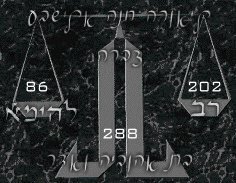
Redemptive Chesed. RaV (of seder Chesed) has a gematria of 202. Following the fall of the beit, through raising the letters of the Torah up one space, 202 sparks of holiness are also raised from the galut of mitzrayim. Tradition teaches us that each soul is born with a mission to redeem 288 fallen sparks of holiness entangled in and exiled throughout creation. Of these 288 sparks, 202 of them are specifically associated with the exile of mitzrayim. Thus, within the first flicker of my soul's experience in creation, is the redemptive power to raise these sparks.
Redemptive Gevurah. Having raised 202 sparks, 86 remain. Eighty-six is the gematria of Elo-him, Hashem's Name associated with creation, the sefirah Gevurah, the power to support and raise the fallen, and strict judgment. In the new RaV configuration of Bereshit 1:1 as written above, the Name Elo-him is transformed into the Name להימא . This Name also has a gematria of 86. Consequently, we can see that through this Name, להימא , the remaining 86 sparks scattered throughout creation are raised and redeemed. להימא is Holy Gevurah of Atzilut.
Tikun HaTohu. Elo-him אל-הים is from the 3-letter root הים meaning agitate or creating confusion. Confusion and agitation are created by the mem sofit, which represents hidden wisdom. When wisdom is hidden from and access is closed to the mind, the mind lacks clarity. להימא opens up the mem and channels wisdom and clarity into the mind. This is the tikun of Elo-him in the world of Tohu, from which all the lower worlds (Beriyah, Yetzirah and Assiyah) are derived.
Tikun HaBrit. Now, through להימא, the world of Tikun itself can be rectified and prepared to receive the great light of Tohu. Eighty-six is the gematria of the word וימל meaning "and he circumcised" [Bereshit 17:23]. This is the tikun of Elo-him in Beriyah.
Tikun HaAf. Eighty-six is also the gematria of האף meaning "surely" [Bereshit 18:13], for surely have I remembered, and surely Sarah laughs with the Name להימא. Surely remembering and laughing at the absurdity of it all, anger, אף [Shemot 4:14] is transformed into a measure of remembrance equal to all the mitzvot of the Torah. This is the tikun of Elo-him in Yetzirah, the world of the letter vav.
Tikun HaChemah, Sh'lim. With Elo-him and the world of Yetzirah rectified, the broken vav of shalom is restored to wholeness. Through restoration of vav, wrath חמה is transformed into a protecting wall, חומה.
Tikun HaShechinah, Tashuv Hey. The digit sum of all the letters constituting the newly configured Bereshit 1:1 is 5. Five is the value of the letter hey, representing the power of expression and complete teshuvah. This is the tikun of Elo-him in Assiyah and sweetens the 5 judgments in Malchut at their root. hamtakat hadinim beshorsham
Shem Chai. Each person has a spark of Mashiach, one's living name, one's shem chai שם חי. With the 4 letters of shem chai and the following 4 expressions, the 4th side of the letter beit is closed, restoring the power of redemption to wholeness in all 4 worlds, and drawing it down into all existence.
מ This is my name, ליאורה חנה אלישבע צברה בת אהוביה ואדר
ש this is my remembrance, ראשיתב ראא להימא תה שמימו אתה ארצו
י this is my hallel, רב
ח and this is my decree, להימא
making a vessel fit for (my spark of) Mashiach.
technorati tags: Torah kabbalah Judaism talmud torah soul prenatal oath jewish jewish mysticism baal teshuvah


 Posts
Posts


