
כ׳ בכסלו תשע"א
Shamash 23
Myfanwy pronunciation: Listen and hear how to pronounce my Noble Name "Myfanwy" in Welsh forvo.com/word/myfanwy/ .
Showing posts with label welsh words. Show all posts
Showing posts with label welsh words. Show all posts
Saturday, November 27, 2010
How to Pronounce Myfanwy in Welsh

Sunday, June 21, 2009
Leying The Entire Array Of Sacred Knowledge
כ"ט בסיון תשס"ט
Mab 29
Yesterday's (Leying The Land) Midsummer's Eve magical Ogham (Coll), drawn during the planetary hour of Mars (ג), is followed today on Midsummer's Day, drawn just now also during the planetary hour of Mars, by the magical Ogham, Koad (pronounced kawt). The letter Koad represents not one tree, but an entire Sacred Grove - an entire array of esoteric Hidden Knowledge: Koad, representing the Sacred Grove:
represents all knowledge, a sacred place where all is linked and becomes clear in togetherness and unity - just as the old Groves contained tree sense and bound their users together in a common purpose ... the Grove gathers together for your journey all the knowledge hidden in the trees. It holds comprehension of all that you already know or are capable of learning.
What beautiful magic are the Oghams bringing forth for this summer solstice sabbat!
The names of Koad:
Koad (Breton)
Coill, Garrán (Irish)
Coedwigoedd, Coedwig (Welsh)
Cus (pronounced kawz), Cos, Kelly (Cornish)
The color of Koad:
shades of green
The 'planet' of Koad:
the Sun
Saturday, June 20, 2009
Leying The Land
כ"ח בסיון תשס"ט
Mab 28
Today I initiated my newest card deck consisting of Ogham letters, the Celtic Tree Oracle.
Just now, during the planetary hour of Mars (ג), I opened my new deck, shuffled the cards of magical Ogham letters, and drew out one card - drawing forth with it, the initiatory energy which shall characterize this deck. The card holds the letter Coll, corresponding to the Hazel tree, mediation, measurement and calculation. In Celtic mysticism, Hazel/Coll is associated with the Druids, who:
are inheritors of the knowledge of measurement and calculation of the earlier 'dodmen', the prehistoric surveyors of the ley lines and trackways portrayed in the ancient chalk-cut figure of the Long Man of Wilmington, shown holding staves or rods. Also skilled in the Law, the Druids were called upon to mediate disputes concerning property and land boundaries, much as present day surveyors.
In other words, the magic of this card pertains to laying out mystical pathways and setting up the boundaries of the Land. This card Coll resonates in perfect harmony with my earlier parsha entry about the Land - Walking With Giants.
The word dodmen comes from the Welsh word dodi meaning to lay or place.
Coll means life force within as a channel for creative energy, to catalyze and mediate manifest transformation.
Hazel/Coll in Celtic Folklore
Wednesday, December 24, 2008
The Crystal Cave Of Hitbodedut
כ"ז כסלו תשס"ט
Shamash 28
When I was a child my parents frequently tried to coax me out of my bedroom where I was engaged in solitary play, reading, working with my microscope set or frequently, just thinking and being alone. They called my self-initiated retreat into my own space hibernation. I still hibernate to this day, whether at home or at the office. The drive to hibernate is integral to who I am, to my purpose in life and to my destiny. Importantly, I have naturally hibernated in my crystal cave of solitude (whether literally or thoughtfully) from my earliest memories of existence.
In light of this tendency toward cave-dwelling hibernation, linked from the dark depths to the Great Bear constellation and stars, the twenty-fifth shaman stone in my Temple collection corresponds to the spirit of Arth (the Welsh word for Bear), whose primal powers include hibernation, deep introspection, meditation (hitbodedut, self-seclusion), healthy vitality, reclaiming truth through unconventionality, attaining altered states of consciousness, astral travel and dreamworking. Arth is also associated with the winter solstice (the sabbat of Yule), bringing light from darkness (Chanukah), the North Star, the ancient stellar goddess, the throne of the queen of heaven, the realm of the crystal castle, the realm beyond time and the realm of causes. All of these associations link together through the idea that the great spirit of Arth is the great Crystal Cave spirit of crystal caves (which extend the field of apprehension), like in my poem The Magic Ladder.
As the shaman stone for Arth I've designated a natural peridot crystal specimen, a visionary stone whose shamanic qualities include protection, health, wealth, sleep, inner balance, peace and connection to destiny.
Wednesday, October 01, 2008
Relentlessly Faithful And True

Spirit Of Blodeuwedd
ב' תשרי התשס"ט
Blodlessing 3
Rosh Hashanah 2
The fourth shaman stone in my Temple Collection is represented by the Celtic dark goddess Blodeuwedd (pronounced blode-ae-wehd), the flower woman. Blodeuwedd "was made out of 9 flowers by two male magicians, Gwydion and Math, to be the bride of Llew, " yet once made, she had her own ideas regarding the path her life would take. And forge her own path she did.
In the minds of most men, Blodeuwedd is considered the epitome of the faithless woman. Faithless Blodeuwedd is not. On the contrary, Blodeuwedd epitomizes relentless Faith in her own inner vision of the Divine and the courage to follow one's own inner Truth.
Catrin James (Doorways To The Otherworld) writes of Blodeuwedd:
She calls to you to take courage, not to listen to the calumny or slander of others, to do what is right for you. Out of bondage. To see through the darkness of other people's opinions and the shadows of the everyday world into the heart of the matter. You came to earth for a purpose but it is not the purpose imposed upon you by others. Listen to your heart, listen to that still inner voice. It will not betray you.
Blodeuwedd, Blodeuwedd, Blodeuwedd ... oh, how I am made like you! My truest patroness, my own path I forge too!
I've chosen witches' amber (jet, a black fossilized wood), linked with the earth element, for the shaman stone corresponding to Blodeuwedd, the flower woman.
Faith (אמונה) and truth (אמת) in Hebrew will mark the shaman stone, as will Welsh faithful (ffyddlon) and true (gwir) in Ogham letters, Gaelic faithful (dílis pronounced DEE-lish) and true (fior) in Bardic runes, and Potawatomi truth (de'bwe'wIn) in English letters.
Thursday, March 01, 2007
Dydd Gŵyl Dewi Sant
 י"א באדר תשס"ז
Today is Saint David's Day - Dydd Gŵyl Dewi Sant. 'Dewi Ddyfrwr' (David the Water-Drinker) is a Welsh patron saint. While I'm not Christian, I do have some Welsh ancestry and absolutely love daffodils - my favorite flower.
From Wiki regarding traditions:
"Children take part in school concerts or eisteddfodau, with recitation and singing being the main activities. Formerly, a half-day holiday was afforded to school children. Officially this custom does not continue, although the practice can vary on a school-to-school basis.
Many Welsh people wear one or both of the national emblems of Wales on their lapel to celebrate Saint David: the daffodil (a generic Welsh symbol which is in season during March) or the leek (Saint David's personal symbol) on this day. The association between leeks and daffodils is strengthened by the fact that they have similar names in Welsh, Cenhinen (leek) and Cenhinen Bedr (daffodil, literally "Peter's leek")."
Interestingly, including my ancestry and proclivity for Welsh tarot cards, my kabbalistic name incense includes daffodil (cenhinen bedr). I had no idea at the time when I wrote the incense recipe that cenhinen bedr is an emblem of Wales or of a saint named David (Dewi). The two letters yod, one in my name Liorah לֵיאורהּ and the other in the Hebrew phonetic transliteration of my craft name Lleucu ללאכי correspond to the flower.
Daffodil is a feminine botanical linked to the planet Venus (or Mars, in some sources) [1] and to the element of water. It's magickal influences include love, fertility and good fortune. It has a cute folk name: daffy-down-dilly.
"The Chinese daffodil belongs to the amaryllis genus. Daffodil is a perennial herb. Because its bulb looks likes onion or garlic, it was called Elegant Garlic in the Six Dynasties and Heaven Shallot in the Song Dynasty (960-1279). Subsequently, it obtained several smart and beautiful names, such as golden calix, silver desk, couple orchid, elegant guest, and woman star."
In honor of Dydd Gŵyl Dewi Sant, I'm burning some shin kokonoe (daffodil) incense today. Hmm, smells good.
Footnote:
[1] Venus (Enclyclopedia Of Magical Herbs, Scott Cunningham) or Mars (Culpepper)
Technorati tags: Torah Talmud Torah Judaism Kabbalah jewish mysticism mysticism jewish meditation meditation shamanism jewish shamanism kabbalah iyunit kabbalah maasit jewitchery witch jewitch jewish woman sacred feminine divine feminine shechinah lilith spiritual development spirituality kosher spirituality saint david's day
Tuesday, February 27, 2007
ע Llyn Tegid, Lake Of Serenity
י' באדר תשס"ז
In a previous post, I wrote regarding the connection of ayin-Bala Lake to the murder of Erez Levanon, noting the phonetic Hebrew root of "bala" (BLA) to be בלע which means to "swallow completely" and "calamity striking" [1]. I also noted the general Celtic derivation of "bala" to be from the word "belago" meaning the efflux of a river from a lake.
However, the Welsh form of "Bala Lake" is actually "Llyn Tegid", meaning "Lake Of Serenity". I use tarot cards based in Welsh mythology. So, in my tarot reading, the Tower tarot card brought out for me serenity (according to the Welsh meaning) as opposed to calamity (according to the transliterated meaning of BLA).
Transliterating into Hebrew letters, Llyn Tegid pertains to the Hebrew shorashim [1]:
לנן - dwell, dwelling
לון - shelter from possible danger
גוד - connect
These Hebrew roots (as opposed to בלע) are determined to be correct correspondences for Llyn Tegid (and the Tower tarot card) because they reflect reality as it unfolded for me from the tarot reading and because they reflect the implied meaning of the words and tarot archetype, namely, protection and serenity amidst great change and chaos.
Footnote:
[1] Etymological Dictionary Of Biblical Hebrew, R' Matityahu Clark
Technorati tags: Torah Talmud Torah Judaism Kabbalah jewish mysticism mysticism jewish meditation meditation shamanism jewish shamanism kabbalah iyunit kabbalah maasit jewitchery witch jewitch jewish woman sacred feminine divine feminine shechinah lilith spiritual development spirituality kosher spirituality tarot
Saturday, January 27, 2007
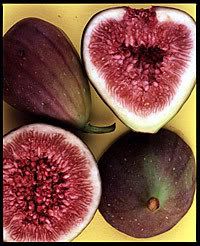
Fig - Cell Of A Song
ח' שבט ה'תשס"ז
The fourth product of the Land of the Divine Feminine eaten during Tu B'Shevat is the fig. Again, as with the last two "foodstuffs", the word (in Devarim 8:8) for fig (ותאנה) is prefaced with a connecting vav. The root is תאנ and the final letter hey (ה) is a feminine ending.
Significantly, the gate (2-letter root, sha'ar in Hebrew) to the shoresh (3 letter root) consists of the word "ta" (תא), a "completely dark" cell of the Holy Temple [1] corresponding to midat hadin (the attribute of justice) [2]. Normally, humankind cannot endure strict midat hadin. Yet, this attribute forms the foundation of each feminine cell of the Holy Temple.
Moreover, King Solomon recognized that the essence of the Divine Spirit is contained within the "order of justice" (midat hadin) [2] and prayed for it to be made understandable to man. Understanding (corresponding to the sefirah Binah), as is a Temple cell (corresponding to the sefirah Malchut), is a feminine quality. The feminine quality of Understanding corresponds to the letter nun (נ), the third letter in the shoresh following the gate "ta". Importantly, the letter nun symbolizes the messianic soul [1]. Thus, it is here, hidden in the symbolism of the fig, where a woman may access her messianic soul spark.
Like King Solomon, the ancient Celts recognized the Presence of the Divine Spirit in the complete darkness of a cell.
In Ireland, Wales and Scotland, bardic colleges would use a technique for incubating tehilim (psalms, songs of prophetic poetry) called the cell of a song. A bard-psalmist would be laid on a wattle bed in a closed, windowless cell ...after 24 hours, the bard would emerge from the darkness and write of that revealed there.
Ancient Celtic bards, like ancient Hebrew psalmists and Welsh awenyddion, were prophetic poets whose prophecies were oftentimes accompanied by song or music.
Taking all this together, we can understand that the fourth product of the Land we eat during Tu B'Shevat symbolizes the experience of the complete darkness found in the cell of the Holy Temple. Evidence that we have truly "eaten" of it, and thus internalized its message, is the poetry and artistry that such an experience itself produces in the one who has experienced it.
The musical poetry of Walking On Fire.
Bringing light from darkness and cells of the Temple.
Footnotes:
[1] The Hebrew Letters, R' Yitzchak Ginsburgh (p. 325 and p. 216)
[2] Wisdom In The Hebrew Alphabet, R' Michael Munk (p. 229)
Technorati tags: Torah Talmud Torah Judaism Kabbalah jewish mysticism mysticism jewish meditation meditation shamanism jewish shamanism kabbalah iyunit kabbalah maasit jewitchery jewitch jewish woman sacred feminine divine feminine shechinah lilith spiritual development spirituality kosher spirituality tu b'shevat
Wednesday, January 24, 2007
Imbolg - Celebrating She Who Heals
 ו' שבט ה'תשס"ז
Imbolg (also called Imbolc) is one of the four Greater Sabbats of Celtic witchcraft. The Welsh name for Imbolg is Gwyl Ffraed. Typically, Imbolg is observed February 1/February 2 in the northern hemisphere. Purification, healing and recovery, prophetic poetry and smithcraft are linked with the Divine Feminine power ruling this sacred time.
Transliterating the word Imbolg into the mystical alphabet I am familiar with, that is Hebrew, we have the letters: אם בלג
The first two letters "im" (אם) spell "mother". "Mother" is from the 3-letter root אמה which means "pillar" and "support" [1]. Significantly, the word and the root begin with the letter aleph (א). Aleph symbolizes air and the central pillar of the sefirotic array. It also is bound specifically to the feminine sefirah Malchut (kingship/queenship), the sefirah through "which all other sefirot (divine emanations) are expressed" [2]. Consequently, the root implies balance, a quality of hishtavut (mystical equanimity), and Divine rulership.
The final three letters form the root BLG (בלג), meaning "strengthening", "supporting" and "recovering" [1]. The meanings in this root fit well with the healing message of Imbolg.
Taken together, we can see that Imbolg is a Celtic Sabbat celebrating the divine She Who Heals, where She Who Heals goes by the Celtic name Brigid, by the Welsh name Ceridwen, and by the Hebrew designation, the Shechinah.
Footnotes:
[1] Etymological Dictionary Of Biblical Hebrew, R' Matityahu Clark
[2] Sefer Yetzirah, R' Aryeh Kaplan translation (p.153)
Technorati tags: Torah Talmud Torah Judaism Kabbalah jewish mysticism mysticism jewish meditation meditation shamanism jewish shamanism kabbalah iyunit kabbalah maasit jewitchery jewitch jewish woman sacred feminine divine feminine shechinah lilith spiritual development spirituality kosher spirituality imbolg gwyl ffraed
Tuesday, December 19, 2006
The 37th Chanukah Light
Later this week, December 21, 2006 (Rosh Chodesh Tevet 5767) marks the winter solstice, known among witches as the lesser sabbat, Yule. Spiritually, Yule corresponds to the "dark night of the soul", which in Jewish kabbalah corresponds to an experience of the chalal hapanui as a trial in the course of prophetic development.
This year, the winter solstice marking the darkest astrological night of the year is also the night of the 7th Chanukah candle. Falling on Thursday, the Hebrew and Celtic archetypes corresponding to the winter solstice of 5767 are Aaron and Lugh, respectively.
Aaron is the kohen gadol who kindles the lights of the menorah in the Temple and causes those lights to ascend.
In the Celtic myth, The Coming Of Lugh, Lugh is given the sword-scepter of Light by the one who rules the endless sea. As one is a silent aleph (א), so too are the letters "gh" at the end of Lugh silent. Pronounced "Loo", similarly to the Divine Name [1] Hoo (הוא), the silence of the Gaelic-Celtic "gh" of Lugh corresponds to the aleph of Hoo. Consequently, the phonetic transliteration of Lugh into Hebrew letters is Lua (לוא).
Lua (לוא) has a gematria of 37, making it the im hakolel of lamed-vav (לו) , where lamed-vav represents the 36 total lights lit over the 8 days of Chanukah (1+2+3+4+5+6+7+8), the lamedvav tzaddkim and the concept of hitkalelut.
In Jewish kabbalah, it is taught that the mashiach will arise from one of the 36 lamedvav tzaddikim in existence. Consequently, the gematria of 37, and thus the name Lua, corresponds to the elevation of a lamedvavnik to the "next level"; that is, to become the catalyst of messianic consciousness using the power of "reverse vision", changing "not" (the translation of Lua) into "not not".
The specifically Welsh-Celtic name of Lugh is Lleu Llaw Gyffes, Lleu Strong Hand, where the name is etymologically derived from a proto-Celtic compound conveying the meaning "flowing vigor" and "flight, flying, soaring". This latter meaning of Lleu Llaw Gyffes links back to the function of Aaron, who kindles the lights of the Temple menorah and causes them to ascend.
Blessed Be, Amen.
Footnote:
[1] Sha'are Orah, R. Yosef Gikatilla
Technorati tags: Torah Talmud Torah Judaism Kabbalah jewish mysticism mysticism jewish meditation meditation shamanism jewish shamanism kabbalah iyunit kabbalah maasit jewitchery jewitch jewish woman sacred feminine divine feminine shechinah lilith spiritual development spirituality kosher spirituality chanukah yule winter solstice sabbat
Monday, December 18, 2006
Yaakov, Beli Mawr & Torah LeAtid Lavo
 According Sefer Yetzirah, Tuesday is ruled by the sun. The corresponding Hebrew and Celtic archetypes are Yaakov and Belenos, respectively.
Belenos is a "Romanized" form of the Celtic name Beli Mawr (בלי מאור), where beli means "shining" (Celtic) and mawr means "of light" (Celtic and Hebrew).
Alternatively, in Hebrew, beli can mean "without" - like within the word "belimah" of Sefer Yetzirah (page 25). Thus, Beli Mawr (בלי מאור) can mean both "shining of light" and "without light" simultaneously, depending on whether one is looking through Celtic or Hebrew consciousness. Consequently, in this archetypal name, we have both a kav (a "shining" of light as in Celtic myth and Jewish kabbalah) and a Lamp of Darkness (Botzina de Kardenuta, or the tzimtzum of Jewish kabbalah) existing together in harmony.
Interestingly, both Yaakov and "the giving of the Torah" are represented by the kav in Jewish kabbalah. This association is more in line with the meaning of the Celtic (kav) interpretation of Beli Mawr as opposed to the Hebrew (tzimtzum) interpretation. This makes Hebrew Yaakov and Celtic Beli Mawr one and the same essence, both possessing Torah, and each the "reverse vision" of the other.
Technorati tags: Torah Talmud Torah Judaism Kabbalah jewish mysticism mysticism jewish meditation meditation shamanism jewish shamanism kabbalah iyunit kabbalah maasit jewitchery jewitch jewish woman sacred feminine divine feminine shechinah lilith spiritual development spirituality kosher spirituality beli mawr kav reverse vision tzimtzum
Saturday, December 09, 2006
Throne Of The Shechinah
On the Idra:
The Idra, which means threshing floor in Aramaic, is a Kabbalistic work included in printings of the Zohar.
There are actually two texts in Zoharic literature called Idra: the first being the Idra Rabba, or “greater Idra”, and the second being the Idra Zuta, or “lesser Idra”, with these two texts being intimately connected to each other.
The story of the Idroth is as follows:
Idra Rabba: R. Shim‘on b. Yohai convenes with nine other scholars, and they gather in the sacred אִדְרָא, or threshing field, where they thresh out secrets. Each scholar expounds various configurations of the partsufin, and three of them die in ecstasy while doing so.
Idra Zuta: Years later, at RASHB"I’s deathbed, the seven still-living scholars come to his deathbed, along with the whole heavenly host. He alone explains the configurations of the partsufin, so this work is more unified. RASHB"I wavers between this world and the next.
Even as Idra Zuta gathers into a more unified prophetic experience which wavers (yesodically) between worlds, there exists in Welsh mythology a story which ties it all together and (malchutically) brings it down.
Among the mystical teachings of Welsh witchcraft, the story of Cadair Idris (throne of Idris) tells of the seeker's vision quest upon the King's mountain, which can result in one of three ways - in death, in madness or in shamanic-prophetic experience. The difference between the seekers of the Zoharic Idrot and the shamanic seeker of the Welsh myth is like the difference between merkavah mysticism and the mysticism of Sar HaTorah [1] in that the mysticism of the Welsh myth and Sar HaTorah are directly concerned that the prophetic experience be sought with the kavanah of service to the community at large as opposed to serving a select group of seekers acting to share mystical secrets only among themselves. The Zoharic mystical group is less overtly concerned with service to the community, although the Divine force may be drawn down to the level of yesod. In this manner, the Zoharic mystics are conduits of Divine force. The mystic of the Welsh myth is more shamanic, where the Divine force is brought down to the level of malchut and bestowed prophetically upon the community.
The Celtic (throne of) Idra-s is a circle gathering which actualizes an iterating cycle of receiving and bestowing. Consequently, it epitomizes a shamanic vision quest worthy to be called reishit.
Cadair Idris is both a mountain in northern Wales and the Welsh myth inhered within the universe-world tarot card [2] - the tarot card which described me here.
According to Welsh mythology:
Cadair Idris is imbued with numerous legends; some nearby lakes are supposed to be bottomless, and anyone who sleeps on its slopes will supposedly awaken either a madman or a poet.
As mentioned above, the mountain's name refers to the giant Idris (meaning ardent lord) of Welsh mythology. The name is sometimes translated as Arthur's Seat, presumably with reference to King Arthur (a Celtic messianic figure).
The poets awakened upon the mountain are transformed by the visionary experience into prophetic seer-poets called awenyddion (Divinely Inspired ones), infused with the hashra'ah of the Shechinah.
The Idrot of the Zohar concludes with RASHB"I wavering between worlds. The Welsh awenydd, clothed with the prophetic mantle of the Shechinah (אדר-אתתא) while sitting upon the throne of Idris, concludes with the "Sinaitic" descent of the Shechinah, filling all worlds with immersive hashra'ah.
the Holy One makes a circle dance ... Yishayahu 25:9
m'Awenydd, The Prophetic Poetry of Walking On Fire
the symbolism of the Awen
Footnotes:
[1] The Ancient Jewish Mysticism, R' Joseph Dan, pp. 139-167
[2] Llewellyn Tarot Card Companion, Anna-Marie Ferguson, pp.169-173 (I received my purchase of these tarot cards and companion manual based upon Welsh mythology yesterday afternoon.)
Technorati tags: Torah Talmud Torah Judaism Kabbalah jewish mysticism mysticism jewish meditation meditation shamanism jewish shamanism kabbalah iyunit kabbalah maasit jewitchery jewitch jewish woman sacred feminine divine feminine shechinah lilith spiritual development spirituality kosher spirituality cadair idris awenyddion bard ovate druid sinai matan torah reishit
Saturday, December 02, 2006
Sceptre Of Selection
This shabbat marks the observance of Celtic Gwyl o Rhiannon.
Rhiannon is the Lady of the Lake who gave legendary King Arthur of Camelot the mystical sword Excalibur (Caledfwlch in Welsh, meaning "hard lightning"). Interestingly, this discovery on my part follows Wednesday morning's dream where I am the woman emerging from the lake. Consequently, my dream suggests that I have integrated this "goddess" archetype psychospiritually with consciousness. In other words, it has emerged from the water of the concealed world and become revealed. This is an example of אתהפכא חשוכא לנהורא in action.
In Celtic mythology, the Lady of the Lake is She who gives (as described above) and receives back for safekeeping Caledfwlch:
As Arthur lay dying, he tells a reluctant Sir Bedivere (Sir Griflet in some versions) to return the sword to the lake by throwing it into the water. Bedivere thinks the sword too precious to throw away, so twice only pretends to do so. Each time, Arthur asks him to describe what he saw. When Bedevere tells him the sword simply vanished underwater, Arthur scolds him harshly. Finally, Bedivere throws Excalibur into the lake. Before the sword strikes the water's surface, the hand reaches up to grasp it and pull it under. Arthur leaves on a death barge with the three queens to Avalon, where as his legend says, he will one day return to save Britain from a threat.
From this we can see that Caledfwlch is interwoven with the Celtic messianic ideal. Among the sword's mystical abilities, is the ability to "select" the "destined" King. It is the Divine Scepter of selection. Caledfwlch, the scepter of Divine Truth which selects and the sceptre of Kings, represents spiritual evolution.
In Jewish kabbalah, both of these functions - selection and evolution - are characteristic of the letter zayin. Zayin epitomizes the Woman of Valor. Like the Lady of the Lake whose gift bestows enhanced survival skills, zayin "sustains" and provides sustenance for living. Her Divine Hand opens to extend the sceptre of benevolence and to select species for "leaps" of development and evolution.
As zayin also corresponds to the Shabbat Queen, feminine nevuah and the matriarchal archetype Sarah, so too do Caledfwlch and Rhiannon connect with these concepts. As previously written, Rhiannon has a correspondence with Tzipporah as well. Significantly - zayin, Sarah, Caledfwlch, Rhiannon and Tzipporah - all have mythic roles where a critical "selection" determines the outcome of history.
zayin, the letter of shabbat, pertains to natural selection of species
Sarah selects Yitzchak to receive the covenantal blessing
Caledfwlch (the sceptre of Rhiannon) selects the King of destiny
Tziporrah/Rhiannon selects the redeemer
It is fitting therefore, that this year 5767, Gwyl o Rhiannon observance begins on Shabbat.
Technorati tags: Torah Talmud Torah Judaism Kabbalah jewish mysticism mysticism jewish meditation meditation shamanism jewish shamanism kabbalah iyunit kabbalah maasit jewitchery jewitch jewish woman sacred feminine divine feminine shechinah lilith spiritual development spirituality kosher spirituality gwyl o rhiannon
Friday, December 01, 2006
Secret Of The Split Shin
As explained in a previous entry, Circle Name Of Shabbat Consciousness, the Welsh/Celtic name Lleucu is my Jewitch ritual name. Lleucu, meaning light and daybreak, carries both receptive and imparting mystical functions. It's both a mekubal and a mashpia. It's a circle of receiving and giving. For these and other reasons, Lleucu is an appropriate name for HaMasovevet, one whose "sacred encircling" turns the events of history.
Both my Jewish and Celtic roots came to the USA from Wales/England. Consequently, it honors my ancestors to add a Celtic name to my Hebrew name. Lleucu is the Welsh version of both my English name (Lori) and my Hebrew name (Liorah). These names each describe the same essence in unique ways.
These are my true names. They are neither something I've deceptively pulled out of a hat nor the result of distorted thinking. Each one is intimately woven into the very fabric of my life experience.
An interesting tidbit (hat-tip to Steg, commenting @ Balashon on Samech) surrounding Lleucu which demonstrates the true interweaving of my names with my life experience - both the Hebrew letter sin שׂ (of siyach, like in the epiphany) and the Welsh consonantal sound Ll (of Lleucu) are derived from some unknown common voiceless alveolar lateral fricative. Consequently, one could suggest that as שׂ (of siyach) characterizes "hesech hada'at" of the epiphany, Ll + שׂ might characterize "b'hesech hada'at" (Sanhedrin 97a) of messianic consciousness and the 4-headed shin of the luchot. Just a cute play on doubled/split/two-ב letters?
Technorati tags: Torah Talmud Torah Judaism Kabbalah jewish mysticism mysticism jewish meditation meditation shamanism jewish shamanism kabbalah iyunit kabbalah maasit jewitchery jewitch jewish woman sacred feminine divine feminine shechinah lilith spiritual development spirituality kosher spirituality voiceless alveolar lateral fricative
Saturday, November 25, 2006
Circle Name Of Shabbat Consciousness
In addition to my Hebrew names, my circle name [1] shall I hereby join to them.
Lleucu, pronounced "Lly-kee" (i.e. Lley-kee) is a Celtic/Welsh name meaning "light". As "Liorah" means "light to me", Lleucu marks its reception. It is the name of a true mekubal.
Transliterated into Hebrew letters, Lleucu ללאכו (where א is vowelized with tzere) comes from the root (shoresh) לאך, meaning "accomplishing work", "messenger" and "angel". [2] This root is found in derivation in Bereshit 2:2 -
"And on the seventh day God finished His work which He had made; and He rested on the seventh day from all His work which He had made."
ויכל אל הים ביום השביעי, מלאכתו אשר עשה; וישבת ביום השביעי, מכל-מלאכתו אשר עשה
Lleucu ללאכו is my name of Shabbat consciousness. ללאכו has a gematria of 87 (see Akvah). It is also the root לאך surrounded by the letters ל"ו (see lamedvavnik).
Footnotes:
[1] Ritual mystical name.
[2] Etymological Dictionary Of Biblical Hebrew, R' Matityahu Clark
Technorati tags: Torah Talmud Torah Judaism Kabbalah jewish mysticism mysticism jewish meditation meditation shamanism jewish shamanism kabbalah iyunit kabbalah maasit jewitchery jewitch jewish woman sacred feminine divine feminine shechinah lilith spiritual development spirituality kosher spirituality circle name jewitch name ritual name shabbat consciousness
Subscribe to:
Posts (Atom)


 Posts
Posts


