
כ"ב טבת תשס"ט
Grael 23
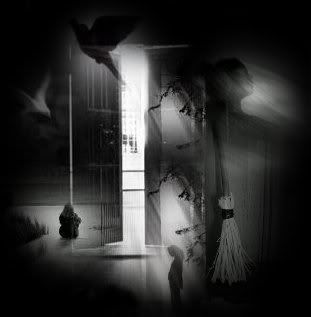
She Who Strikes Fear
Skatha is a Welsh goddess of the Underworld. Her name means 'She Who Strikes Fear' (into birds, for example) and 'Shadow One'.
Red Branch Warriors
Patroness of blacksmiths, healing, magic, prophecy and the martial arts, Skatha is teacher to hero-warriors. Famous for invincible battle methods, the battle yell, and the 'magical leap', her students are known as 'Red Branch warriors'.
Protected Species
In interesting connection to Divine Feminine 'Skatha consciousness', at the same time I acquired my blood-red coral and gold magic earrings, I also acquired 15 natural red coral branches for my magical curios collection (Protected By Judgment). Red coral is a protected species. Note the 'golden tips' on this colonial animal, clearly my totem, made up of several individuals:
Saturday, January 17, 2009
She Who Strikes Fear

Monday, May 07, 2007
Bar H, The Little Tavern That Could
י"ט באייר תשס"ז
An anonymous commenter on Mitzvah Of Besom [1] & The First Tzimtzum has made an interesting observation regarding the gematria of 207, as follows:
ain 61 sof 146 aur 207
61 + 146 = 207
So, what we have in this gematria are two sets of 207 - one set, a dark essence (ain sof אין סוף) and one set, a revealed light (aur אור). Ain sof aur means light without end. Yet, ain sof is a dark essence, while aur is revealed light. Consequently, we can see that the light without end is a reunification of dark and light.
In this gematria, we also have another connection to the lone structure which remained standing following this weekend's devastating Kansas tornados, the tavern Bar H (בר ה), also with a gematria of 207. Bar H corresponds to the light (aur) of the complete phrase ain sof aur.
Bar H, the tavern which became a beacon of light. What an elevation for that humble little bar! Like sacred ground.
Footnote:
[1] A besom is a witch's broomstick.
Technorati tags: Torah Talmud Torah Judaism Kabbalah jewish mysticism mysticism jewish meditation meditation shamanism kabbalah iyunit kabbalah maasit witchcraft jewitchery jewitch witch sacred feminine divine feminine shechinah lilith spiritual development spirituality kosher spirituality
Wednesday, January 10, 2007
Mitzvah Of Besom & The First Tzimtzum
It was suggested by Gabbe at Hashkafah forums that the original form of the tetragrammaton may have consisted of the letters yod-ayin-vav-alef (יעוא). He provides a graphic of the Gemara (?) text from his source for this suggestion (see link).
In my mind, it may be that this letter combination also describes the first tzimtzum. Here's why I think this:
First, the shoresh (3-letter root) yod-ayin-hei (יעה) means to "clear away". In other words, it means to create a "vacated space" (chalal). The shoresh also means to "remove". In other words, to "remove" the One's apparent Presence (chalah hapanui) in reality. These meanings fit perfectly with the idea of a tzimtzum, where Ein Sof carved out within the Infinite Light a "place" for creation by removing the Light of Ein Sof (via a mechanism known as the Lamp of Darkness, an Infinite Negative Light called Botzina de Kardenuta).
Second, another possible shoresh involved in creating 4-letter combination is ayin-vav-hei (עוה), meaning "to deviate" and being "crooked". This too, fits perfectly with the first tzimtzum as I remember it among my memories of preincarnate existence as discussed here in A Mystery Of Consciousness and here in Reishit Beit. The journey through the River of Fire (also known as the Sambatyon, the Shabbat River and Nahar Dinur) is indeed a crooked journey. I remember pivoting like a shalshelet through it into a state of congealing conciousness.
Importantly, both of the 3-letter shorashim contributing to the construction of our understanding of the novel 4-letter tetragrammaton יעוא end with a letter hei (ה). The first root's hei symbolizes the Higher Shechinah. The second root's hei symbolizes the Lower Shechinah. In the two shorashim reside the secret of the "split" within the original Divine Feminine. In the new variation of the tetragrammaton resides the secret to rectification, reunification and elevation of the Divine Feminine, alluded to by the dropped letters hei (from the combination of the shorashim) and the added letter alef (א).
Kabbalah teaches regarding the original split within the Divine Feminine resulting from the first tzimtzum:
This is why she abandoned her supernal place and descended to a lower degree, assuming the dimension of light which is the body of the Sephiroth. This also means that her full dimension was split in half; for she became a body consisting of but six Sephiroth without a head. Her condition of being split is connoted in Hebrew חץ "Chetz". This Hebrew word embodies two definitions:
1. Split in half.
2. An arrow that is let loose from a bow in order to kill.
Interestingly, the witch's besom (ritual broomstick) reflects the rectification of the Divine Feminine perfectly, in that it consists of a body of six sefirot (the broomstick) with a head (the bristles of herbs and twigs). Consequently, the besom is the third witch's tool, along with the athame of iron and incense, to align with the idea of restoring the Divine Feminine to Her Full Glory.
More importantly, the witch's besom is a tool whose purpose is to sweep away suffering and to enhance life, not to end it. There is even an organization called The Besom, dedicated to making a difference in the world. The mission statement of The Besom:
The Besom helps people make a difference. It provides a bridge between those who want to give time, money, things or skills and those who are in need. It ensures what is given is used effectively. The service it provides is free.
Poverty, isolation, abuse, ill health, injustice, homelessness. We all see the sharp inequalities of life around us and the devastating impacts they have on people's lives. Many of us want to do something, to get involved but we don't always know how. The Besom, set up in 1987, exists to help you make a difference to the lives of others and to make it easy for you to do so.
Technorati tags: Torah Talmud Torah Judaism Kabbalah jewish mysticism mysticism jewish meditation meditation shamanism jewish shamanism kabbalah iyunit kabbalah maasit jewitchery jewitch jewish woman sacred feminine divine feminine shechinah lilith spiritual development spirituality kosher spirituality tzimtzum chalal hapanui besom
Tuesday, December 19, 2006
The 37th Chanukah Light
Later this week, December 21, 2006 (Rosh Chodesh Tevet 5767) marks the winter solstice, known among witches as the lesser sabbat, Yule. Spiritually, Yule corresponds to the "dark night of the soul", which in Jewish kabbalah corresponds to an experience of the chalal hapanui as a trial in the course of prophetic development.
This year, the winter solstice marking the darkest astrological night of the year is also the night of the 7th Chanukah candle. Falling on Thursday, the Hebrew and Celtic archetypes corresponding to the winter solstice of 5767 are Aaron and Lugh, respectively.
Aaron is the kohen gadol who kindles the lights of the menorah in the Temple and causes those lights to ascend.
In the Celtic myth, The Coming Of Lugh, Lugh is given the sword-scepter of Light by the one who rules the endless sea. As one is a silent aleph (א), so too are the letters "gh" at the end of Lugh silent. Pronounced "Loo", similarly to the Divine Name [1] Hoo (הוא), the silence of the Gaelic-Celtic "gh" of Lugh corresponds to the aleph of Hoo. Consequently, the phonetic transliteration of Lugh into Hebrew letters is Lua (לוא).
Lua (לוא) has a gematria of 37, making it the im hakolel of lamed-vav (לו) , where lamed-vav represents the 36 total lights lit over the 8 days of Chanukah (1+2+3+4+5+6+7+8), the lamedvav tzaddkim and the concept of hitkalelut.
In Jewish kabbalah, it is taught that the mashiach will arise from one of the 36 lamedvav tzaddikim in existence. Consequently, the gematria of 37, and thus the name Lua, corresponds to the elevation of a lamedvavnik to the "next level"; that is, to become the catalyst of messianic consciousness using the power of "reverse vision", changing "not" (the translation of Lua) into "not not".
The specifically Welsh-Celtic name of Lugh is Lleu Llaw Gyffes, Lleu Strong Hand, where the name is etymologically derived from a proto-Celtic compound conveying the meaning "flowing vigor" and "flight, flying, soaring". This latter meaning of Lleu Llaw Gyffes links back to the function of Aaron, who kindles the lights of the Temple menorah and causes them to ascend.
Blessed Be, Amen.
Footnote:
[1] Sha'are Orah, R. Yosef Gikatilla
Technorati tags: Torah Talmud Torah Judaism Kabbalah jewish mysticism mysticism jewish meditation meditation shamanism jewish shamanism kabbalah iyunit kabbalah maasit jewitchery jewitch jewish woman sacred feminine divine feminine shechinah lilith spiritual development spirituality kosher spirituality chanukah yule winter solstice sabbat


 Posts
Posts


